Introduction
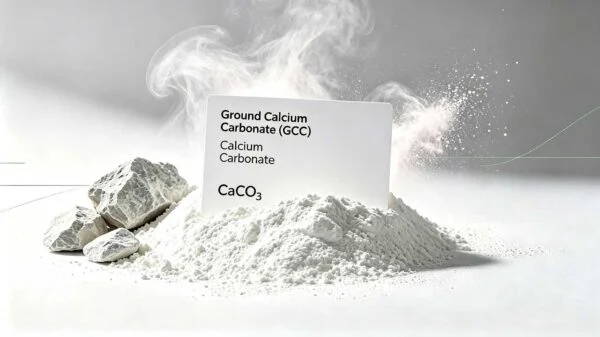
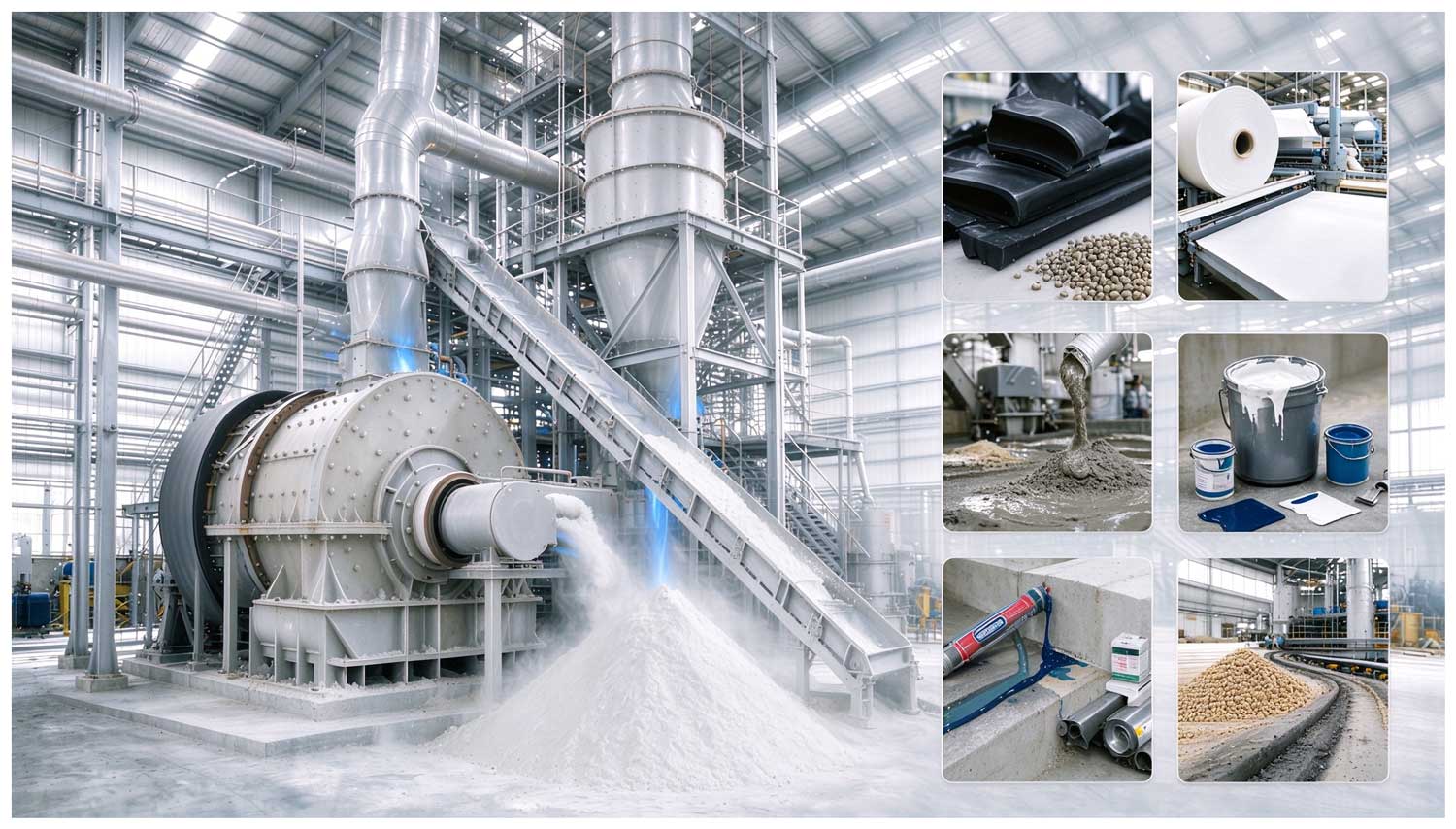
Ground Calcium Carbonate (GCC) is one of the most widely‑adopted functional mineral fillers derived from natural calcite, marble and chalk. Thanks to high whiteness, stable chemical properties and cost‑effective performance, GCC is extensively deployed across rubber‑plastic, papermaking, coatings, adhesives, construction, animal feed and many other industrial sectors.
Each downstream industry sets unique requirements for GCC on particle‑size distribution (D97), whiteness and purity. Selecting the proper dry‑grinding production solution is critical to achieve target powder specifications for your end‑products. This article systematically sorts out major GCC industrial applications, corresponding particle‑size requirements, available dry‑grinding processes, and practical reference tables to support mineral filler plant project decision‑making.
1. What Is Ground Calcium Carbonate (GCC) and Its Basic Value
Ground Calcium Carbonate (GCC) is mineral filler powder produced by mechanically grinding natural calcite, marble or chalk ore. It features high whiteness, stable chemical performance, good dispersion and low cost compared with other white pigments.
In finished products, GCC mainly brings three basic values:
- Volume increase: GCC replaces part of expensive base resin or pigment, helping manufacturers reduce overall raw‑material cost.
- Performance improvement: It can improve rigidity, surface hardness, dimensional stability, wear‑resistance and optical properties of end products.
- Process adjustment: It helps control flowability, thixotropy and filling level in coatings, adhesives and plastic compounds.
The final GCC powder quality, including fineness, particle‑size distribution and whiteness, depends heavily on the grinding and classification process. Different end‑use industries set very different requirements on these specifications.
2. Main Industrial Applications of Ground Calcium Carbonate (GCC)
This section is the core of the article: for each major industry, we explain what GCC is used for, what performance function it provides, and the typical D97 particle size required. D97 means 97 % of powder particles are smaller than the given micron value, which is the key quality index for commercial GCC filler.
2.1 Rubber & Plastic Products
Use: GCC is added to rubber goods, plastic sole, PVC floor, plastic extrusion products and modified masterbatch as a high‑volume filler.
Performance function: It improves rigidity, surface hardness and dimensional stability of finished parts, enhances wear‑resistance, and lowers raw‑material expenses.
Required particle size (D97):
- General rubber sole and low‑grade plastic parts: medium‑coarse GCC, D97 around 40‑63 μm.
- Rubber extrusion, high‑performance modified plastic and PVC floor: fine‑grade GCC, D97 8‑25 μm.
2.2 Papermaking Filler
Use: GCC serves as a critical filler in paper‑making production for general paper and high‑grade printing paper.
Performance function: It improves paper whiteness, surface smoothness and printability, while reducing plant fiber consumption to control manufacturing costs.
Required particle size (D97):
- General paper: medium fineness GCC, D97 around 15‑25 μm.
- High‑grade glossy printing paper: ultrafine GCC, D97 2‑5 μm.
2.3 Coatings & Paints
Use: GCC is widely used in architectural paint, industrial coating, anti‑rust coating, water‑borne paint and printing ink systems.
Performance function: Proper GCC filler improves paint film fullness, leveling performance and surface hardness; its high whiteness also helps optimize hiding power of the finished coating.
Required particle size (D97):
- General‑purpose paint: GCC D97 20‑45 μm.
- High‑quality coating and printing ink: ultrafine GCC D97 8‑20 μm.
2.4 Adhesives & Sealants
Use: Adhesive, construction bond and sealant products use GCC as a core functional filler.
Performance function: GCC optimizes thixotropy, dimensional stability and mechanical strength of adhesive systems, and helps control paste consistency.
Required particle size (D97): Most adhesive applications require medium‑fine GCC powder within D97 10‑25 μm.
2.5 Construction & Asphalt Materials
Use: GCC is applied as filler for asphalt mixture, plaster, road marking materials and building plaster products.
Performance function: In these scenarios GCC fills voids, improves structural performance and stability of construction compounds, and supports compaction in asphalt mixes.
Required particle size (D97):
- Asphalt filler and road marking: coarse‑to‑medium GCC, D97 63‑125 μm.
- Plaster and building mortar: coarse GCC, from 125 μm up to millimeter‑size sand fraction.
2.6 Animal Feed & Agriculture
Use: GCC acts as a calcium supplement raw material for animal feed; in agriculture, GCC powder is used for soil pH adjustment.
Performance function: It provides available calcium content for feed nutrition, and helps regulate soil acidity without strict fineness requirements.
Required particle size (D97): Feed‑grade GCC usually adopts coarse powder range D97 125‑500 μm.
2.7 Other Special‑use Applications
- Detergent: Medium‑fine GCC is used as an auxiliary filler to support cleaning powder formulation.
- Food‑grade GCC: Used as a food additive under strict purity and hygiene requirements.
- Polishing agent: Fine GCC powder is used for surface polishing purposes.
3. Dry‑Grinding Production Solutions for Different‑Grade GCC
To produce the various GCC powder grades required across the industries above, mineral processing plants mainly adopt four mature dry‑grinding production processes. These processes are presented as production solutions serving different application specifications, rather than as a head‑to‑head equipment comparison.
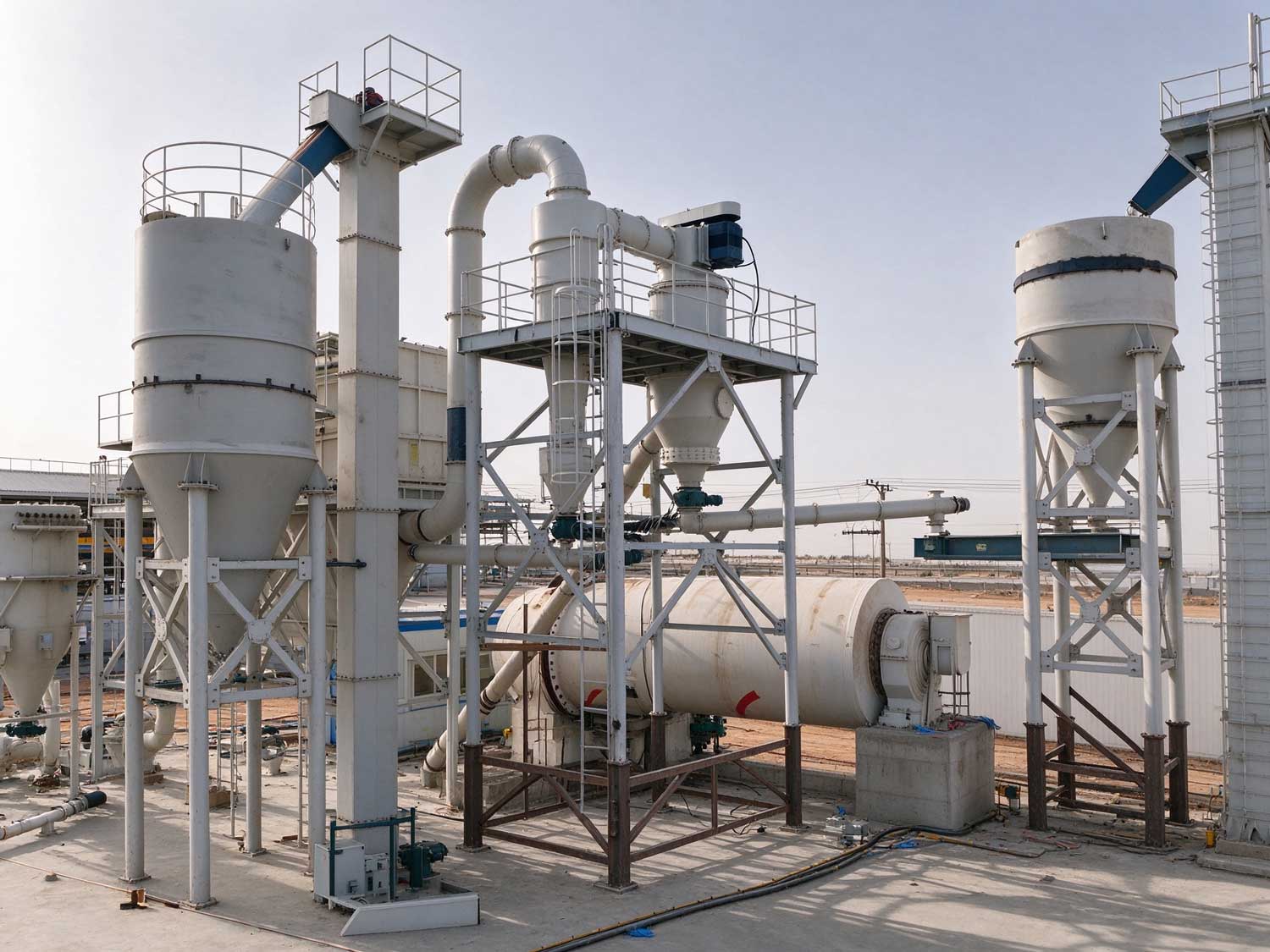
3.1 Ball Mill + Air Classifier Production Process
This closed‑circuit grinding solution pairs a ball mill with an independent air classifier. Oversized coarse particles return back to the ball mill for re‑grinding, it can stably produce ultrafine to medium GCC powder within its economical range D97 5‑45 μm.
Benefiting from large production capacity and flexible fineness adjustment via classifier, this low‑speed grinding system creates minimum impact and friction. It is not only suitable for abrasive high‑hardness minerals, but also delivers high‑economic efficiency for grinding low‑hardness white fillers such as Ground Calcium Carbonate (GCC).
Matched applications: High‑grade paper‑making filler, premium rubber extrusion, modified plastic, paint‑ink and top‑tier adhesive products that require fine, stable particle‑size distribution.
3.2 Vertical Mill Production Process
Vertical Mill Production Process integrates grinding and classification in one unit, mainly outputting medium‑fine GCC D97 20‑63 μm.
Matched applications: Mass‑production GCC for PVC floor, general‑grade paint, construction filler and asphalt‑related GCC materials.
3.3 Ring Roller Mill Production Process
Ring Roller Mill Production Process produces medium‑to‑ultrafine GCC of D97 8‑45 μm through roller and ring grinding combined with internal classification.
Matched applications: Coating‑grade GCC, ink filler and medium‑grade plastic‑rubber filler applications.
3.4 Raymond Mill Production Process
Raymond Mill Production Process generates coarse‑to‑medium GCC powder D97 40‑150 μm using roller grinding and internal classification.
Matched applications: Construction filler, animal feed‑grade GCC and low‑requirement general rubber‑plastic filler.
4. Summary: Application, Particle Size and Grinding Process
The table below summarizes the matching relationship between GCC end‑use industry, typical D97 fineness and suitable dry‑grinding production process, for quick reference. Ball Mill + Air Classifier performs outstandingly within its economical 5‑45 μm range for high‑quality fine‑medium GCC filler scenarios.
| GCC End‑Use Industry | Typical D97 Fineness | Suitable Dry‑Grinding Production Process |
|---|---|---|
| High‑grade paper‑making, premium plastic & rubber extrusion | 5‑20 μm | Ball Mill + Air Classifier |
| Paint, ink, medium‑grade adhesive | 8‑45 μm | Ball Mill + Air Classifier / Ring Roller Mill |
| PVC floor, general‑grade coating, construction mass filler | 20‑45 μm | Ball Mill + Air Classifier / Vertical Mill / Ring Roller Mill |
| General construction filler, road marking, building mortar | 45‑125 μm | Vertical Mill / Raymond Mill |
| Animal feed, coarse construction filler | 125‑500 μm | Raymond Mill |
Note: D97 value is the key industrial specification for commercial Ground Calcium Carbonate (GCC). Ball Mill + Air Classifier is recommended for high‑quality fine‑to‑medium GCC within D97 5‑45 μm, where stable particle‑size distribution, large throughput and closed‑circuit re‑grinding are required. For powder above 45 μm, vertical mill or raymond mill deliver better economy. Different manufacturers may adjust actual fineness according to local product standards and end‑product requirements.
5. FAQ: Ground Calcium Carbonate (GCC) Application Questions
- Q: What is Ground Calcium Carbonate (GCC)?
A: Ground Calcium Carbonate (GCC) is mineral filler powder produced by mechanical grinding of natural calcite, marble or chalk ore, widely used across rubber, plastic, papermaking, paint, construction and feed industries. - Q: Why do different industries need GCC of different particle sizes?
A: Particle‑size distribution directly decides filling performance, whiteness, dispersion and physical improvement effect. Too‑coarse GCC cannot work for high‑gloss paper or fine paint; over‑ultrafine powder brings unnecessary cost for construction or feed‑grade projects. - Q: Can one grinding process produce GCC for multiple industries?
A: Many modern grinding lines can adjust powder fineness through classifier settings. Still, each production process has its most economical particle‑size window for target GCC applications. - Q: What is the difference between GCC used for paint vs GCC for animal feed?
A: Paint‑grade GCC requires fine particle size and high whiteness. Animal‑feed GCC focuses more on calcium content and purity while allowing much coarser particle sizes. - Q: What is the difference between GCC and PCC?
A: GCC (Ground Calcium Carbonate) is produced by dry or wet grinding natural calcite, marble or chalk ore. PCC (Precipitated Calcium Carbonate) is a chemically precipitated synthetic powder with more controlled particle shape and finer distribution. GCC is generally chosen for cost‑effective bulk filling, while PCC is used where stricter particle morphology and brightness are required. - Q: Can GCC improve the strength or rigidity of plastic and rubber products?
A: Yes. When properly dispersed, GCC filler can increase rigidity, surface hardness and dimensional stability of plastic and rubber compounds. The actual improvement depends on GCC fineness, loading ratio and surface treatment of the powder. - Q: What raw materials are used to produce Ground Calcium Carbonate (GCC)?
A: Commercial GCC is mainly produced from natural calcium carbonate ores such as calcite, marble and chalk. The raw ore is crushed, ground and classified into different powder grades according to target whiteness, fineness and purity requirements.
6. Contact Us for Your GCC Project
If you are planning to set up or expand a Ground Calcium Carbonate (GCC) powder plant, please share your target end‑applications, required powder fineness and expected hourly output. Our engineering team can propose a matching dry‑grinding production solution for your mineral filler project.
Contact us to discuss your material condition, target GCC grade and production capacity, and receive a technical proposal tailored to your application.