Calcium carbonate (CaCO₃) does not undergo hydrolysis reactions. The core reason lies in the ionization characteristics of the corresponding acid (carbonic acid, H₂CO₃) and base (calcium hydroxide, Ca(OH)₂), which make its ionic bonds difficult to dissociate in water, and the dissociated ions cannot interact effectively with water molecules. The details are explained from the following two aspects:
1. Calcium carbonate is extremely insoluble in water and cannot provide sufficient hydrolyzable ions The prerequisite for a hydrolysis reaction is that the electrolyte dissociates ions in water that can react with H₂O (such as weak acid radical ions and weak base cations). However, calcium carbonate is a typical insoluble salt with a solubility of only about 0.0013g/100mL in water at 20℃ and an extremely low solubility product constant (Ksp ≈ 3.3×10⁻⁹). This means that it can hardly dissociate free Ca²⁺ and CO₃²⁻ in water, lacking the “reactants” (hydrolyzable ions) required for hydrolysis reactions, so hydrolysis cannot naturally occur.
2. Even if slightly dissociated, the hydrolysis tendency of ions is inhibited by the dissolution equilibrium Theoretically, ignoring the solubility limit, CO₃²⁻, as a weak acid radical ion (the secondary ionization product of the weak acid H₂CO₃, Ka₂ of H₂CO₃ ≈ 4.8×10⁻¹¹), could undergo hydrolysis: CO₃²⁻ + H₂O ⇌ HCO₃⁻ + OH⁻, HCO₃⁻ + H₂O ⇌ H₂CO₃ + OH⁻; Ca²⁺, as a strong base cation (corresponding to the strong base Ca(OH)₂, although Ca(OH)₂ is slightly soluble, the dissolved part is completely ionized), hardly undergoes hydrolysis (the tendency of Ca²⁺ + 2H₂O ⇌ Ca(OH)₂ + 2H⁺ is extremely weak and can be ignored).
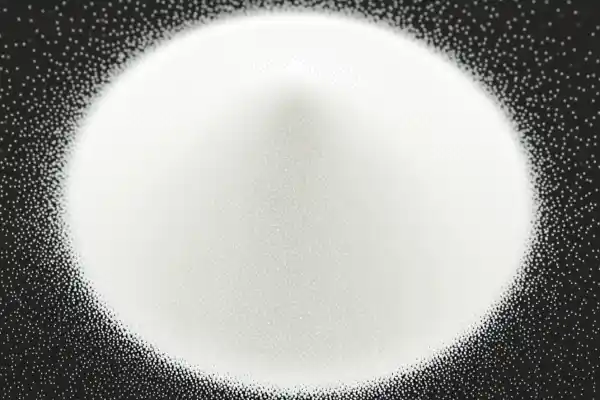
In practice, however, due to the dissolution equilibrium of calcium carbonate (CaCO₃(s) ⇌ Ca²⁺(aq) + CO₃²⁻(aq)) being severely biased to the left, the concentration of CO₃²⁻ in the solution is extremely low, the degree of hydrolysis reaction is greatly inhibited, and no hydrolysis phenomenon can be observed macroscopically (such as no obvious change in solution pH, no bubble generation, etc.).
Supplementary explanation: If calcium carbonate is put into an acidic solution, H⁺ will combine with the slightly dissociated CO₃²⁻ to form H₂CO₃ (which then decomposes into CO₂ and H₂O). This will break the dissolution equilibrium and promote the continuous dissolution of calcium carbonate, but this is an “reaction between acid and salt”, not a hydrolysis reaction.
