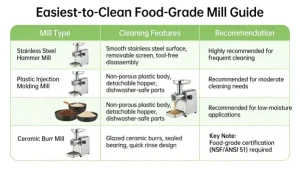
For industrial food-grade production,under-driven conical millsare widely recognized as the easiest-to-clean milling solution for most sanitary applications, with sanitary pin mills as a close second for dry, friable materials. The optimal choice ultimately depends on your product type, production mode, and hygiene compliance requirements (FDA, 3-A, EHEDG, GMP).
Top Easy-to-Clean Mill Types for Food-Grade Production
1. Under-Driven Conical Mill (Hygienic Gold Standard)
This is the industry-preferred choice for high-hygiene, frequent product changeover scenarios in food and nutraceutical manufacturing.
-
Core Cleanability Advantages:
- Bottom-driven design eliminates shaft seals, bearings, and crevices in the product contact zone, removing the #1 source of hidden residue and bacterial harborage.
- Tool-free, quick-release grinding chamber: the rotor, impeller, and screen can be fully disassembled in seconds for manual cleaning or autoclaving, cutting cleaning time by over 60% compared to traditional hammer mills.
- Fully self-draining, sloped surfaces with no horizontal dead zones, ensuring 100% gravity discharge of product and cleaning fluids, with near-zero residual material.
- Standard 316L stainless steel construction with electropolished surfaces (Ra ≤ 0.8μm) for non-porous, easy-to-sanitize contact areas, compliant with 3-A, EHEDG, and FDA standards.
- Compatible with fully validated CIP (Clean-in-Place) and SIP (Sterilize-in-Place) cycles for full automation without disassembly.
-
Ideal For: Dry and wet milling, infant formula, dairy products, spices, nutraceuticals, and batch production with frequent product changes.
2. Sanitary Pin Mill (Centrifugal Impact Mill)
The easiest-to-clean option for high-throughput dry milling of friable food materials.
-
Core Cleanability Advantages:
- Minimalist, screen-free design with no hammers, blades, or rollers, eliminating the complex, hard-to-clean components that plague other impact mills.
- Smooth interior walls with zero hidden crevices, and hinged vertical housing that opens fully for unobstructed access to every internal surface.
- Full gravity discharge with no material retention pockets, resulting in extremely low cross-contamination risk.
- Electropolished 316L stainless steel construction, compatible with CIP cycles and rapid wipe-down or deep cleaning between batches.
-
Ideal For: Grains, flours, sugars, spices, and other dry, friable food materials in continuous or semi-continuous production.
3. Specialized Easy-to-Clean Mills for Niche Applications
-
Sanitary HorizontalColloidMill: Best for high-viscosity, slurry, or paste products (e.g., nut butters, sauces, emulsions, dairy products). Its split motor design allows quick disassembly of the rotor-stator assembly, with smooth, crevice-free flow paths and full CIP compatibility for fast wet cleaning.
-
Sanitary Jet Mill: The lowest-cleaning-effort option for ultra-fine milling of heat-sensitive, high-value food powders. It has no moving parts or grinding media, with a completely smooth, empty milling chamber. Cleaning requires only a simple purge or rinse, with zero risk of media contamination or wear-related harborage points.
Mills with Higher Cleaning Burden (to Avoid for Frequent Changeovers)
-
Hammer Mills: Even sanitary models have numerous hammers, pins, screens, and tight gaps that trap product residue. Full cleaning requires complete disassembly of many small parts, making them only suitable for long runs of a single product.
-
Roller Mills: Multiple roller sets, narrow gaps, and bearing seals create hard-to-reach areas for cleaning. They are designed for continuous grain milling, not high-hygiene multi-batch production.
-
Basket/Bead Mills: Require full removal and cleaning of grinding media, with lengthy, labor-intensive cleaning procedures that are not ideal for most food-grade applications.
Critical Selection Criteria for Easy-Clean Food-Grade Mills
-
Compliance: Prioritize mills with 3-A, EHEDG, FDA, or GMP certification, as these standards mandate hygienic, cleanable design by default.
-
Material: All product-contact parts must be 316L stainless steel (or equivalent food-grade alloy) with an electropolished finish (Ra ≤ 0.8μm) to prevent adhesion and bacterial growth.
-
Design: Avoid blind holes, threaded joints, horizontal dead zones, and exposed seals in the product zone. Look for tool-free disassembly, self-draining surfaces, and full separation of drive components from the product stream.
-
CleaningCompatibility: Ensure the mill supports your required cleaning method, whether manual wipe-down, autoclaving, or fully automated CIP/SIP cycles.