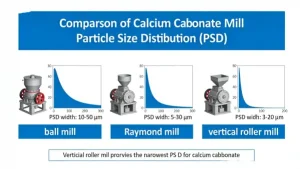
Jet mills (fluid energy mills) are the definitive choice for producing calcium carbonate (CaCO₃) with the narrowest particle size distribution (PSD), particularly for ultra-fine (D97 < 10 μm) and nano-grade CaCO₃—this is the industry standard for high-purity, tight-PSD CaCO₃ used in high-value applications (coatings, plastics, advanced papermaking, adhesives).
For fine-to-medium grinding (D97 5–80 μm), pin mills (pin disc mills) and closed-circuit classifier mills (impact/hammer mills integrated with high-efficiency turbo classifiers) are also excellent options for narrow PSD, while closed-circuit ball mills (with cyclone/turbo classifiers) deliver a significantly narrower PSD than open-circuit ball mills for fine CaCO₃ grinding.
Below is a detailed breakdown of the top mills for narrow PSD CaCO₃, their working principles, PSD performance, and typical application ranges, along with why they outperform other grinding equipment:
1. Jet Mills (Fluid Energy Mills) – Narrowest PSD (Ultra-Fine/Nano CaCO₃)
Core principle: Compressed air/steam is accelerated to supersonic speeds (2–3 Mach) through nozzles, creating high-velocity fluid jets that collide CaCO₃ particles with each other (interparticle collision, no metal-on-metal contact) in a grinding chamber. A built-in precision classifier immediately separates fine particles that meet the target size, while coarse particles recirculate for regrinding.
PSD key advantages:
-
No grinding media contamination (critical for high-purity CaCO₃) and minimal particle agglomeration.
-
The integrated high-precision classifier enables tight control of top size (D90/D97) and eliminates overgrinding/undergrinding.
-
Produces a monodisperse PSD (low span value: Span = (D90-D10)/D50) – typical span for jet-milled CaCO₃ is 1.5–2.5 (far lower than other mills).
Typical CaCO₃ grind range: D50 0.5–10 μm (D97 < 5 μm for nano CaCO₃).
Common types for CaCO₃: Fluidized bed jet mills (most widely used), spiral jet mills, and opposed jet mills.
2. Pin Mills (Pin Disc Mills) – Narrow PSD (Fine CaCO₃)
Core principle: Two high-speed rotating discs fitted with hardened steel pins impact and shear CaCO₃ particles between the pins; advanced models include an internal classifier to separate fine particles and recirculate coarse ones.
PSD key advantages:
-
High-speed, uniform shear/impact force ensures consistent particle breakage, avoiding wide size variation.
-
Built-in classification eliminates coarse particle “tails” in the PSD.
-
Compact design and high grinding efficiency for fine CaCO₃.
Typical CaCO₃ grind range: D50 2–20 μm (D97 5–40 μm), span = 2.5–3.5.
Ideal for: Fine ground CaCO₃ (FGCC) for general coatings, plastics, and papermaking fillers.
3. Closed-Circuit Classifier Mills – Narrow PSD (Fine-to-Medium CaCO₃)
Core principle: A compact grinding unit combining an impact/hammer mill (for primary particle breakage) with a high-efficiency turbo classifier (mounted on the mill top). The classifier continuously sorts ground CaCO₃: fine particles exit as product, coarse particles fall back to the grinding chamber for reprocessing.
PSD key advantages:
-
Replaces open-circuit grinding (which produces wide PSD due to unseparated coarse/fine particles) with closed-loop control, drastically reducing the coarse particle fraction.
-
Customizable classifier speed allows precise tuning of PSD to match application requirements.
Typical CaCO₃ grind range: D50 5–40 μm (D97 10–80 μm), span = 3.0–4.0.
Ideal for: Medium FGCC for construction fillers, rubber, and general-purpose plastics.
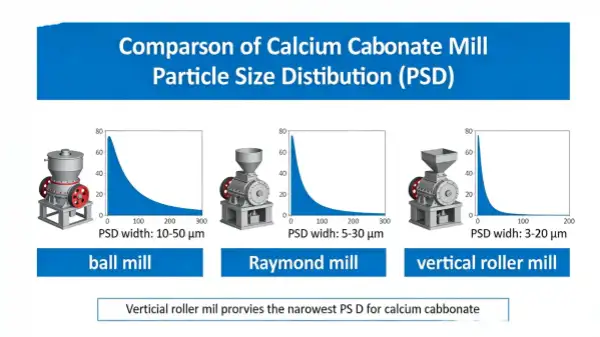
4. Closed-Circuit Ball Mills – Narrow PSD (Fine CaCO₃, Cost-Effective)
Core principle: Traditional ball milling (steel balls as grinding media) is paired with an external cyclone or turbo classifier to form a closed circuit. Classified coarse CaCO₃ particles are returned to the ball mill for regrinding, while fine particles are collected as product.
PSD key advantages:
-
Eliminates the “coarse tail” problem of open-circuit ball mills, cutting the span from 5.0–7.0 (open) to 3.0–4.5 (closed).
-
Lower capital/operating costs than jet mills, making it a cost-effective choice for fine CaCO₃ grinding in mid-scale production.
Caveat: Minor media wear may cause trace contamination (mitigated with high-purity alumina/zirconia balls for food/pharma-grade CaCO₃).
Typical CaCO₃ grind range: D50 8–50 μm (D97 20–100 μm).
5. Rod Mills – Narrow PSD (Coarse CaCO₃ Grinding)
For coarse ground CaCO₃ (CGCC) (D90 100–500 μm) used in cement, concrete, and construction fillers, rod mills (with steel rods as media) deliver a narrower PSD than open-circuit ball mills/hammer mills. The rod-on-rod grinding action crushes particles uniformly and avoids overgrinding of fine particles, producing a coarse PSD with minimal fine “fines” and a tight top size.
Why Other Mills Produce Wide PSD for CaCO₃
Open-circuit ball mills, hammer mills, and roll mills lack precision classification systems and produce inconsistent particle breakage (e.g., hammer mills cause random impact, roll mills have uneven pressure). This results in a wide PSD with both overground fines and underground coarse particles (span > 5.0) – these are only used for low-value CaCO₃ applications where PSD control is not critical.
Critical Supplementary Factors for Narrow PSD (Beyond Mill Type)
Even with the right mill, the following factors directly impact CaCO₃ PSD tightness – they are non-negotiable for industrial production:
-
High-efficiency classification: The classifier (turbo, cyclone, or jet mill internal classifier) is the heart of narrow PSD control; low-efficiency classifiers negate the mill’s performance.
-
Process parameters: For jet mills: air pressure/temperature, feed rate, and nozzle design; for pin/classifier mills: rotor speed and classifier speed; all must be precisely calibrated for the target CaCO₃ particle size.
-
Raw material quality: Pure, low-moisture (moisture < 0.5%) CaCO₃ ore (calcite/aragonite) minimizes agglomeration and uneven breakage.
-
Pre-grinding & drying: A pre-crusher (jaw/cone mill) reduces raw ore to a uniform feed size (< 5 mm), and drying (if needed) eliminates moisture-induced agglomeration.
-
Post-grinding dispersion: For ultra-fine CaCO₃, a post-grinding air classifier or ultrasonic dispersion step further narrows the PSD by removing agglomerates.
Summary of Mill Selection for Narrow PSD CaCO₃
|
Mill Type
|
Narrowest PSD Span
|
Typical CaCO₃ Grind Range (D97)
|
Primary Application
|
|
Jet Mill
|
1.5–2.5
|
< 10 μm (nano/ultra-fine)
|
High-value coatings/plastics
|
|
Pin Mill (with classifier)
|
2.5–3.5
|
5–40 μm (fine)
|
General coatings/papermaking
|
|
Closed-Circuit Classifier Mill
|
3.0–4.0
|
10–80 μm (fine-medium)
|
Rubber/construction fillers
|
|
Closed-Circuit Ball Mill
|
3.0–4.5
|
20–100 μm (fine)
|
Cost-effective fine FGCC
|
|
Rod Mill
|
3.5–4.5
|
100–500 μm (coarse)
|
Cement/concrete fillers
|
In short, jet mills are unrivaled for the narrowest PSD in ultra-fine/nano CaCO₃ production, while pin mills and closed-circuit classifier mills are the best cost-performance options for fine CaCO₃ with tight PSD control. For all mills, integrated high-precision classification is the single most important feature for achieving a narrow CaCO₃ PSD.