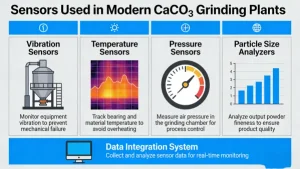
Modern CaCO₃ grinding plants (covering dry grinding for GCC (ground calcium carbonate) and wet grinding for PCC/precipitated calcium carbonate/nano-CaCO₃) rely on a multi-sensor network to monitor particle size/quality, process parameters, equipment status, and safety/environmental indicators. These sensors are integrated with PLC/SCADA systems for real-time data acquisition, closed-loop control, and predictive maintenance—tailored to CaCO₃’s unique properties (mild abrasiveness, easy agglomeration in wet grinding, slight water solubility, and dust risks in dry grinding).
Sensors are categorized by their core application in the grinding process (the most critical for CaCO₃ production), with clear distinctions between dry grinding (GCC mainstream) and wet grinding (PCC/nano-CaCO₃) use cases, and emphasis on industry-specific design requirements (abrasion resistance, anti-fouling, explosion-proof).
Core Sensor Categories for Modern CaCO₃ Grinding Plants
1. Particle Size & Particle Characteristic Sensors (The Most Critical for Product Quality)
These are the core PAT (Process Analytical Technology) sensors, directly monitoring PSD (particle size distribution) and agglomeration—the primary quality index for CaCO₃ (D10/D50/D90/D99 for coatings/paper/plastics). All are optimized for CaCO₃’s grinding conditions (high solid content in wet slurry, dust in dry pneumatic conveying, mild abrasion).
|
Sensor Type
|
Principle & Design Features (CaCO₃ Adaptation)
|
Application Scenario (CaCO₃ Grinding)
|
Key Metrics Monitored
|
|
In-line Laser Diffraction Probes
|
Mie scattering; hardened ceramic (SiC/Al₂O₃) measurement cells, sapphire laser windows, purge air (anti-powder/slurry adhesion); 4–20 mA/Modbus output
|
Dry grinding (GCC: 1–200 μm) (pneumatic conveying pipelines/after air classifiers); wet grinding (PCC: 1–50 μm) (circulation pipelines with optional automatic dilution)
|
Full PSD (D10/D50/D90/D99), particle concentration
|
|
FBRM (Focused Beam Reflectance Measurement) Probes
|
Rotating laser chord length detection; no sampling/dilution; sapphire probe tip, purge gas (anti-fouling); 1s/scan fast response
|
Wet grinding only (nano-CaCO₃/PCC: <100 nm/1–50 μm) (high-solid slurry 30–70 wt%, high viscosity)
|
Chord Length Distribution (CLD), real-time agglomeration (critical for CaCO₃ wet grinding)
|
|
On-line DLS (Dynamic Light Scattering) Sensors
|
Brownian motion light scattering; automatic dilution/dispersion unit (for high-solid nano-CaCO₃ slurry); low-concentration measurement (0.1–1 wt%)
|
Nano-CaCO₃ wet grinding only (<100 nm) (after bead mill circulation pipelines)
|
Hydrodynamic diameter, nano-PSD (D50/D90)
|
|
At-line Compact Laser Particle Sizers
|
Lab-grade laser diffraction; rapid 30s analysis; manual sampling (low-cost)
|
Small-scale CaCO₃ grinding plants, batch production (near real-time quality check)
|
Full PSD (D10/D50/D90)
|
|
Image Analysis (IA) Sensors
|
High-speed camera + AI image recognition; abrasive-resistant lens; measures shape + size
|
CaCO₃ grinding for shape-sensitive applications (e.g., paper coating—need acicular/flake CaCO₃)
|
PSD + particle morphology (aspect ratio, roundness)
|
Industrial Examples: Malvern Panalytical Mastersizer 3000 In-Line, Mettler Toledo FBRM G400, Bettersize 2600 In-Line (cost-effective for CaCO₃ industry), Malvern Zetasizer Nano On-Line.
2. Process Parameter Sensors (Stabilize Grinding Operations)
Monitor the fundamental physical/chemical parameters of dry/wet grinding processes—these directly affect PSD consistency and grinding efficiency (e.g., mill feed rate, slurry solid content). All sensors feature abrasion/anti-scaling coatings for CaCO₃ powder/slurry contact.
Dry Grinding (GCC) – Pneumatic Conveying & Mill Process Sensors
|
Sensor Type
|
Application
|
Key Role for CaCO₃ Dry Grinding
|
|
Coriolis Mass Flow Sensors (Powder)
|
Mill feed pipeline, classifier discharge
|
Accurately measure GCC powder feed rate (avoids over/under grinding; stabilizes D50)
|
|
Differential Pressure (DP) Sensors
|
Air classifier, pneumatic conveying pipelines, bag filters
|
Monitor classifier airflow (critical for PSD control); detect filter clogging (dust control)
|
|
PT100/RTD Temperature Sensors
|
Mill cavity, bearing, hot air inlet (for drying-grinding integration)
|
Prevent mill overheating (avoids CaCO₃ thermal degradation); control drying temperature (GCC moisture <0.5%)
|
|
Pressure Sensors (Hydraulic)
|
Vertical mill/ Raymond mill grinding roller
|
Monitor grinding pressure (adjusts for target PSD; e.g., higher pressure = finer GCC)
|
|
Microwave Moisture Sensors
|
GCC finished product pipeline
|
Real-time measure powder moisture (prevents agglomeration; meets customer specs)
|
Wet Grinding (PCC/Nano-CaCO₃) – Slurry Circulation & Mill Process Sensors
|
Sensor Type
|
Application
|
Key Role for CaCO₃ Wet Grinding
|
|
Electromagnetic Flow Meters
|
Slurry feed/circulation pipelines
|
Measure slurry flow rate (avoids over-grinding; stabilizes bead mill load)
|
|
Microwave/Radio Frequency (RF) Concentration Sensors
|
Grinding tank, circulation pipelines
|
Real-time measure slurry solid content (wt%) (critical—high solid content causes agglomeration; low = low grinding efficiency)
|
|
pH Sensors (Industrial Grade)
|
Slurry tank, grinding loop
|
Monitor slurry pH (maintain 8–10 with alkaline dispersant; prevents CaCO₃ dissolution in acidic water (false PSD readings))
|
|
Ultrasonic Level Sensors/Radar Level Sensors
|
Grinding tanks, slurry storage tanks
|
Non-contact level monitoring (avoids slurry scaling on sensors; prevents tank overflow/empty)
|
|
Viscosity Sensors (Rotational/Ultrasonic)
|
Nano-CaCO₃ slurry pipelines
|
Monitor slurry viscosity (high viscosity = severe agglomeration; adjust dispersant dosage)
|
3. Grinding Equipment Status Sensors (Predictive Maintenance & Safe Operation)
CaCO₃ grinding mills (vertical mill, Raymond mill, bead mill, ball mill) and auxiliary equipment (air classifier, pump) are high-value, high-wear assets. These sensors monitor mechanical status to detect early wear/faults, avoid unplanned downtime, and ensure grinding process stability.
All sensors for CaCO₃ plants feature explosion-proof (ATEX/IECEx) and vibration-resistant designs (for mill/ classifier high vibration).
|
Sensor Type
|
Application
|
Key Metrics & Role for CaCO₃ Plants
|
|
Accelerometer Vibration Sensors
|
Mill bearings/rotor, air classifier, slurry pump
|
Monitor vibration amplitude/frequency (detect bearing wear, rotor imbalance; predict mill failure)
|
|
Current/Power Transducers
|
Mill/classifier/pump motors
|
Measure motor current/power (indicate grinding load; e.g., high current = overloaded mill (GCC powder blockage))
|
|
Photoelectric/Hall Effect Speed Sensors
|
Air classifier impeller, bead mill rotor, mill main shaft
|
Real-time measure rotational speed (core PSD control for dry grinding—higher classifier speed = finer GCC)
|
|
Load Cells (Weighing Sensors)
|
Vertical mill grinding roller, bead mill media hopper
|
Measure grinding roller pressure (adjust for target GCC PSD); monitor bead media load (wet grinding)
|
|
Ultrasonic Wear Sensors
|
Mill liner, grinding media (balls/beads), classifier blades
|
Detect wear thickness (CaCO₃ is mildly abrasive—plan liner/media replacement; avoid coarse particles from worn equipment)
|
|
Proximity Sensors
|
Mill door, classifier cover
|
Safety interlock (stop equipment if cover is open; prevent dust explosion/accidents)
|
4. Safety & Environmental Sensors (Compliance & Plant Safety)
CaCO₃ dry grinding produces large amounts of fine powder dust (with low explosion risk but high environmental impact); wet grinding has slurry leakage risks. These sensors ensure compliance with industrial safety/environmental regulations (e.g., EU ATEX, China GB 3095) and protect plant personnel/equipment.
Dry Grinding (GCC) – Dust & Explosion Safety Sensors (Most Critical)
|
Sensor Type
|
Application
|
Key Role
|
|
Laser Scattering Dust Concentration Sensors
|
Grinding workshop, powder silo, pneumatic conveying vents
|
Real-time monitor airborne dust concentration (trigger alarm/ dust collection if exceeding limit; prevent occupational disease)
|
|
ATEX/IECEx Explosion-Proof Dust Detectors
|
GCC silo, bag filter housing
|
Detect dust cloud explosion risks (trigger inert gas (N₂) purging if needed)
|
|
Differential Pressure (DP) Sensors
|
Bag filters/ dust collectors
|
Monitor filter pressure drop (detect clogging; ensure efficient dust collection)
|
|
Flame Detectors (UV/IR)
|
Dry grinding mill, powder silo
|
Detect early fire/explosion (trigger fire suppression system)
|
Wet Grinding (PCC/Nano-CaCO₃) – Environmental & Leak Sensors
|
Sensor Type
|
Application
|
Key Role
|
|
Liquid Leak Sensors (Conductive/Ultrasonic)
|
Slurry tank floor, pipeline joints
|
Detect slurry leakage (prevent environmental pollution; avoid equipment corrosion)
|
|
VOC Sensors (Volatile Organic Compounds)
|
Dispersant storage area, wet grinding workshop
|
Monitor dispersant fumes (comply with VOC emission limits)
|
|
Oxygen Sensors
|
Nano-CaCO₃ grinding with inert gas (N₂)
|
Control oxygen concentration (prevent agglomeration/oxidation of nano-CaCO₃)
|
General Plant Safety Sensors
-
Temperature/Humidity Sensors: Workshop/silo (prevent CaCO₃ powder吸潮 (moisture absorption) and agglomeration).
-
Gas Detectors (CO/CO₂): Boiler/ hot air generator (for dry grinding drying) – monitor flue gas leakage.
-
Emergency Stop (E-Stop) Sensors: All grinding stations – manual safety interlock.
5. Auxiliary Quality Sensors (CaCO₃ Product Special Requirements)
Monitor secondary quality indicators of CaCO₃ (beyond PSD) to meet customer application specs (e.g., whiteness for paper coating, purity for food-grade CaCO₃).
|
Sensor Type
|
Monitored Metric
|
Application Scenario
|
|
On-line Whiteness Sensors (Spectrophotometric)
|
CaCO₃ whiteness (L*a*b*)
|
Finished product pipeline (GCC/PCC for paper/coating)
|
|
X-ray Fluorescence (XRF) Sensors
|
Chemical purity (CaCO₃ content, impurities: Fe₂O₃/SiO₂)
|
Finished product pipeline (high-purity CaCO₃ for plastic/ food/pharma)
|
|
Zeta Potential Sensors
|
Slurry zeta potential
|
Nano-CaCO₃ wet grinding slurry (monitor dispersion stability; optimal zeta potential = -30~-50 mV)
|
Key Integration & Design Requirements for CaCO₃ Plant Sensors
All sensors in CaCO₃ grinding plants must adhere to industry-specific engineering rules (due to CaCO₃’s mild abrasiveness, dust/slurry contact, and PSD consistency requirements)—these are critical for sensor reliability and measurement accuracy:
-
Abrasion & Anti-Fouling Design: All contact sensors use sapphire windows, SiC/Al₂O₃ ceramic linings, or tungsten carbide coatings (resist CaCO₃ powder/slurry wear); add purge air/water systems to prevent powder/slurry adhesion to probe/ sensor surfaces (e.g., FBRM/laser diffraction probes).
-
Explosion-Proof Certification: Dry grinding plant sensors (all types) must meet ATEX Zone 2/IECEx Ex ib IIB T4 (GCC dust explosion risk); use intrinsic safety (IS) wiring.
-
Industrial Communication Protocols: Unify sensor output to 4–20 mA (analog), Modbus RTU/TCP, or OPC UA (digital)—seamless integration with PLC/SCADA for closed-loop control (e.g., adjust classifier speed via laser diffraction PSD data).
-
Calibration & Maintenance: Regular calibration (monthly) with NIST-traceable standard reference materials (e.g., polystyrene latex for PSD sensors); periodic cleaning (weekly) of sensor probes (remove CaCO₃ scaling/sediment).
-
Redundancy Design: Core sensors (laser diffraction, classifier speed, mill pressure) use dual redundancy to avoid measurement failure (critical for continuous CaCO₃ production).
Typical Sensor Combinations for Common CaCO₃ Grinding Processes
1. GCC Dry Grinding (Vertical Mill/Air Classifier – Paper Coating Grade, D50=2 μm)
Core Sensors: In-line Laser Diffraction Probe + Powder Coriolis Flow Sensor + Classifier Speed Sensor + Hydraulic Pressure Sensor (grinding roller) + Dust Concentration Sensor.
Closed-Loop Control: Laser diffraction D50 data → PLC adjusts classifier speed/ mill feed rate/ grinding pressure → stabilize PSD (±0.1 μm deviation).
2. PCC Wet Grinding (Ball Mill – Paint Grade, D50=5 μm)
Core Sensors: In-line Laser Diffraction Probe (with dilution) + Slurry Electromagnetic Flow Meter + Microwave Concentration Sensor + pH Sensor + Vibration Sensor (mill bearing).
Closed-Loop Control: Concentration/pH data → adjust water/dispersant dosage; PSD data → adjust mill feed rate → stabilize slurry quality.
3. Nano-CaCO₃ Wet Grinding (Bead Mill – Plastic Filler Grade, D50=50 nm)
Core Sensors: FBRM Probe (agglomeration) + On-line DLS Sensor (nano-PSD) + Slurry Viscosity Sensor + Zeta Potential Sensor + Bead Mill Speed Sensor.
Closed-Loop Control: FBRM CLD data → adjust dispersant dosage/ ultrasonic dispersion; DLS D50 data → adjust mill speed/ feed rate → eliminate agglomeration and stabilize nano-PSD.
Future Trends: Smart Sensors for CaCO₃ Grinding
Modern CaCO₃ plants are moving toward Industry 4.0/smart manufacturing—sensor technology is evolving with the following trends:
-
Multi-Parameter Integrated Sensors: Single probe monitors PSD + moisture + whiteness (reduce sensor installation and maintenance).
-
AI-Enhanced Sensors: AI algorithms correct measurement errors (e.g., CaCO₃ agglomeration/ scaling) and predict PSD trends (proactive process adjustment).
-
Wireless Sensor Networks (WSN): Battery-powered wireless sensors (LoRa/NB-IoT) for remote monitoring of mill vibration/ temperature (no wiring, easy installation in harsh grinding environments).
-
Self-Cleaning/Self-Calibrating Sensors: Auto-cleaning probes (ultrasonic/brush) and auto-calibration with built-in standards (reduce manual maintenance).
-
Digital Twin Integration: Sensor data feeds into CaCO₃ grinding process digital twins—simulate PSD changes and optimize grinding parameters for minimum energy consumption (grinding accounts for 60–80% of CaCO₃ plant energy use).
In summary, the sensor network in modern CaCO₃ grinding plants is a holistic system—it not only ensures product quality (PSD consistency) but also stabilizes operations, reduces energy consumption, and ensures safety/environmental compliance. The selection and integration of sensors are always tailored to the specific CaCO₃ grinding process (dry/wet, coarse/nano) and customer product specs.