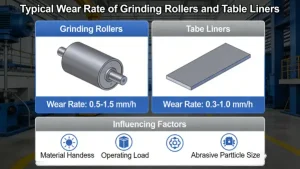
The wear rate of grinding rollers and table liners in vertical roller mills (VRMs) varies significantly based on material type, operating conditions, and maintenance practices. Below is a comprehensive guide to typical wear rates, measurement units, and influencing factors.
📊 Key Measurement Units
Wear rate is commonly expressed in three ways:
- Mass-based: grams per ton of material processed (g/t)
- Dimension-based: millimeters per 1000 operating hours (mm/1000h) or total wear depth (mm) over service life
- Time-based: service life (operating hours or months) before replacement
⚙️ Typical Wear Rate Ranges
1. Mass-Based Wear Rate (g/t)
| Application | Material | Grinding Roller Wear Rate | Table Liner Wear Rate | Notes |
|---|---|---|---|---|
| Cement Raw Meal | High-chromium cast iron | 0.08-0.20 g/t | 0.05-0.15 g/t | Lower for hardfaced liners (0.04-0.12 g/t) |
| Cement Clinker | High-chromium cast iron | 0.15-0.35 g/t | 0.10-0.25 g/t | Higher due to harder material |
| Calcium Carbonate | Composite cast iron | 0.05-0.12 g/t | 0.03-0.08 g/t | Lower for soft minerals |
| Granite/Basalt | Ceramic composite | 0.03-0.09 g/t | 0.02-0.06 g/t | Extreme abrasion resistance needed |
2. Dimension-Based Wear Rate (mm/1000h)
| Material Type | Grinding Roller Wear Rate | Table Liner Wear Rate | Service Life Expectation |
|---|---|---|---|
| Standard high-chromium cast iron (Cr20-26) | 0.3-0.8 mm/1000h | 0.2-0.6 mm/1000h | 8,000-12,000 hours |
| Hardfaced alloy (WC-Co/Cr3C2) | 0.1-0.3 mm/1000h | 0.08-0.2 mm/1000h | 12,000-18,000 hours |
| Ceramic composite (ZTA/Al₂O₃ ≥92%) | 0.02-0.1 mm/1000h | 0.01-0.05 mm/1000h | 18,000-30,000 hours |
3. Time-Based Service Life
| Industry | Material | Grinding Roller Life | Table Liner Life | Replacement Trigger |
|---|---|---|---|---|
| Cement (5000 t/d line) | High-chromium iron | 12-18 months | 15-24 months | 5-8 mm total wear depth |
| Mineral Processing | Composite cast iron | 8-14 months | 10-16 months | Uneven wear > 3 mm deviation |
| Calcium Carbonate | Ceramic composite | 18-24 months | 20-30 months | Wear depth < 2 mm after 18 months |
📈 Real-World Case Studies
- Ethiopian Calcium Carbonate Plant: After 18 months of operation, grinding roller wear was 12.5 mm (0.23 mm/1000h), 21% lower than design expectation
- Chinese Cement Raw Mill: Ceramic liners showed only 1.2 mm wear after 18 months, while high-chromium cast iron wore 6 mm+ in the same period (7x better wear resistance)
- Large Cement Mill (10,000+ hours): Hardfaced liners reduced wear rate by 50% (from 0.30 g/t to 0.12 g/t) compared to standard cast iron
🎯 Factors Influencing Wear Rate
1. Material Properties
- Hardness: Higher chromium content (20-28%) increases wear resistance (HRC ≥58)
- Microstructure: Carbide distribution and matrix toughness determine resistance to cracking/spalling
- Composite Materials: Ceramic-metal combinations offer best wear resistance (7-10x better than cast iron)
2. Operational Parameters
- Grinding Pressure: Excessive pressure (above design by 10-15%) increases wear by 30-50%
- Material Feed:
- Particle size >25 mm increases wear by 20-40%
- Quartz content >15% drastically accelerates wear (main abrasive component)
- Mill Speed: Optimal speed is 75-85% of critical speed; deviations increase wear
3. Maintenance Practices
- Hardfacing: Extends life by 30-50% when applied correctly
- Regular Inspection: Prevents uneven wear and catastrophic failure
- Foreign Material Removal: Iron/metal contamination increases wear by 50-100%
🛠️ How to Measure Wear Rate Accurately
- Pre-installation: Mark reference points on liners and measure initial thickness
- Periodic Checks:
- Measure wear depth at 4-6 locations per roller/liner using ultrasonic thickness gauge
- Record operating hours and material throughput
- Calculate:
Wear Rate (mm/1000h) = (Initial Thickness - Current Thickness) × 1000 / Operating Hours
Wear Rate (g/t) = (Initial Weight - Current Weight) × 1000 / Total Throughput (tons)
💡 Optimization Tips to Reduce Wear Rate
- Material Selection:
- Use high-chromium cast iron (Cr26) for general applications
- Upgrade to ceramic composite for highly abrasive materials
- Apply hardfacing with WC-Co alloys for critical areas
- Operational Adjustments:
- Maintain optimal grinding pressure (80-90% of design)
- Control feed size <20 mm and remove tramp metal
- Keep quartz content below 12% if possible
- Maintenance:
- Re-hardface liners at 50-60% wear
- Rotate liners periodically to ensure even wear
- Monitor vibration levels (indicates uneven wear)