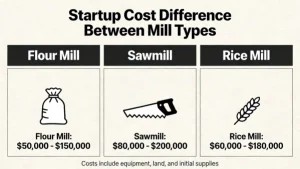
Startup (capital) costs for industrial grinding mills vary drastically by mill type, driven by equipment complexity, auxiliary system requirements, civil works, and scale of production. Below is a structured comparison of mainstream mill types, based onequalthroughputcapacity (10–50 tph, mid-scale industrial standard)and core startup cost components (equipment purchase, auxiliary systems, installation/civil works, commissioning, and initial consumables).
Core Definition of Mill Startup Costs
Total startup capital expenditure (CAPEX) for grinding mills typically breaks down as:
- 60–75%: Core mill equipment purchase
- 10–20%: Auxiliary systems (dust collection, feeding, lubrication, hydraulic, electrical/automation)
- 5–15%: Civil works, installation, and assembly
- 2–8%: Initial spare parts and grinding media
- 2–5%: Engineering, permitting, and commissioning
Side-by-Side Startup Cost Comparison
| Mill Type | Typical Total Startup CAPEX (10–50 tph) | Relative Cost (vs. Hammer Mill = 1.0) | Core Cost Drivers & Key Differentiators |
|
Hammer Mill
|
$100k – $300k | 1.0 (Baseline) | Lowest upfront cost overall. Simplest impact-based design, no grinding media required, minimal civil works, and basic auxiliary systems. Equipment makes up 80%+ of total startup cost, with fast deployment and low installation labor. |
|
Raymond Mill (Roller Mill)
|
$300k – $600k | 1.2 – 1.8 |
Initial investment is only30–40% of a vertical roller mill (VRM)and 50–60% of a comparable ball mill for 80–400 mesh fine powder production. Compact vertical structure cuts civil works costs by 30–50% vs. horizontal mills; turnkey packages include standard dust collection and classification systems with minimal add-on costs.
|
|
Rod Mill
|
$300k – $1.2M | 2.0 – 3.5 | Designed for coarse grinding. Heavier steel construction, initial steel rod grinding media (5–10% of equipment cost), and a reinforced concrete foundation drive higher costs vs. small mills. Civil works costs are 20–30% higher than hammer/Raymond mills. |
|
Ball Mill
|
$200k – $1.5M | 2.5 – 4.0 | Industry benchmark for mid-scale grinding. Initial equipment cost is 20–30% lower than VRM for small-to-mid capacity, but 2–3x higher than Raymond mills. Critical add-on costs include initial steel ball grinding media (3–8% of equipment cost), high-torque power infrastructure, and a larger footprint that increases civil works. Economies of scale make it 20–40% cheaper than VRM for large-scale (>100 tph) operations. |
|
Vertical Roller Mill (VRM)
|
$800k – $3.5M | 4.0 – 8.0 | Highest upfront cost for conventional fine/ultrafine grinding. Core equipment cost is 2.5–3x higher than a same-capacity ball mill for small-to-mid scale operations. Cost drivers include integrated drying/hydraulic/lubrication systems, precision-manufactured rollers/grinding tables, and advanced automation. Offset partially by 20–30% lower civil works (small vertical footprint, outdoor installation capability) and a simplified single-unit process flow that cuts total plant CAPEX by 10–20% for large cement/mineral operations. |
|
Jet Mill
|
$300k – $2M | 3.0 – 10.0 | For ultrafine (1250+ mesh) precision grinding. Upfront cost is driven by high-pressure compressed air systems (40–60% of total cost), precision classification, and explosion-proof/dust-tight enclosures. Total startup cost is 2–5x higher than a same-throughput ball mill. |
|
SAG/AGMill
|
$2M – $10M+ | 20.0 – 100.0+ | For large-scale mining operations. Single-unit equipment cost ranges from $2M to $50M+, with civil works and high-voltage electrical infrastructure adding 50–100% to total startup cost. Only viable for high-throughput mining circuits, with CAPEX 10–50x higher than conventional ball mill systems. |
Critical Factors That Shift Cost Differences
-
Production Scale: Economies of scale drastically narrow the cost gap. For large-scale (>100 tph) operations, VRM total startup cost becomes only 10–20% higher than ball mills, while small-scale VRM remains 2–3x more expensive.
-
Material &FinenessRequirements: For hard abrasive materials (e.g., iron ore, granite) and ultrafine powder, the upfront premium for ball mills/VRM shrinks, as simpler hammer/Raymond mills require frequent wear part replacements and auxiliary system upgrades that raise commissioning and initial operating costs.
-
Location: Remote sites increase logistics and civil works costs, which disproportionately impact heavy, large mills (ball mills, SAG mills) vs. compact, modular mills (Raymond, hammer mills).
-
Turnkeyvs. Standalone: Turnkey packages (including installation, auxiliary systems, and commissioning) reduce cost gaps between mill types, as simpler mills often require custom auxiliary engineering that adds hidden upfront costs.
Key Takeaway
-
Lowest upfront cost: Hammer mills and Raymond mills, ideal for small-to-medium scale, budget-limited operations with coarse-to-medium fineness requirements.
-
Balanced mid-range cost: Ball mills and rod mills, the industry standard for wide material compatibility, moderate upfront investment, and scalable production.
-
High upfront cost, long-term savings: VRM, jet mills, and SAG mills, with a significant upfront premium but 30–50% lower long-term energy and operating costs, best suited for large-scale, high-throughput, energy-sensitive operations.