The service life of ceramic linings in calcium carbonate (CaCO₃) mills is not a fixed value and depends primarily on ceramic material type, silica (SiO₂) content of CaCO₃ feedstock, mill type, and operational maintenance standards. Under industrial continuous production conditions, the typical service life ranges from 6 months to 5 years. Among these factors, the SiO₂ content of the feedstock is the most critical (SiO₂ has a Mohs hardness of 7 and is the primary abrasive impurity for ceramic linings), while the hardness and toughness of the ceramic material directly determine its wear and impact resistance.
Combined with industrial practices of CaCO₃ grinding (dry ball mill, vertical roller mill/ring roller mill, jet mill, wet bead mill), the following presents the actual service life of ceramic linings by material type and working condition, along with key influencing factors and practical methods to extend service life—all are industry-validated standard data for the CaCO₃ sector.
Core Conclusion: Industrial Actual Service Life of Ceramic Linings in CaCO₃ Mills
Categorized by ceramic material + feedstock SiO₂ content (the two most core variables in the CaCO₃ industry), the typical service life under 24/7 continuous production is provided below, applicable to mainstream CaCO₃ grinding mills (ball mill, vertical roller mill, jet mill, bead mill):
|
Ceramic Lining Material
|
Mohs Hardness
|
Suitable CaCO₃ Feed SiO₂ Content
|
Typical Service Life (Industrial Continuous Production)
|
Main Applicable Mill Types
|
|
92%~99% Alumina Ceramic
|
9
|
<0.5% (Pure CaCO₃)
|
1~3 years
|
Dry ball mill, vertical/ring roller mill (grinding chamber/hopper)
|
|
92%~99% Alumina Ceramic
|
9
|
0.5%~3% (Medium SiO₂)
|
6~12 months
|
Dry ball mill, vertical/ring roller mill
|
|
ZTA Toughened Alumina Ceramic
|
9+
|
<0.5% (Pure CaCO₃)
|
2~4 years
|
Dry ball mill, jet mill (grinding cavity/nozzle housing)
|
|
ZTA Toughened Alumina Ceramic
|
9+
|
0.5%~3% (Medium SiO₂)
|
1~2 years
|
Dry ball mill, jet mill
|
|
Stabilized Zirconia Ceramic
|
8.5~9
|
<0.5% (Pure CaCO₃)
|
3~5 years
|
Wet bead mill (slurry chamber), food-grade ball mill
|
|
Reaction-Bonded Silicon Carbide (SiC)
|
9.5
|
>3% (High SiO₂, even >5%)
|
2~4 years
|
High-silica CaCO₃ ball mill, vertical roller mill
|
Supplementary Note: Due to the dual loads of rolling and impact on the grinding rollers and tables of vertical/ring roller mills, pure ceramic linings are generally not used. Instead, ceramic composite coatings (WC-Co + alumina) are adopted, which have a 3~5 times longer service life than pure steel coatings. They are suitable for medium and high-silica CaCO₃ grinding with a typical service life of about 1~3 years.
4 Core Factors Affecting the Service Life of Ceramic Linings
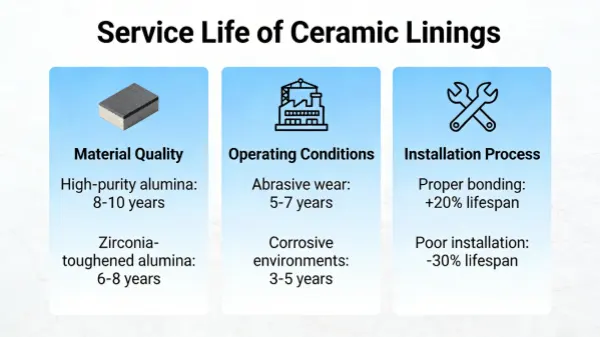
In CaCO₃ grinding scenarios, the main failure modes of ceramic linings are abrasive wear (caused by high-silica feedstock), impact cracking/chipping (caused by oversized feed particles), and vibration detachment (caused by improper installation). The core influencing factors are ranked by their weight of impact:
1. SiO₂ Content of CaCO₃ Feedstock (Weight >60%)
SiO₂ is the most significant abrasive impurity in CaCO₃, with a Mohs hardness of 7—far higher than that of CaCO₃ (Mohs 3~4). High-silica feedstock continuously scours the surface of ceramic linings, accelerating wear:
-
Pure CaCO₃ (SiO₂ <0.5%): Almost non-abrasive; wear of ceramic linings only comes from mild friction with CaCO₃ particles, resulting in the longest service life.
-
High-silica CaCO₃ (SiO₂ >3%): SiO₂ particles act as abrasives that rapidly scratch the ceramic surface. Even high-hardness SiC ceramics see their service life reduced by about 50% compared to pure CaCO₃ grinding conditions.
2. Inherent Properties of Ceramic Materials (Weight >20%)
Different ceramics vary significantly in hardness, toughness, and abrasion resistance, and are suitable for different wear conditions. Selecting the wrong material will drastically shorten the service life:
-
Alumina ceramic: The most cost-effective option with good abrasion resistance but moderate toughness and poor resistance to strong impact; suitable for dry grinding of low/medium-silica CaCO₃.
-
ZTA ceramic: Zirconia-doped alumina with a 2~3 times improvement in toughness, resistant to impact and chipping; suitable for high-impact areas of jet mills and ball mills.
-
Zirconia ceramic: Optimal toughness, high chemical inertness, and no metal impurity leaching; suitable for wet bead mills and grinding of food/pharmaceutical-grade CaCO₃, with excellent resistance to slurry erosion.
-
Silicon carbide ceramic: The highest hardness (Mohs 9.5) and optimal abrasion resistance; specially designed for high-silica CaCO₃ grinding and the only choice for high-silica working conditions.
3. Mill Type and Wear Conditions (Weight ≈10%)
Different mills exhibit different wear modes (abrasion, impact, erosion), leading to significant differences in the stress on ceramic linings and thus their service life:
-
Dry ball mill: Wear is dominated by abrasion + moderate impact (collisions between grinding media and linings); alumina/ZTA ceramics are suitable, with a medium service life.
-
Vertical/ring roller mill: Wear is dominated by rolling + mild abrasion (extrusion between grinding rollers and tables); ceramic composite coatings are suitable, as pure ceramics are prone to cracking.
-
Jet mill: Wear is dominated by high-speed erosion + micro-impact (supersonic impact of CaCO₃ particles); ZTA/SiC ceramics are suitable for their excellent erosion resistance.
-
Wet bead mill: Wear is dominated by slurry erosion (no strong impact); zirconia ceramics are suitable, with the longest service life (3~5 years).
4. Operation, Installation and Maintenance (Weight ≈10%)
Ceramic linings are brittle; improper installation and operation can lead to premature cracking/detachment, drastically shortening the service life even for high-quality ceramics:
-
Installation: Failure to fully bond the lining with high-adhesion wear-resistant epoxy resin or the presence of air gaps will cause ceramic linings to crack due to mill vibration.
-
Feedstock: Limestone feed particles larger than 10mm will impact ceramic linings and cause chipping.
-
Operation: Dry running of the mill (without CaCO₃ powder as a buffer) leads to direct impact of grinding media on ceramic linings, resulting in rapid cracking.
-
Cleaning: Using steel brushes/metal scrapers to clean linings will scratch the ceramic surface, and abrasives will embed in the scratches to accelerate wear.
6 Practical Methods to Extend the Service Life of Ceramic Linings in CaCO₃ Mills
Combined with the industrial production process of CaCO₃, optimizing from the aspects of feedstock pretreatment, mill operation, and installation maintenance can extend the service life of ceramic linings by 30%~100%. These are universal optimization methods in the industry:
1. Feedstock Desilication (Most Effective, Reducing Abrasion at the Source)
Following the aforementioned silica removal methods, reduce the SiO₂ content of CaCO₃ feedstock to <0.5% through water washing/scrubbing + reverse flotation. This eliminates abrasive impurities at the source and can directly double the service life of ceramic linings.
2. Strictly Control Mill Feed Particle Size
After crushing and screening limestone, control the mill feed particle size to 0~10mm and prohibit oversized particles (>10mm) from entering the mill to avoid impact chipping of ceramic linings. For high-silica CaCO₃, the particle size can be further reduced to 0~5mm to minimize abrasive impact.
3. Standardize Ceramic Lining Installation Processes
-
Use high-wear-resistance epoxy resin dedicated for CaCO₃ mills to achieve full, gap-free bonding between ceramic linings and the mill’s metal substrate, preventing cracking caused by vibration.
-
Adopt interlocking ceramic tiles + metal backing plates in high-impact areas (e.g., ball mill feed end) to enhance the impact resistance of linings.
-
Avoid over-tightening bolts during mechanical fastening to prevent compressive cracking of ceramic linings.
4. Match with Non-Metallic Grinding Media to Avoid Secondary Impact
Ceramic linings must be paired with alumina/zirconia ceramic grinding media (replacing steel balls/sections). This not only eliminates metal contamination but also reduces the impact hardness of grinding media on linings (ceramic media has a lower density than steel, resulting in smaller impact loads).
5. Prohibit Mill Dry Running and Maintain a Reasonable Material Level
During CaCO₃ grinding, powder in the mill forms a buffer layer, preventing direct impact of grinding media/rollers on ceramic linings. Strictly prohibit dry running of the mill; feed material first before starting the mill during startup, and stop the mill first before cutting off the feed during shutdown.
6. Standardize Maintenance and Cleaning to Avoid Ceramic Surface Damage
-
Clean linings with nylon brushes/plastic scrapers + oil-free dry compressed air; never use metal tools that can scratch the ceramic surface.
-
Inspect linings monthly and immediately repair minor cracks/chipping with epoxy resin to prevent crack expansion and subsequent lining detachment.
-
Regularly lubricate mill bearings to reduce mill vibration and avoid cracking of ceramic linings due to long-term vibration.
Judgment Criteria for Ceramic Lining Failure (Timely Replacement to Avoid Impact on CaCO₃ Quality)
Ceramic linings must be replaced in a timely manner if any of the following conditions occur; otherwise, it will lead to reduced CaCO₃ grinding efficiency, widened particle size distribution, and even ceramic debris mixing into the powder (no metal contamination, but adverse to product particle size):
-
The wear depth on the ceramic lining surface exceeds 5mm, or the metal substrate is exposed due to local wear-through.
-
The lining has cracks longer than 10mm or multiple chips (>5mm) that cannot be repaired with epoxy resin.
-
The lining has detached/hollow areas that produce a hollow sound when tapped and shed ceramic debris during mill vibration.
-
The unit power consumption of CaCO₃ grinding increases by more than 15% or the product D50 deviates by more than 10% due to lining wear, indicating that lining wear has affected grinding efficiency.