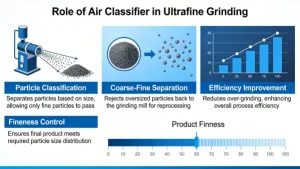
The airclassifier is the coreprecisioncontrol and sorting unit of the closed-circuit ultrafine grinding system (for materials like GCC with target fineness D97 < 2 μm, even near-nano 100–500 nm). Unlike traditional mechanical screening (invalid for ultrafine powder <45 μm), air classifiers use the couplingeffect of gas flow suspension andcentrifugal force to separate fine/coarse particles—this is the only industrial technology for high-precision sorting of ultrafine powder.
In ultrafine grinding (especially for ground calcium carbonate, the most common industrial application), the air classifier is not a simple “screening device”; it directly determines the particlesizeprecision,particle size distribution, production efficiency, and final product quality (brightness/dispersibility) of ultrafine GCC. Its role is highly targeted to solve the pain points of ultrafine grinding (severe over-grinding, wide particle size distribution, high energy consumption, easy agglomeration), and it forms a synergistic closed loop with ultrafine grinding equipment (jet mill/vertical mill/ultrafine Raymond mill).
Below is a detailed breakdown of its core roles, combined with the industrial characteristics of CaCO₃ ultrafine grinding (the most typical application scenario for ultrafine air classification):
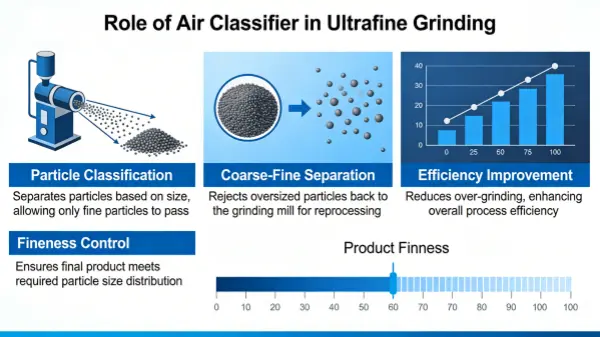
1. Precise Size Classification: The “Core Gatekeeper” for Qualified Ultrafine Powder
The fundamental role of the air classifier is to accurately separate qualified ultrafine powder from the mixed coarse/fine powder discharged by the mill and strictly control the product’s cut size (the critical particle size for separation).
Working principle for ultrafine powder: The mixed powder (coarse + ultrafine) is suspended and lifted by high-speed airflow into the classification chamber; the rotating impeller generates strong centrifugal force. Qualified ultrafine particles (≤ target fineness, e.g., D97=1 μm for GCC) have small mass and are carried by the airflow through the impeller gap to the powder collection system (cyclone/bag filter) as finished product. Unqualified coarse particles are thrown to the classification chamber wall by centrifugal force, lose kinetic energy, and fall back to the mill for regrinding.
CaCO₃-specific value: For ultrafine GCC (D97=0.5–2 μm) used in high-grade coatings/papermaking coatings, the air classifier ensures the productfinenessis 100% up tostandard—no coarse particles are mixed (coarse particles cause poor dispersibility and reduced coating film smoothness in downstream applications). For near-nano GCC (100–500 nm), multi-stageprecisionair classifiers achieve sub-nanometer level cut size control, the highest precision of physical sorting technology.
2. Inhibit Over-Grinding: Protect CaCO₃ Brightness and Reduce Energy Consumption
Over-grinding is the biggest fatal defect in ultrafine grinding (especially for brittle materials like calcite). It not only causes a sharp increase in energy consumption but also damages the quality of GCC—over-grinding breaks calcite’s rhombohedral crystal lattice (causing the product to appear gray and reduce whiteness) and triggers particle agglomeration (due to exponentially increased surface energy of ultra-fine particles).
The air classifier eliminates over-grinding at the source by:
Real-time separating qualified ultrafine powder from the mill, so fine powder will not be repeatedly ground with coarse powder;
Only returning unqualified coarse powder to the mill for targeted regrinding, avoiding “useless grinding” of qualified powder.
For CaCO₃ production: This role directly *retains GCC whiteness (increases CIE L by 2–3 units)** and reduces grinding energy consumption by 30–50% compared with open-circuit grinding (no classification). For near-nano GCC grinding (jet mill), inhibiting over-grinding also prevents heat accumulation (caused by excessive grinding) and avoids slight CaCO₃ decomposition or Fe²+ oxidation (yellowing).
3. Optimize Circulating Load: Stabilize Mill Operation and Improve ProductionCapacity
The circulatingload rate (mass ratio of returned coarse powder to finished fine powder) is the key operating parameter of the closed-circuit ultrafine grinding system (200–400% is the optimal range for CaCO₃). The air classifier is the only device that precisely controls the circulating load rate.
If the classification efficiency is high: The proportion of qualified fine powder separated is high, the circulating load rate is moderate, and the mill runs under the optimal load—grinding efficiency is maximized.
If the classification efficiency is low: A large amount of fine powder is mixed with coarse powder and returned to the mill, leading to excessive circulating load (>400%), mill overload, increased energy consumption, and severe over-grinding.
For CaCO₃ ultrafine grinding: The air classifier stabilizes the circulating load at the optimal range, making the mill achieve 40–60% higher production capacity than open-circuit grinding, and ensures continuous and stable operation (no frequent shutdown due to overload/under-grinding). This is critical for industrial large-scale production of ultrafine GCC.
4. NarrowParticle Size Distribution: Improve the Application Performance of Ultrafine GCC
Downstream high-end applications of ultrafine GCC (high-grade water-based coatings, papermaking coating colorants, nano ink) have strict requirements for narrowparticle size distribution (low D90/D10 ratio). A wide particle size distribution will cause problems such as poor powder dispersibility, uneven coating film, and reduced hiding power—the airclassifieris the core device to narrow the particle size distribution of ultrafine powder.
By adjusting key parameters (classifier impeller speed, airflow rate, classification chamber pressure), the air classifier can:
Remove coarse particle tailings (the main cause of wide distribution) with high efficiency (≥95%);
Avoid excessive mixing of ultra-fine powder (<0.1 μm) and fine powder (0.1–2 μm) (ultra-fine powder agglomerates easily and affects product fluidity);
Realize monodisperse-likeparticle size distribution for ultrafine GCC (D90/D10 <3 for high-grade products).
CaCO₃-specific benefit: Narrow distribution makes ultrafine GCC disperse more uniformly in coatings/plastics, significantly improving the smoothness of coating films, the printability of paper, and the toughening effect of plastics—this is the key to ultrafine GCC replacing part of nano-CaCO₃ in mid-to-high-end applications.
5. Auxiliary Purification and Anti-Contamination: Protect CaCO₃ Brightness and Purity
For high-brightness ultrafine GCC (CIE L*≥95), the air classifier also plays a secondary purification and anti-iron contamination role in the grinding process, which is closely linked to CaCO₃’s core quality index (whiteness):
Impurity separation: Light impurities in calcite ore (e.g., ultrafine clay micro-powder, organic carbon particles) have lower density than CaCO₃ and are more easily carried by the airflow to the finished product collection system together with qualified fine powder—by adjusting the classification airflow intensity, the classifier can selectively separate most of these light impurities (or send them to the dust removal system for discharge), reducing the graying of GCC caused by clay/organic matter.
Anti-iron contamination design: Industrial air classifiers for CaCO₃ use ceramic impellers/liners (alumina/zirconia) and 304/316 stainless steel shells (no carbon steel contact parts). This avoids iron chip mixing caused by equipment wear (the main cause of GCC yellowing) during high-speed rotation for ultrafine classification, and the airtight structure prevents secondary contamination of ultrafine powder by workshop dust/iron filings.
Agglomeration reduction: The high-speed airflow in the classification chamber generates mild shear force, which can break soft agglomerates (formed by van der Waals forces) of ultrafine GCC particles (<2 μm) during grinding, improving the dispersibility of the finished product.
6. FlexibleFinenessAdjustment: Realize Multi-Specification Ultrafine GCC Production
Industrial production often requires switching between multiple ultrafine GCC specifications (e.g., from D97=2 μm to 1 μm, then to 500 nm) to meet different downstream application requirements. The air classifier enables on-line, fastfinenessadjustment without replacing grinding equipment—this is a huge advantage for reducing production costs and improving production flexibility.
The fineness adjustment is achieved by simply changing two key parameters:
Impeller speed: Positive correlation with product fineness (higher speed = finer finished powder). For example, increasing the turbine classifier speed from 2000 r/min to 3000 r/min can reduce GCC fineness from D97=2 μm to 1 μm.
Airflow rate: Negative correlation with product fineness (lower airflow rate = finer finished powder, as fewer coarse particles are carried by the airflow).
CaCO₃ industrial value: This flexibility allows a single closed-circuit grinding system to produce ultrafine GCC of multiple fineness grades (0.5–2 μm), avoiding the need to invest in multiple sets of grinding equipment for different specifications—greatly reducing fixed asset investment.
7. Special Role in Jet Mill Near-Nano Grinding (100–500 nm GCC)
For the fluidized bed jet mill (the core equipment for CaCO₃ near-nano grinding), the matching multi-stage precision air classifier has an additional unique role beyond the above functions:
Non-contact classification matching non-contact grinding: Jet mills use high-speed airflow for non-contact grinding (no mechanical wear, no iron contamination), and multi-stage air classifiers maintain this “non-contact” characteristic, ensuring the near-nano GCC has ultra-high purity (CaCO₃ ≥99.9%) and whiteness (CIE L*≥97).
Stage-by-stage sorting for narrow distribution: Multi-stage classification separates the mixed powder into different particle size fractions step by step, further narrowing the particle size distribution of near-nano GCC (100–500 nm) and avoiding the mixing of submicron coarse particles (>500 nm) and nano fine particles (<100 nm).
Deagglomeration enhancement: The high-speed swirling airflow in the multi-stage classification chamber generates stronger shear force, which can break most soft agglomerates of near-nano GCC particles, releasing monodisperse primary particles and improving the product’s dispersibility in high-end nano coatings/electronic materials.
Key Performance Requirements of Air Classifier for CaCO₃ Ultrafine Grinding
To exert the above roles effectively, the air classifier must meet strict performance indicators tailored to CaCO₃’s characteristics (high whiteness, anti-contamination, narrow distribution):
Classification efficiency ≥95%: Ensure almost all qualified ultrafine powder is separated, and coarse powder is returned for regrinding (no coarse particle leakage).
Precise cut size control: For D97=1 μm GCC, the cut size error is ≤±0.05 μm; for near-nano GCC (500 nm), the error is ≤±0.02 μm.
Non-ferrous contact parts: Ceramic impeller/liner + stainless steel pipeline (100% no carbon steel) to avoid iron contamination.
Low pressure drop & low energy consumption: The pressure drop of the classification system is <3 kPa, and the energy consumption accounts for ≤15% of the total grinding system energy consumption.
Airtight structure: No dust leakage, to prevent secondary contamination and meet environmental protection standards (workshop dust concentration <10 mg/m³).
Stable operation: Continuous running time ≥8000 h/year, no impeller wear or vibration (critical for near-nano grinding).
In ultrafine grinding (especially for CaCO₃ GCC production), the air classifier is not a secondary auxiliary device but the “brain and precision control center” of the closed-circuit system—its performance directly determines the quality, efficiency, and cost of ultrafine/near-nano GCC.
It collaborates with ultrafine grinding equipment (jet mill/vertical mill) to solve the core pain points of ultrafine grinding (over-grinding, wide distribution, high energy consumption) and ensures the ultrafine GCC has the key properties required for high-end applications: precise fineness, narrow particle size distribution, high brightness, high purity, and good dispersibility. For the production of near-nano GCC (100–500 nm), the multi-stage precision air classifier is an indispensable matching device, which is the key to realizing the industrial physical grinding limit of CaCO₃.
Simply put: Without a high-precision air classifier, there is no high-quality industrial ultrafine grinding of CaCO₃.