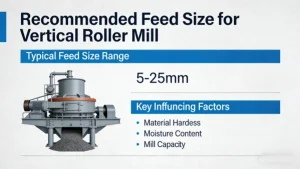
The recommended feed size for a vertical roller mill (VRM) varies significantly based on the mill model, size, application, and material type, but there are typical ranges and guiding principles. Below is a structured overview:
Typical Recommended Feed Size Ranges by Application
| Application | Typical Max Feed Size | Special Cases |
|---|---|---|
| Cement Raw Meal | 30-50 mm | 20-45 mm for smaller mills |
| Cement Clinker | 20-40 mm | 15-38 mm for specialized cement mills |
| Coal Grinding | 40-50 mm | Up to 200 mm for large coal mills (e.g., FLSmidth ATOX®) |
| Slag Grinding | 35-55 mm | 30-45 mm for standard slag vertical mills |
| Non-Metallic Minerals | 30-70 mm | 10-20 mm for ultrafine vertical mills |
Key Factors Influencing Recommendation
-
Mill Size and Design: Larger mills with bigger grinding discs and rollers can handle larger feed sizes. Smaller laboratory or pilot mills typically require feed sizes below 20 mm.
-
Material Properties:
- Hardness (Mohs scale): Harder materials should be fed at smaller sizes (10-30 mm) to reduce wear and energy consumption
- Brittleness: Brittle materials can be fed at larger sizes (40-70 mm)
- Moisture content: Higher moisture may require smaller feed sizes to prevent agglomeration
-
“More Crushing, Less Grinding” Principle: Industry best practice emphasizes reducing feed size through efficient crushing before milling to optimize energy usage and mill performance.
-
Product Requirements: Finer desired products often necessitate smaller feed sizes for better control and efficiency.
General Guidelines
- Maximum Feed Size: Typically 1/10 to 1/15 of the grinding disc diameter for optimal performance
- Optimal Size Distribution: Feed should be well-graded, with most particles between 10-30 mm for general applications
- Critical Limits: Avoid oversized lumps (exceeding manufacturer’s specifications) as they cause uneven wear, vibration, and potential damage to rollers and table
Important Notes
- Always refer to the specific manufacturer’s recommendations for your vertical roller mill model
- For best results, maintain a consistent feed size distribution to ensure stable operation and consistent product quality
- The recommended feed size is closely linked to the mill’s capacity, power consumption, and maintenance requirements