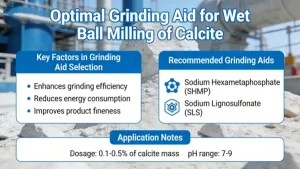
For wet ball milling of calcite—especially for ultrafine grinding (d97 < 2 μm)—the optimal grinding aid is a low-polydispersity sodium polyacrylate (PAAS) or a polycarboxylate-based copolymer, often used in combination with a small amount of alkali carbonate (e.g., Na₂CO₃) to synergistically enhance performance. For general fine grinding, sodium hexametaphosphate (SHMP) is a cost-effective inorganic alternative.
Key Recommendations by Application
- Ultrafine grinding (target d97 < 2 μm, high solid loading)
PAAS (low PDI) + Na₂CO₃ blend is the gold standard. It delivers the finest particle size, narrowest distribution, and lowest slurry viscosity, critical for high-efficiency milling.
- General fine grinding (d97 2–10 μm, cost-sensitive)
SHMP (sodium hexametaphosphate) is optimal. It provides good dispersion with lower cost, though it is less effective for submicron grinding.
- Specialty applications (rheology control, high stability)
Polycarboxylate copolymers (e.g., acrylic-maleic anhydride) offer superior dispersion and stability over PAAS for high-solids slurries.
Optimal Dosage & Conditions
| Grinding Aid | Optimal Dosage (wt.% on calcite) | Key Conditions | Performance Impact |
|---|---|---|---|
| PAAS (low PDI) | 0.05–0.2% | 60–75% solids, pH 8–10 | Reduces viscosity by 40–60%; d97 down to 0.5 μm |
| SHMP | 0.1–0.3% | 50–65% solids, pH 7–9 | Improves fineness by 15–25%; prevents agglomeration |
| PAAS + Na₂CO₃ | 0.03–0.15% PAAS + 0.05–0.1% Na₂CO₃ | 70–80% solids, pH 9–11 | Synergistic effect: 20% lower dosage vs. PAAS alone; better rheology |
Mechanisms of Action
-
Dispersion & Rheology Control
- PAAS adsorbs strongly to calcite via carboxyl-Ca²⁺ bonding, creating an electrostatic barrier to prevent agglomeration.
- Low PDI PAAS provides more uniform adsorption, minimizing viscosity at high solids.
- SHMP chelates Ca²⁺ ions in the slurry, reducing interparticle forces and improving flow.
-
Grinding Efficiency Enhancement
- Adsorption reduces surface free energy, accelerating crack propagation in calcite crystals.
- Lower slurry viscosity increases particle collision frequency with grinding media, boosting breakage rates.
- The PAAS-Na₂CO₃ blend buffers pH and stabilizes the polymer, reducing required dosage.
Critical Selection Factors
-
Particle Size Target
- Submicron: PAAS or polycarboxylate copolymer (SHMP is ineffective).
- Micron range: SHMP for cost efficiency.
-
Slurry Solids Content
- High solids (>70%): PAAS + Na₂CO₃ (maintains low viscosity).
- Medium solids (50–65%): SHMP suffices.
-
Cost vs. Performance
- Inorganic SHMP is 30–50% cheaper than organic PAAS.
- For ultrafine applications, the productivity gain from PAAS offsets its higher cost.
-
Downstream Compatibility
- PAAS is compatible with most paper coating, plastic, and paint applications.
- SHMP may leave phosphate residues; check specifications for food, pharmaceutical, or high-purity uses.
Practical Tips for Use
- Dosage Optimization: Start at the lower end of the range and increase incrementally—excess dosage can cause re-agglomeration or foaming.
- Addition Method: Add the grinding aid to the slurry before milling for uniform dispersion; avoid adding dry powder directly to the mill.
- pH Adjustment: Maintain the recommended pH range (8–11 for PAAS, 7–9 for SHMP) using NaOH or Na₂CO₃ to maximize effectiveness.
- Synergistic Blends: For ultrafine grinding, replace 20–30% of PAAS with Na₂CO₃ to reduce costs without sacrificing performance.
Summary
- Ultrafine wet ball milling of calcite: Low-PDI sodium polyacrylate (PAAS) + sodium carbonate is the optimal choice, delivering superior fineness, rheology, and efficiency.
- General fine grinding: Sodium hexametaphosphate (SHMP) offers the best cost-performance ratio.
- Always match the grinding aid to your particle size target, solids content, and downstream application requirements for optimal results.