The optimal calcium carbonate (CaCO₃) particle size for latex paint opacity depends on your formulation’s pigment volume concentration (PVC), performance targets, and CaCO₃ type, with core ranges validated by industry leaders (Omya, etc.) and coating research:
1. Primary Optimal Range (Maximizing TiO₂ Efficiency & Opacity, Most Latex Paint Systems)
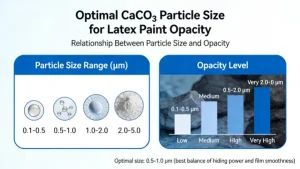
The golden standard for balanced opacity performanceis amedianparticlesize (D50) of 0.5–1.5 μm(ultra-fine ground calcium carbonate, UFGCC, or precipitated calcium carbonate, PCC) with a narrow particle size distribution (PSD, d97 < 10 μm).
- This size range closely matches the 0.2–0.4 μm optimal light-scattering size of rutile TiO₂, the primary opacifying pigment in latex paint. CaCO₃ particles in this range act as a spacer, preventing TiO₂ agglomeration (particle crowding) and maximizing the number of effective light-scattering sites in the dried film.
-
For mainstream interior matte latex paints (the largest market segment), the most widely used commercial grade has aD50 of ~1.0–1.5 μm, which balances opacity enhancement, low oil absorption, rheology control, and cost efficiency.
2. High-Performance/High-End Formulations (Low PVC, Gloss/Semi-Gloss Paints)
For premium low-PVC (below critical pigment volume concentration, CPVC) gloss/semi-gloss latex paints, the optimal size shifts toD50 0.2–0.8 μm (submicron CaCO₃).
- This ultra-fine, narrow PSD grade delivers the most uniform TiO₂ spacing, preserves gloss, and maximizes both wet and dry opacity, while enabling significant TiO₂ reduction (15–30%) without sacrificing hiding power.
3. High-PVC Matte/Economy Paints (Above CPVC, Interior Wall Paints)
For high-PVC (at or above CPVC) matte and economy latex paints, the optimal range isD50 1.0–2.5 μm.
- In these formulations, CaCO₃ not only spaces TiO₂ but also creates controlled micro-voids in the dried film (filled with air, refractive index = 1.0). The large refractive index difference between air and CaCO₃ (1.63) creates additional light scattering, boosting dry opacity. This range balances this void-driven opacity with low binder demand and low cost.
Critical Supplementary Notes
-
Particle Size Distribution(PSD) Matters More ThanMedianSize Alone: A narrow PSD is essential for consistent opacity. Wide PSD with coarse particles (>5 μm) fails to space TiO₂ effectively, causes film defects, and reduces hiding power.
-
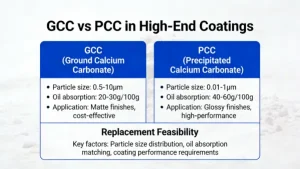
PCC vs GCC Performance: Precipitated Calcium Carbonate (PCC) typically has a narrower, more controllable PSD and better TiO₂ spacing efficiency at equal particle size vs. Ground Calcium Carbonate (GCC). UFGCC offers a lower-cost alternative with lower oil absorption for high-volume formulations.
-
Size Boundaries to Avoid:
- Particles <0.1 μm (nano-CaCO₃): Provide minimal opacity benefit, drastically increase oil absorption, raise binder/dispersant demand, and can cause unwanted thickening and poor flow.
- Particles >5 μm: Cannot effectively separate TiO₂, may induce TiO₂ crowding, and significantly reduce opacity and film smoothness.