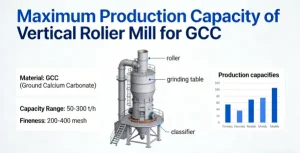
The maximum production capacity of a vertical roller mill for GCC (Ground Calcium Carbonate) varies significantly depending on the desired product fineness and the specific mill model.
Key Capacity Ranges by GCC Fineness
| GCC Fineness Range | Typical Maximum Capacity |
|---|---|
| Ultra-fine GCC (3-22μm, 600-3000 mesh) | Up to 50 t/h |
| Standard GCC (22-180μm, 80-325 mesh) | Up to 700 t/h |
Detailed Explanation
-
Ultra-fine GCC Production: For high-end applications like coatings, plastics, and paper, where particle sizes range from 3-22μm (D97), the largest vertical roller mills can achieve up to 50 t/h. The HLMX2800 from Guilin Hongcheng is specifically designed for this purpose and is considered one of the world’s largest ultra-fine vertical roller mills.
-
Standard GCC Production: For general industrial applications with coarser particle sizes (22-180μm), much larger capacities are possible. The HLM series from Guilin Hongcheng can reach up to 700 t/h桂林鸿程, while other manufacturers like SBM offer LM series mills with capacities up to 340 t/h for non-metallic mineral processing including GCC.
-
Capacity vs. Fineness Relationship: Production capacity decreases exponentially as fineness increases. For example, a mill that produces 700 t/h at 180μm might only produce 50 t/h at 10μm particle size.
Industry Context
Vertical roller mills for GCC production integrate crushing, drying, grinding, grading, and conveying into a single unit, making them highly efficient for large-scale operations. The largest models are typically used in massive GCC production facilities serving global markets, while smaller mills (1-40 t/h) are common for regional operations or specialized applications.
Note: These capacities represent state-of-the-art equipment from major manufacturers and may vary based on specific material properties, moisture content, and operating conditions.