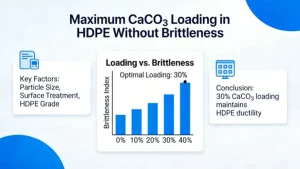
There is no fixed universal maximum loading of CaCO₃ in HDPE without brittleness, as it is highly dependent on the properties of CaCO₃, formulation design, processing technology, and the definition of “non-brittleness” (typically defined as retaining ductile fracture behavior, acceptable impact strength, and elongation at break). Below are the generally accepted critical loading ranges from academic research and industrial practice:
1. Unmodified CaCO₃ (untreated ground calcium carbonate, GCC)
Unmodified CaCO₃ has poor interfacial compatibility with the non-polar HDPE matrix, which easily causes particle agglomeration and stress concentration. Exceeding this range will lead to a sharp drop in notched impact strength and elongation at break, and the material will change from ductile to brittle fracture.
2. Surface-modified CaCO₃
With surface treatment (stearic acid, silane coupling agent, phosphate ester, etc.), the interfacial adhesion between CaCO₃ and HDPE is greatly improved, and the brittleness threshold is significantly increased:
-
Modified micro-sized GCC: The maximum non-brittleness loading can reach 40–50 wt%. In well-dispersed systems, the impact strength of HDPE can even be improved (rigid particle toughening effect) at 20–40 wt% loading, rather than causing brittleness. Classic research shows that phosphate-modified CaCO₃ at 50 wt% can increase the notched Izod impact strength of HDPE from 230 J/m to 580 J/m, maintaining excellent ductility.
-
Modified nano-CaCO₃ (particlesize <100 nm): With good dispersion, the maximum non-brittleness loading is 30–40 wt%. Nano-CaCO₃ is more prone to agglomeration than micro-sized particles, and poor dispersion will reduce the upper limit to below 25 wt%.
3. Synergistic toughening system (modified CaCO₃ + elastomer/compatibilizer)
This formula is widely used in industrial extruded products (pipes, sheets, profiles). The elastomer and modified CaCO₃ have a synergistic toughening effect, which can offset the brittleness caused by high filling, and maintain the ductile fracture behavior of the material.
Key factors affecting the brittleness threshold
-
Particlesize anddispersion: Narrow particle size distribution, fine particle size, and uniform dispersion will significantly increase the upper limit of non-brittleness loading; large particles (>5 μm) will easily become stress concentration points and reduce the threshold.
-
Processing technology: Extrusion molding can tolerate higher filling than injection molding. Injection molding products usually require the loading to be controlled below 30 wt% for unmodified CaCO₃ and below 40 wt% for modified CaCO₃ to avoid insufficient melt flow and brittle defects.
-
HDPEmatrix: HDPE with moderate melt flow rate (MFR) and wide molecular weight distribution has higher tolerance to CaCO₃ filling; high crystallinity, ultra-high molecular weight or low MFR HDPE is more prone to brittleness under high filling.