The lifespan of grinding media (balls/pebbles) in a ball mill for CaCO₃ grinding is a critical operational metric—directly impacting production costs, grinding efficiency, and CaCO₃ product purity (especially metal contamination). It is not a fixed value and varies widely based on four core factors: grinding media material, CaCO₃ feed silica (SiO₂) content (the single biggest driver), ball mill operating parameters, and media size/loading ratio.
For industrial CaCO₃ dry/wet ball milling (GCC production, D50=2–50 μm), the lifespan of grinding media ranges from 1 month to 5+ years under 24/7 continuous production. Below is a comprehensive, industry-validated guide to grinding media lifespan for CaCO₃ ball mills, including material-specific lifespan data, key influencing factors, lifespan optimization strategies, and matching recommendations with ceramic linings (for low-metal contamination). All data is tailored to CaCO₃ grinding characteristics (low Mohs hardness 3–4, but abrasive SiO₂ impurities are the main wear cause).
Core Lifespan Data: Grinding Media for CaCO₃ Ball Mills (24h Continuous Production)
Grinding media for CaCO₃ ball mills are divided into metallic media (steel-based, for standard industrial-grade CaCO₃) and non-metallic ceramic media (for high-purity/coating/food-grade CaCO₃, to eliminate metal contamination). The SiO₂ content of CaCO₃ feed is the dominant factor—higher SiO₂ = faster media wear = shorter lifespan (SiO₂, Mohs 7, acts as a natural abrasive that scours grinding media surfaces).
Below is the definitive lifespan table for the most widely used grinding media in CaCO₃ industry, with clear categorization by media material, CaCO₃ SiO₂ content, and grinding type (dry/wet). This is the standard reference for CaCO₃ producers to select media and plan replacement cycles.
Table 1: Lifespan of Metallic Grinding Media (Steel-Based) for CaCO₃ Ball Mills
Metallic media is cost-effective for standard industrial-grade CaCO₃ (construction/cement, metal impurity limits >50 ppm) and is the most common choice for low-cost CaCO₃ production. Wear generates Fe/Cr metal particles (causes contamination/whiteness loss), so it is not recommended for high-purity CaCO₃.
|
Metallic Media Type
|
Hardness (HRC)
|
CaCO₃ Feed SiO₂ Content
|
Typical Lifespan (24h continuous production)
|
Grinding Type (Dry/Wet)
|
Core Application for CaCO₃
|
|
Low-carbon steel balls
|
20–30
|
<0.5% (pure CaCO₃)
|
1–3 months
|
Dry only
|
Low-cost coarse GCC (D50=50–100 μm)
|
|
High-chromium steel balls (20–25% Cr)
|
58–65
|
<0.5% (pure CaCO₃)
|
6–12 months
|
Dry/Wet
|
Standard fine GCC (D50=10–50 μm)
|
|
High-chromium steel balls (20–25% Cr)
|
58–65
|
0.5–3% (medium SiO₂)
|
3–6 months
|
Dry/Wet
|
Standard fine GCC (D50=10–50 μm)
|
|
High-chromium steel balls (20–25% Cr)
|
58–65
|
>3% (high SiO₂)
|
1–3 months
|
Dry/Wet
|
Industrial-grade CaCO₃ (abrasive feed)
|
|
Alloy steel pebbles
|
45–55
|
<0.5% (pure CaCO₃)
|
4–8 months
|
Dry only
|
Large-scale ball mills (low impact)
|
Table 2: Lifespan of Non-Metallic Ceramic Grinding Media for CaCO₃ Ball Mills
Ceramic media is the industry standard for high-purity CaCO₃ (coating/paper/food/pharma grade, metal impurity limits <1–10 ppm) — it eliminates metal contamination (no Fe/Cr particles) and has far higher wear resistance than metallic media (especially for high-silica CaCO₃). It is more expensive upfront but offers lower lifetime costs (fewer replacements) and better product quality (higher whiteness).
|
Ceramic Media Type
|
Mohs Hardness
|
CaCO₃ Feed SiO₂ Content
|
Typical Lifespan (24h continuous production)
|
Grinding Type (Dry/Wet)
|
Core Application for CaCO₃
|
|
92% Alumina (Al₂O₃) ceramic balls
|
9
|
<0.5% (pure CaCO₃)
|
2–3 years
|
Dry/Wet
|
High-purity coating/paper GCC (D50=5–20 μm)
|
|
92% Alumina ceramic balls
|
9
|
0.5–3% (medium SiO₂)
|
1–2 years
|
Dry/Wet
|
High-purity coating/paper GCC (D50=5–20 μm)
|
|
ZTA (Zirconia-Toughened Alumina) ceramic balls
|
9+
|
<0.5% (pure CaCO₃)
|
3–4 years
|
Dry/Wet
|
Ultra-fine GCC (D50=2–10 μm), high-impact ball mills
|
|
ZTA ceramic balls
|
9+
|
0.5–3% (medium SiO₂)
|
2–3 years
|
Dry/Wet
|
Ultra-fine GCC (D50=2–10 μm)
|
|
Stabilized Zirconia (ZrO₂) ceramic balls
|
8.5–9
|
<0.5% (pure CaCO₃)
|
4–5+ years
|
Wet only
|
Food/pharma/nano CaCO₃ (ultra-high purity, no contamination)
|
|
Reaction-bonded SiC (Silicon Carbide) balls
|
9.5
|
>3% (high SiO₂, even >5%)
|
2–4 years
|
Dry only
|
High-silica CaCO₃ (most abrasive feed, no metal contamination)
|
Critical Supplementary Notes:
-
Wet vs. Dry Grinding: Ceramic media has a longer lifespan in wet grinding (CaCO₃ slurry acts as a lubricant, reducing abrasion) — zirconia ceramic balls can last 5+ years for wet grinding of pure CaCO₃ (D50<5 μm).
-
Media Size Impact: Smaller grinding media (2–10 mm, for ultra-fine CaCO₃) wear slightly faster than larger media (10–30 mm, for coarse CaCO₃) — lifespan is ~10–20% shorter for small media (higher surface area to volume ratio).
-
Ceramic Lining Matching: For zero metal contamination, ceramic media must be paired with ceramic mill linings (alumina/ZTA/ZrO₂) — a hybrid system (ceramic media + steel linings) still generates metal contamination from steel liner wear.
4 Key Factors Determining Grinding Media Lifespan for CaCO₃
CaCO₃ grinding media wear is dominated by abrasive wear (from SiO₂ impurities) and impact wear (from media-media/media-liner collisions). The four factors below determine wear rate and lifespan—sorted by weight (highest to lowest) for CaCO₃-specific grinding.
1. CaCO₃ Feed Silica (SiO₂) Content (Weight: 60–70%)
The single most important factor—SiO₂ (Mohs 7) is the primary abrasive in CaCO₃ feed (CaCO₃ itself, Mohs 3–4, has almost no abrasive effect on grinding media).
-
Pure CaCO₃ (SiO₂ <0.5%): Wear is only from mild friction between media and CaCO₃ particles—media lifespan is maximized (e.g., high-Cr steel: 6–12 months; alumina ceramic: 2–3 years).
-
High-silica CaCO₃ (SiO₂ >3%): SiO₂ particles act as “micro-grit” that scours the media surface, accelerating wear by 3–5x—even high-hardness steel media lasts only 1–3 months (SiC ceramic is the only viable option for long lifespan).
-
Silica pre-removal: Washing/flotation to reduce SiO₂ <0.5% doubles/triples media lifespan (the most cost-effective lifespan optimization strategy for CaCO₃).
2. Grinding Media Material & Hardness (Weight: 15–20%)
Hardness is the primary property for abrasive wear resistance—higher hardness = slower wear = longer lifespan (for both metallic and ceramic media).
-
Metallic media: High-chromium steel (58–65 HRC) is 3–5x more wear-resistant than low-carbon steel (20–30 HRC) — the only metallic media recommended for CaCO₃ grinding (low-carbon steel is too soft for most industrial applications).
-
Ceramic media: Mohs hardness is the key metric (Alumina: 9; ZTA:9+; SiC:9.5) — ceramic media is 5–20x more wear-resistant than high-Cr steel for CaCO₃ grinding (especially high-silica feed).
-
Toughness balance: Ceramic media has high hardness but lower toughness—ZTA (zirconia-toughened alumina) adds toughness to alumina, reducing chipping/cracking (critical for high-impact ball mills) while maintaining high wear resistance.
3. Ball Mill Operating Parameters (Weight: 10–15%)
Improper operating parameters increase impact wear (media collisions) and abrasive wear (faster particle circulation)—shortening media lifespan for CaCO₃. Key parameters for CaCO₃ grinding:
-
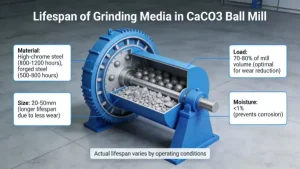
Media filling rate: Optimal for CaCO₃ is 30–45% (dry) / 40–50% (wet) — overfilling (>50%) increases media-media collisions (higher impact wear); underfilling (<30%) reduces grinding efficiency and causes uneven media wear.
-
Mill speed: Operate at 70–80% of critical speed (the standard for CaCO₃) — overspeeding (>80%) increases centrifugal force and media impact velocity (faster wear); underspeeding (<70%) causes inefficient grinding and media sliding (abrasive wear).
-
Feed size: CaCO₃ feed to the ball mill should be 0–10 mm (crushed limestone) — oversize feed (>10 mm) increases media impact force and wear (and causes ceramic media chipping).
-
Grinding aid dosage: Adding 0.1–0.5% grinding aid (triethanolamine/glycol) reduces CaCO₃ agglomeration and grinding resistance—lowers media wear by 10–20% (industrial verified for CaCO₃).
4. Ball Mill Lining Material & Media Size Distribution (Weight: 5–10%)
-
Lining material: Ceramic linings (alumina/ZTA) have a lower friction coefficient than steel linings—reducing media sliding and abrasive wear (media lifespan is ~10–15% longer with ceramic linings for CaCO₃).
-
Media size distribution: A graded media mix (small/medium/large balls, e.g., 10/20/30 mm) for CaCO₃ grinding optimizes grinding efficiency and reduces media wear—mono-size media causes uneven wear and inefficient grinding.
-
Lifter design: Ceramic/steel lifters with a 30–45° angle (standard for CaCO₃) lift media to the optimal impact height—poor lifter design causes media sliding (abrasive wear) or excessive impact (faster wear).
How to Extend Grinding Media Lifespan for CaCO₃ Ball Mills (30–100% Longer)
Based on the key wear factors, these are practical, industry-validated strategies to extend grinding media lifespan for CaCO₃ production—sorted by cost-effectiveness (highest to lowest). All strategies are tailored to CaCO₃ grinding and require minimal capital investment (except ceramic media upgrade).
1. Pre-Remove Silica (SiO₂) from CaCO₃ Feed (Most Cost-Effective)
-
Use washing/scratching + reverse flotation to reduce SiO₂ content to <0.5% (the gold standard for CaCO₃ grinding).
-
Eliminates the primary abrasive (SiO₂) — doubles/triples media lifespan (the single biggest impact on wear rate).
-
Secondary benefit: Improves CaCO₃ product purity and whiteness (no silica impurities).
2. Optimize Ball Mill Operating Parameters (Zero Capital Cost)
-
Fix media filling rate: Set to 30–45% (dry) / 40–50% (wet) for CaCO₃—avoid over/underfilling.
-
Control mill speed: Operate at 70–80% of critical speed (use variable frequency drive (VFD) for precise control).
-
Limit feed size: Crush limestone to 0–10 mm (add a vibrating screen to remove oversize particles >10 mm).
-
Add grinding aid: Dose 0.1–0.5% triethanolamine/glycol (continuous on-line addition) — reduces agglomeration and media wear by 10–20%.
-
Avoid dry run: Never run the ball mill without CaCO₃ feed (media collides directly with liners/media—causes catastrophic wear/chipping).
3. Upgrade to High-Wear-Resistance Media (High ROI)
-
For metallic media users: Replace low-carbon steel with 20–25% high-chromium steel balls (lifespan 3–5x longer, minimal upfront cost increase).
-
For high-silica CaCO₃ (SiO₂>3%): Replace steel media with SiC ceramic balls (lifespan 2–4 years vs. 1–3 months for steel—ROI in <6 months).
-
For high-purity CaCO₃: Upgrade to alumina/ZTA ceramic balls (lifespan 2–4 years, eliminates metal contamination, improves whiteness).
4. Match Media with Ceramic Linings & Optimize Liner Design
-
Pair ceramic media with alumina/ZTA ceramic linings (lower friction = less media wear, 10–15% longer lifespan).
-
Use graded media size mix (small/medium/large) for CaCO₃ grinding (optimizes efficiency and reduces uneven wear).
-
Replace worn lifters (steel/ceramic) — ensure lifter angle is 30–45° (standard for CaCO₃) to avoid media sliding.
5. Regular Media Maintenance & Screening (Zero Capital Cost)
-
Screen worn media monthly: Remove small/worn media balls (using a vibrating screen) and top up with new media—worn media causes inefficient grinding and accelerates wear of new media.
-
Maintain media size distribution: Keep the graded mix (e.g., 10/20/30 mm) — avoid mono-size media.
-
Inspect media for chipping/cracking: Remove chipped/cracked ceramic media immediately (they cause excessive wear of other media/liners).
When to Replace Grinding Media for CaCO₃ Ball Mills (Replacement Criteria)
Timely media replacement is critical to maintain grinding efficiency, CaCO₃ product quality (PSD/D50), and avoid excessive wear/metal contamination. Replace media when any of the following industry-validated criteria are met (for CaCO₃ grinding):
-
Wear loss: Metallic media loses 30–40% of its original weight / Ceramic media loses 20–30% of its original weight (worn media has reduced grinding efficiency).
-
Size reduction: Media diameter is 20–30% smaller than the original size (small media cannot grind CaCO₃ to target D50, causes PSD widening).
-
Grinding efficiency drop: Unit energy consumption (kWh/t CaCO₃) rises by >15% (worn media requires more energy to achieve the same product size).
-
Product quality deviation: CaCO₃ D50 deviates by >10% from the target, or PSD span (D90-D10)/D50 increases by >0.5 (worn media causes uneven grinding).
-
Contamination/whiteness loss: For metallic media, CaCO₃ Fe/Cr metal impurity exceeds 50 ppm (industrial grade) / 10 ppm (coating grade), or whiteness drops by >2 points (from steel wear particles).
-
Chipping/cracking: Ceramic media has >5% chipped/cracked balls (causes excessive wear of other media/liners and ceramic debris in CaCO₃ powder).
Final Summary: Grinding Media Lifespan for CaCO₃ Ball Mills
|
CaCO₃ Grade
|
Feed SiO₂ Content
|
Recommended Media Material
|
Typical Lifespan (24h Continuous)
|
Key Benefit
|
|
Industrial (Cement/Construction)
|
0.5–3%
|
High-chromium steel (20–25% Cr)
|
3–6 months
|
Low cost, easy replacement
|
|
High-Purity (Coating/Paper)
|
<0.5%
|
92% Alumina ceramic
|
2–3 years
|
Low metal contamination, high whiteness
|
|
Ultra-Fine (D50=2–10 μm)
|
<0.5%
|
ZTA ceramic
|
3–4 years
|
High wear resistance, anti-chipping
|
|
Ultra-High-Purity (Food/Pharma/Nano)
|
<0.5%
|
Zirconia ceramic (wet)
|
4–5+ years
|
Zero metal contamination, chemical inertness
|
|
High-Silica (SiO₂>3%)
|
>3%
|
SiC ceramic (dry)
|
2–4 years
|
Extreme wear resistance for abrasive feed
|
For CaCO₃ producers, the best lifespan optimization strategy is: pre-remove silica to <0.5% + use high-wear-resistance media (ceramic for high-purity, high-Cr steel for industrial) + optimize ball mill operating parameters. This combination extends media lifespan by 30–100%, reduces production costs, and improves CaCO₃ product quality.