Grinding GCC to 2500 mesh (D97≈4–6μm) requires a demand-driven selection of grinding technology—there is no single “one-size-fits-all” method, but two core solutions (single equipment grindingand combined process grinding) that dominate industrial production, with tradeoffs between product quality, production cost, scale, and investment. The fluidized bedopposedjet millis the gold standard for high-end 2500-mesh GCC(narrow distribution, high purity, intact morphology), while the ultrafine ring roller millis the most cost-effective choice for large-scale general-grade 2500-mesh GCC(low unit cost, high capacity). For enterprises balancing quality and cost, the ultrafine ring roller mill + jet mill combined processis the optimal industrial solution, merging the low-cost advantages of mechanical grinding with the high-precision benefits of airflow grinding.
Below is a detailed breakdown of the 3 optimal grinding methods, including their core principles, performance, applicable scenarios, and key operational parameters—this is the industry-recognized framework for 2500-mesh GCC production.
Fluidized Bed Opposed Jet Mill (Best for High-End 2500-Mesh GCC)
This is the premier single-equipment methodfor producing high-grade 2500-mesh GCC, leveraging fluidenergy interparticle collision(no mechanical contact) to achieve ultra-fine grinding. It is the first choice for GCC used in high-end coatings, BOPP/PE plastic films, coated paper, and food/pharmaceutical-grade applications, where strict requirements for particle size distribution, whiteness, purity, and morphology apply.
Core Grinding Principle
Compressed, dried air (moisture ≤0.01%) is accelerated to 300–500 m/s(supersonic)through ceramic nozzles, forming high-speed airflow jets that entrain GCC coarse powder (80–200 mesh) into the grinding chamber. GCC particles collide, impact, and rub against each other at the intersection of multiple airflow jets, breaking into ultrafine particles. A built-in high-precision air classifierseparates qualified 2500-mesh particles (D97≤5μm), which are collected by a cyclone and bag filter; coarse particles recirculate to the grinding chamber for regrinding.
Key Advantages for 2500-Mesh GCC
- Ultra-narrow particle size distribution: D90/D10≈2–3, no large particles (>8μm), D97 stably controlled at 4–5μm (meets the strictest downstream uniformity requirements).
- Unmatched purity and whiteness: No metal-to-metal contact (grinding chamber/nozzles made of ceramic/PTFE); high-speed airflow removes surface impurities from GCC raw material, increasing whiteness by 0.5–1.0%(vs. raw material) and eliminating iron/manganese contamination.
- Intact particlemorphology: Preserves the natural cubic/spindle shape of GCC with no amorphous particles or edge crushing; excellent dispersibility that requires no additional surface modificationfor direct use in polymer matrices.
- Stable operation: Low vibration (≤85dB), no heavy mechanical wear, and only ceramic nozzles as wearing parts (service life ≥12 months), reducing unplanned downtime.
Critical Operational Parameters (2500-Mesh GCC Calibration)
| Parameter | Optimal Value for 2500-Mesh GCC |
| Feed particle size | 80–200 mesh (dry GCC) |
| Raw material moisture | ≤0.5% (dry first if exceeding) |
| Compressed air pressure | 0.7–0.9 MPa |
| Classifier rotor speed | 2500–3500 r/min |
| Single machine capacity | 0.8–2.0 t/h (industrial model: Φ600–Φ1000) |
| Unit energy consumption | 180–250 kWh/t (includes air compression/classification) |
Applicable Scenarios
- High-end 2500-mesh GCC production (selling price ≥2000 CNY/ton) with annual capacity ≤5000 tons.
- GCC for water-based industrial coatings, high-gloss powder coatings, BOPP/PE films, food/pharmaceutical additives (strict purity/morphology requirements).
- Raw GCC with high silica content (3–5%) or whiteness ≥95% (avoids mechanical wear contamination).
Ultrafine Ring Roller Mill (Most Cost-Effective for Large-Scale 2500-Mesh GCC)
This mechanical pressure grinding method(an upgraded Raymond mill) is the industrial workhorse for large-scale general-grade 2500-mesh GCCproduction. It uses extrusion/rolling between high-hardness rollers and grinding rings, paired with an external high-precision turbine classifier, to achieve 2500-mesh grinding at a unit cost 1/3 that of jet mills. It is the first choice for GCC used in rubber fillers, ordinary plastics, putty powder, and building coatings (basic particle size requirements, cost-sensitive).
Core Grinding Principle
GCC coarse powder (200–325 mesh) is fed into the grinding chamber; grinding rollers (high-chromium alloy/ceramic composite) are pressed against multi-layer grinding rings by centrifugal force and hydraulic pressure (0.3–0.5 MPa). The main shaft drives the rollers to roll at high speed, extruding/rolling GCC into fine powder(2500-mesh) between the roller/ring interface. Blower airflow lifts the fine powder to an external high-precision turbine classifier; qualified 2500-mesh particles are collected, and coarse particles fall back for regrinding. A magnetic separation system is added to remove trace iron debris from roller/ring wear.
Key Advantages for 2500-Mesh GCC
- High capacity & low unit cost: Single machine capacity 2.5–5.0 t/h (industrial model: YFM160–YFM210), unit energy consumption only 60–90 kWh/t—the lowest costfor large-scale 2500-mesh GCC production.
- Low investment & small footprint: Total initial investment is 1/3–1/2 that of a jet mill (no expensive air compression system); integrated design requires only 30–50 m² (vs. 80–120 m² for jet mills).
- Easy operation & raw material adaptability: Automatic feeding/hydraulic pressure control, operable by ordinary workers; adapts to GCC with moisture ≤1.0% and feed particle size 200–325 mesh (no strict pre-grinding requirements).
- Scalable production: Multiple units can be parallelized for annual capacity ≥10,000 tons (meets bulk downstream demand).
Critical Operational Parameters (2500-Mesh GCC Calibration)
| Parameter | Optimal Value for 2500-Mesh GCC |
| Feed particle size | 200–325 mesh (dry GCC) |
| Raw material moisture | ≤1.0% |
| Hydraulic pressure | 0.3–0.5 MPa |
| Classifier rotor speed | 2000–3000 r/min (turbine type) |
| Single machine capacity | 2.5–5.0 t/h |
| Unit energy consumption | 60–90 kWh/t (includes host/classifier) |
| Wearing part service life | Roller sleeve/grinding ring: 3–6 months (high-chromium alloy) |
Applicable Scenarios
- Large-scale general-grade 2500-mesh GCC production (selling price 800–1500 CNY/ton) with annual capacity ≥10,000 tons.
- GCC for rubber fillers (tires/sealing strips), ordinary PP/PE plastics, putty powder, building coatings (no strict distribution/morphology requirements).
- Enterprises with limited initial investment, small plant space, or ordinary operation teams (no professional airflow grinding expertise).
Key Optimization for 2500-Mesh GCC
To mitigate its only drawbacks (slightly wide distribution, trace metal contamination), implement two critical upgrades:
- Use ceramic composite roller sleeves/grinding rings(instead of pure high-chromium alloy) to reduce wear and iron contamination (whiteness loss ≤0.1% vs. raw material).
- Equip a two-stage high-precision classifierto narrow the particle size distribution (D90/D10≈3–4) and eliminate large particles (>8μm) without secondary screening.
Ultrafine Ring Roller Mill + Jet Mill Combined Process (Optimal for Balancing Quality & Cost)
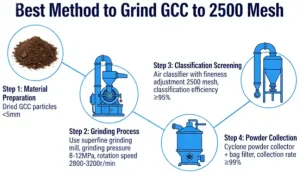
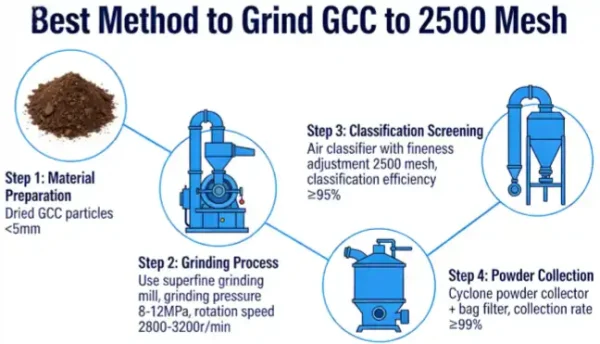
This hybrid grinding processis the most popular industrial solution for medium-to-large scale high-end 2500-mesh GCC production(annual capacity 5000–20,000 tons). It combines the low-cost, high-capacity primary grindingof the ultrafine ring roller mill with the high-precision secondary classification/fine grindingof the fluidized bed jet mill—reducing the unit cost of high-end 2500-mesh GCC by 30–40%vs. pure jet mill production, while meeting all high-end quality requirements (narrow distribution, high purity, intact morphology).
Core Process Flow
Step 1: Low-cost primary grinding with ultrafine ring roller millGrind GCC raw material (200–325 mesh) to 2500-mesh coarse ultrafine powder(D97≈5–6μm) at a capacity of 3–5 t/h and unit energy consumption of 70–80 kWh/t. This step accounts for 80% of the grinding work and minimizes cost.
Step 2: High-precision secondary finishing with jet millFeed the ring roller mill’s 2500-mesh coarse powder into a fluidized bed opposed jet mill for secondary classification and fine grinding: the jet mill removes large particles (>6μm), narrows the distribution (D90/D10≈2–3), and polishes particle surfaces to restore the cubic/spindle morphology. Qualified high-end 2500-mesh GCC (D97≤5μm) is collected, with no metal contamination.
Step 3: Integrated collection & purificationShare a cyclone/bag filter system for both mills; add a magnetic separator before the jet mill to remove any trace iron debris from the ring roller mill step (ensures high purity).
Key Advantages of the Combined Process
- Balanced quality & cost: Meets high-end 2500-mesh GCC requirements (narrow distribution, high whiteness, intact morphology) with a unit cost of ~90–120 kWh/t (30–40% lower than pure jet mill).
- High scalability: Annual capacity 5000–20,000 tons (parallelize ring roller mills for higher primary grinding capacity; match with a medium-sized jet mill for finishing).
- Flexible production: Switch between general-grade GCC(only ring roller mill) and high-end GCC(full combined process) based on market demand—maximizes equipment utilization.
Critical Operational Parameters
| Process Step | Key Parameter Value |
| Ring roller mill capacity | 3–5 t/h (2500-mesh coarse powder) |
| Jet mill finishing capacity | 2.5–4.0 t/h (2500-mesh high-end powder) |
| Combined unit energy consumption | 90–120 kWh/t |
| Final product D97 | ≤5μm, D90/D10≈2–3 |
| Whiteness retention | ≥95% (no loss vs. raw material) |
Applicable Scenarios
- Medium-to-large scale high-end 2500-mesh GCC production (annual capacity 5000–20,000 tons, selling price ≥1800 CNY/ton).
- Enterprises producing both high-end and general-grade 2500-mesh GCC(flexible process switching).
- Downstream applications such as modified plastics, mid-to-high-end water-based coatings (balance of quality and cost).
Key Selection Criteria for the Optimal Method
The choice of grinding method for 2500-mesh GCC boils down to 3 core factors: product grade/downstream requirements, production scale, and investment/cost budget. Use this simple decision tree for industrial application:
- If producing high-end 2500-mesh GCC(narrow distribution, high purity, food/pharmaceutical grade) with small scale (≤5000 tons/year) and no cost constraints → Fluidized bedopposed jet mill.
- If producing general-grade 2500-mesh GCC(basic particle size requirements) with large scale (≥10,000 tons/year) and cost sensitivity → Ultrafine ring roller mill (with ceramic composite wear parts + two-stage classifier).
- If producing high-end 2500-mesh GCCwith medium-to-large scale (5000–20,000 tons/year) and needing to balance quality and cost → Ultrafine ring roller mill + jet mill combined process(industry optimal).
Universal Industrial Best Practices for 2500-Mesh GCC Grinding
Regardless of the method chosen, these practices ensure stable, high-quality, and efficient productionof 2500-mesh GCC:
- Rawmaterial pre-treatment: Dry GCC to moisture ≤0.5% (jet mill) or ≤1.0% (ring roller mill) to avoid agglomeration and grinding inefficiency.
- Classifiercalibration: Use a high-precision turbine/air classifier(rotor speed adjustable 1000–3500 r/min) as the core of particle size control—this is the single most important component for 2500-mesh accuracy.
- Wear part material selection: For jet mills, use ceramic nozzles/PTFE grinding chambers; for ring roller mills, use ceramic composite roller sleeves/grinding rings(minimizes contamination and extends service life).
- On-line quality control: Equip with a laser particle size analyzerfor real-time D97/D90/D10 monitoring—adjust classifier speed/air pressure immediately if parameters deviate.
- Environmentalcompliance: Install a high-efficiency bag filter(filtration efficiency ≥99.9%) to meet dust emission standards (≤30mg/m³); add a noise reduction cover for ring roller mills (reduce noise to ≤85dB).
In summary, the fluidized bed opposed jet mill sets the quality standard for 2500-mesh GCC, the ultrafine ring roller mill is the cost leader for large-scale production, and their combined process is the industrial gold standard for balancing quality and cost—these three methods cover all 2500-mesh GCC production needs in the industry.