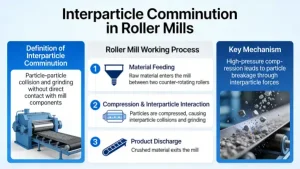
Interparticle comminution (also called particle bed breakage or layer compression comminution) is a highly energy-efficient size reduction process where particles break primarily due to forces exerted by other particles in a confined bed, rather than direct contact with machine surfaces. In roller mills, this occurs when material forms a dense bed between rotating rollers (or a roller and table) and is subjected to high compressive stress.
Definition of Interparticle Comminution
Interparticle comminution is a breakage mechanism where:
- A bed of particles (not individual particles) is stressed between two surfaces (rollers or roller/table)
- Forces are transmitted through particle-particle contacts, creating complex multi-directional stress fields within the bed
- Particles act as both load transmitters and “internal anvils” for neighboring particles
- Breakage happens when stress exceeds material fracture strength at particle contacts and internal flaws
This contrasts sharply with single-particle breakage (used in jaw crushers or hammer mills), where forces act directly on individual particles, causing more random fracture patterns and lower energy efficiency.
How Interparticle Comminution Works in Roller Mills
1. Core Process in All Roller Mills
- Material Bed Formation: Feed enters the gap between counter-rotating rollers (HPGR) or onto a rotating table (VRM), forming a dense layer (typically 80%+ of solid density)
- High Pressure Application: Hydraulic systems apply extreme pressure (50–300 MPa for HPGRs) to the bed, compacting particles together
- Stress Transmission: Loads distribute through particle-particle contacts, creating localized stress concentrations at contact points and within particle interiors
- Crack Initiation & Propagation: Tensile and shear stresses generate micro-cracks at mineral boundaries and internal flaws, weakening particles for easier subsequent breakage
- Product Formation: Material exits as a compacted “flake” or cake, which is then de-agglomerated to release individual particles with high micro-crack density
2. Specific Implementation in Different Roller Mill Types
| Mill Type | Configuration | Interparticle Mechanism Details |
|---|---|---|
| High-Pressure Grinding Rolls (HPGR/roller press) | Two opposing rolls, one fixed and one moveable, rotating at low speed | • Coarse particles are nipped first, then smaller particles form a bed beneath
• Stress gradients develop through the bed thickness • Micro-cracks form throughout particles, improving downstream grindability by 13–30% |
| Vertical Roller Mill (VRM) | Multiple rollers pressing on a rotating table | • Material spreads radially by centrifugal force
• Support rollers stabilize the bed; master rollers apply grinding force • Combined compression + shear stress enhances mineral liberation • Air flow carries fines to classifier, preventing overgrinding |
Key Mechanisms & Advantages
- Stress Distribution: Multiple contact points create hydrostatic-like stress states that more effectively utilize energy than single-point loading
- Micro-Crack Generation: The dense bed creates 3D stress fields that initiate cracks at grain boundaries, improving mineral liberation and reducing energy needed for subsequent processing
- Energy Efficiency: 20–50% less energy consumption than ball mills, as energy focuses on productive particle breakage rather than machine friction or random impacts
- Selective Breakage: Favors fracture along mineral interfaces rather than through grains, enhancing valuable mineral recovery
- Controlled Size Reduction: Narrower particle size distribution compared to impact-based methods
Critical Requirements for Effective Interparticle Comminution
- Bed Stability: Sufficient fines content to create a cohesive bed that transmits stress 均匀 ly
- Optimal Pressure: High enough to exceed particle strength but not so high as to cause excessive agglomeration
- Particle Size Distribution: Feed with particles smaller than the gap width to ensure proper bed formation
- Surface Design: Roll surfaces may have studs or grooves to improve traction and stress distribution
In summary, interparticle comminution in roller mills represents a paradigm shift from traditional single-particle breakage, leveraging particle-particle interactions to achieve more efficient, selective, and energy-saving size reduction with significant benefits for mineral processing and material production industries.