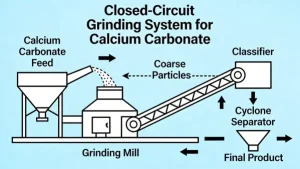
The closed-circuit grinding system is the mainstream industrial grinding process for ground calcium carbonate (GCC), a continuous, cyclic production system that couples a grinding unit with a high-precision classification unit. The core principle is to separate the powder ground by the mill in real time: qualified fine powder is collected as the finished product, and unqualified coarse powder is returned to the grinding unit for regrinding, forming a closed loop of “grinding → classification → regrinding”.
This system is tailored to the physical properties of calcite (brittle, easy to over-grind) and the industrial requirements of GCC (controllable particle size, narrow distribution, high brightness, low energy consumption), and is far superior to the open-circuit grinding system (no classification, direct discharge of all ground powder) for CaCO₃ production. It is widely used for grinding GCC of all fineness grades (from coarse powder D97=45μm to ultra-fine powder D97<2μm, including near-nano GCC D97=100–500nm).
Core Composition of CaCO₃ Closed-Circuit Grinding System
The system is a modular integration of grinding unit, classification unit, powder collection/conveying unit, and auxiliary control unit, with all key components selected for CaCO₃’s unique requirements (anti-iron contamination, highwhitenessretention, low agglomeration). The following is the industrial standard configuration (sorted by process flow):
| System Unit | Core Equipment for CaCO₃ Production | Key Selection Requirements for CaCO₃ |
| Grinding Unit | Raymond mill (ceramic liner), vertical mill (ultra-fine), jet mill/airflow mill (ultra-fine/near-nano) | Replace carbon steel with ceramic (alumina/zirconia), nylon 66 or UHMWPE for all contact parts; avoid iron chip mixing (the main cause of GCC yellowing) |
| Classification Unit | High-precision turbine air classifier (mainstream), cyclone classifier (auxiliary) | Ceramic impeller/liner; classification efficiency >95%; precise adjustment of fineness (D97/D50) for CaCO₃ |
| Powder Collection/Conveying | Cyclone collector (primary collection), bag filter (secondary fine collection), roots blower (pneumatic conveying) | 304/316 stainless steel or UHMWPE pipelines; airtight design to prevent dust leakage and secondary contamination |
| Auxiliary Control Unit | Frequency converter (speed regulation), temperature/humidity sensor, whiteness on-line detector, PLC control system | Real-time monitoring of grinding temperature (avoid organic carbonization in ore) and product fineness/whiteness; automatic adjustment of process parameters |
| Supporting Unit | Hot air dryer, dust removal system, raw material hopper | Dry raw ore to moisture <0.5% (avoid agglomeration during grinding); workshop dust concentration <10mg/m³ |
Working Principle of CaCO₃ Closed-Circuit Grinding (Step-by-Step)
The process is a continuous cyclic operation, with the classification unit as the “corecontrol valve“ for product fineness—all steps are optimized to avoid over-grinding and iron contamination (the two key factors affecting GCC quality). Taking the most commonly used Raymond mill + turbine airclassifier system (for medium-fine GCC D97=2–20μm) as an example:
RawMaterial Pretreatment: High-whiteness calcite ore (dried to moisture <0.5%, pre-removed of magnetic impurities) is fed into the grinding mill at a constant speed via a quantitative feeder.
PrimaryGrinding: The ore is crushed and ground into mixed powder (coarse + fine) by the mill’s grinding rollers/ring (ceramic material) under mechanical force.
Gas-Solid Conveying: High-pressure hot air (100–120℃, dry, dust-free) is introduced into the mill, and the mixed powder is lifted to the classification unit by the air flow (pneumatic conveying).
PrecisionClassification: The turbine air classifier rotates at a set speed (adjustable by frequency converter):
Qualified fine powder: Particles with particle size ≤ target fineness (e.g., D97=5μm) pass through the classifier’s impeller gap with the air flow, entering the powder collection unit.
Unqualified coarse powder: Larger particles are blocked by the impeller, lose kinetic energy, and fall back to the grinding chamber of the mill under gravity for regrinding.
Powder Collection & Finished Product: The air flow carrying fine powder first passes through a cyclone collector (collects 80–90% of qualified powder, primary collection), and the remaining fine powder is captured by a bagfilter (secondary fine collection, 100% collection efficiency). The finished GCC powder is discharged from the collector and conveyed to the storage silo via pneumatic conveying.
Cyclic Operation: The coarse powder returned to the mill is mixed with newly fed raw ore for continuous grinding, forming an uninterrupted closed loop—no unqualified powder is discharged throughout the process.
For ultra-fine/near-nano GCC (D97=0.5–500nm), the system is upgraded to jet mill + high-precision airclassifier: the jet mill uses high-speed airflow to realize non-contact grinding (no mechanical wear), and the classifier adopts a multi-stage turbo structure to ensure narrow particle size distribution of the near-nano product.
Key Process Parameters for CaCO₃ Closed-Circuit Grinding
The parameters are strictly adjusted according to the targetfinenessand grade of GCC (general/medium/high-grade), and the core is to control the circulatingload rate and classificationefficiency—the two most critical indicators for the system. All parameters are optimized to avoid over-grinding (causes GCC graying/agglomeration) and energy waste.
CirculatingLoad Rate: The mass ratio of returned coarse powder to finished fine powder, 200–400%forCaCO₃ (the most economical range). Too low (<200%): insufficient grinding, low fineness; too high (>400%): excessive mill load, high energy consumption, easy over-grinding.
Classification Efficiency: ≥95% for industrial CaCO₃ production. Low efficiency leads to mixed coarse/fine powder, wide product particle size distribution, and unqualified fineness.
Grinding Temperature: Controlled at 80–120℃. Excess temperature (>150℃) causes carbonization of trace organic matter in calcite (forms black spots) and Fe²+ oxidation (forms Fe₂O₃, yellowing); too low temperature leads to high moisture and powder agglomeration.
Air Flow Rate: Matched with mill capacity and classification fineness—too high causes coarse powder to escape, too low leads to insufficient powder lifting and low production efficiency.
ClassifierRotating Speed: Positive correlation with product fineness (for turbine classifier). Higher speed = finer finished powder (e.g., speed from 1000r/min to 2000r/min, product D97 from 10μm to 2μm).
Core Advantages of Closed-Circuit Grinding for CaCO₃ (vs. Open-Circuit Grinding)
Open-circuit grinding (mill direct discharge) has fatal defects for CaCO₃ production: serious over-grinding, wide particle size distribution, low brightness, and high energy consumption. The closed-circuit system solves these problems and is the only choice for industrial high-quality GCC production. Its advantages are highly targeted to CaCO₃’s quality requirements (brightness, fineness, dispersibility):
| Advantage | Specific Benefits for CaCO₃ Production |
| Narrow particle size distribution | Eliminates over-grinding and coarse powder mixing; the product has a uniform particle size (narrow D90/D10 ratio), which improves the dispersibility of GCC in coatings/plastics/papermaking |
| High grinding efficiency & low energy consumption | Only coarse powder is reground; no useless grinding of qualified fine powder—energy consumption reduced by 30–50% compared with open-circuit grinding (critical for industrial cost control) |
| Stable product quality | Real-time classification and on-line detection realize constant fineness/whiteness; the finished GCC has no quality fluctuation (meets the strict requirements of high-end industries such as high-grade coatings) |
| High brightness retention | Avoids over-grinding-induced calcite lattice defects (causes graying) and excessive heat (causes organic carbonization/iron oxidation); GCC whiteness can be increased by 2–3 CIE L* units compared with open-circuit grinding |
| Adjustable fineness & strong flexibility | Adjust the classifier speed/frequency to quickly switch product fineness (e.g., from D97=20μm to D97=2μm) without changing mill equipment—suitable for multi-specification GCC production |
| High production capacity | Continuous cyclic operation, no downtime for screening/removing coarse powder; mill capacity increased by 40–60% compared with open-circuit grinding |
| Low equipment wear | No over-grinding reduces the friction between grinding media/liners; the service life of ceramic parts is extended by 2–3 times, and the risk of iron chip mixing is further reduced |
Common Industrial Configurations of CaCO₃ Closed-Circuit Grinding System
The system configuration is customized according to the targetfinenessand application of GCC (coarse/medium-fine/ultra-fine/near-nano). The following are the four most widely used configurations in the industry, covering all GCC product grades:
| GCC Fineness Grade | Target Particle Size (D97) | Typical System Configuration | Main Application |
| Coarse powder | 20–45μm | Raymond mill (ceramic liner) + single-stage turbine classifier | Rubber filling, building materials, putty powder |
| Medium-fine powder | 5–20μm | Vertical mill + double-stage turbine classifier | General coatings, papermaking filling, plastic filling |
| Ultra-fine powder | 2–5μm | Jet mill (airflow mill) + high-precision turbo classifier | High-grade coatings, papermaking coating, ink |
| Near-nano powder | 0.1–2μm (100–2000nm) | Fluidized bed jet mill + multi-stage precision classifier | Nano-coatings, high-end papermaking, electronic packaging materials |
Note: For *high-brightness GCC (CIE L≥95)**, all configurations must use 100% non-ferrous contact parts (ceramic/nylon/UHMWPE) and add a high-gradient magnetic separation unit before the classifier to remove trace magnetic impurities in the powder in real time.
Key Industrial Notes for CaCO₃ Closed-Circuit Grinding System
To ensure the system runs efficiently and the GCC product has high brightness/stable fineness, the following points must be strictly abided by (combined with CaCO₃’s production characteristics of anti-contamination andwhitenessretention):
Airtightness of the whole system: Realize full closed-loop airtight operation to avoid dust, smoke, and iron filings in the workshop from mixing into the powder (causes secondary contamination and whiteness reduction).
Rawmaterial pretreatment: The calcite ore must be dried to moisture <0.5% and pre-removed of magnetic impurities/clay (clay causes agglomeration, magnetic impurities cause yellowing).
Anti-iron contamination design: All contact parts (grinding rollers, classifier impeller, pipelines, hoppers) are made of non-ferrous materials; regular cleaning (every 24–48h) to remove scale/iron filings in the system.
Dust removal system matching: The bag filter must use high-temperature resistant, anti-sticking filter bags (avoid powder agglomeration on the filter surface); the dust removal efficiency is ≥99.9% (meets environmental standards and avoids powder loss).
On-line quality monitoring: Install CIE Lab* whiteness meter and laser particle size analyzer at the finished product outlet; detect whiteness/fineness in real time (≥1 time/hour) and adjust process parameters automatically.
Avoid over-classification: Excessively high classifier speed will cause partial fine powder to be returned for regrinding (over-grinding); the speed must be calibrated according to the actual mill capacity and target fineness.
The closed-circuit grinding system is the core equipment for industrial GCC production, which perfectly solves the defects of open-circuit grinding (over-grinding, low efficiency, poor quality) and is tailored to the physical properties and quality requirements of calcium carbonate. Its core value lies in real-timeclassification, cyclic grinding, and precise control—it not only improves the production efficiency and reduces the energy consumption of CaCO₃ grinding, but also ensures the product has narrow particle size distribution, high brightness, and stable quality, which is the prerequisite for GCC to meet the application requirements of high-end industries such as coatings, papermaking, and plastics.
For the production of near-nano GCC (100–500nm), the fluidized bedjet mill + multi-stageprecisionclassifier closed-circuit system is the optimal choice (non-contact grinding, no iron contamination, high classification precision), which is the industrial physical grinding limit of CaCO₃.