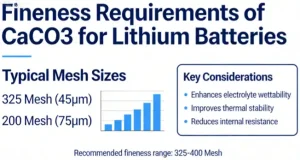
The required fineness of CaCO₃ for lithium batteries depends on its specific application in the battery structure, with distinct particle size ranges optimized for each function. Below is a breakdown of typical specifications:
1. Separator Coating (Main Application)
CaCO₃ is widely used as a cost-effective alternative to Al₂O₃ in separator coatings, enhancing thermal stability, mechanical strength, and ion conductivity.
| Parameter | Standard Specification | Purpose |
|---|---|---|
| D50 (median particle size) | 1–3 μm | Ensures uniform coating thickness (typically 1–3 μm) and prevents short circuits |
| D97 (97th percentile) | ≤5 μm | Eliminates large particles that could puncture the separator or cause uneven coating |
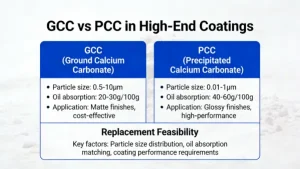
| Type | Ground Calcium Carbonate (GCC) | Cost-effective, high purity (≥98%), low impurity content (Fe, Mg ≤0.1%) |
| Surface Treatment | Required (silane coupling agents) | Improves adhesion to polyolefin separators and electrolyte compatibility |
2. Nano-CaCO₃ for Advanced Applications
Nano-sized CaCO₃ (1–100 nm) is used for specialized functions requiring high surface area and unique electrochemical properties.
| Application | Particle Size | Key Benefits |
|---|---|---|
| Lithium Metal Battery Electrolyte Additive | 20–100 nm | Sustained-release effect, inhibits lithium dendrite growth, improves cycle life (from <400h to >800h at 1 mA cm⁻²) |
| Anion Anchoring Coatings | 30–90 nm | Adsorbs TFSI⁻ anions, reduces ion concentration polarization, promotes Li⁺ diffusion |
| All-in-One Separator Composites | <50 nm | Increases Li⁺ transference number, reduces concentration overpotential, flattens Li deposits |
3. Other Applications
Pore-Forming Template: Micron-sized CaCO₃ (5–20 μm) decomposes at >700°C to create porous structures in anode materials, enhancing capacity and rate performance.
Solid-State Battery Fillers: Nano-CaCO₃ (10–50 nm) improves ion conductivity (up to 1.2×10⁻³ S/cm) and mechanical stability in composite electrolytes.
Key Selection Criteria
Purity: CaCO₃ content ≥98%, with strict limits on transition metal impurities (Fe, Cu, Ni ≤0.01%) to avoid electrochemical side reactions.
Particle Shape: Cubic or rhombohedral morphology preferred for better packing density and uniform coating.
Dispersibility: Critical for nano-CaCO₃ to prevent agglomeration that reduces performance.
| Application | Fineness Range | Most Common Specification |
|---|---|---|
| Separator Coating | Micron-scale | D50=1–3 μm, D97≤5 μm (GCC) |
| Advanced Functional Coatings | Nano-scale | 20–100 nm (precipitated CaCO₃) |
| Pore-Forming Template | Larger Micron | 5–20 μm |
The optimal choice balances performance requirements with cost constraints: micron-sized GCC (1–3 μm D50) is standard for separators, while nano-CaCO₃ is reserved for high-performance applications requiring dendrite suppression or enhanced ion transport.