
CaCO3
JACAN

what fineness of CaCO₃ is needed for PVC pipe

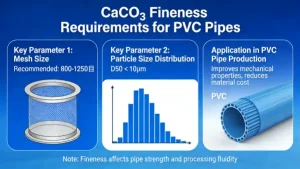
Core Recommended Fineness for PVC Pipe CaCO₃ The most widely used and cost-effective fineness of calcium carbonate (CaCO₃) for PVC pipe manufacturing is800 to 1250 mesh(corresponding to a median particle size d₅₀ of 5~15 μm) for both Ground Calcium Carbonate (GCC, heavy CaCO₃) and Precipitated Calcium Carbonate (PCC, light CaCO₃). This range balances the mechanical performance, processing fluidity, surface finish of the final pipe, and production cost, making it the industry standard for most PVC pipe applications. Fineness Selection by PVC Pipe Type The optimal fineness varies based on the pipe’s application, pressure rating, and performance requirements: Non-pressure PVC pipes (drainage, sewer, DWV, electrical conduit) Basic cost-sensitive formulations: 600~800 mesh (d₅₀≈10~20 μm) GCC, the most economical option for low-demand non-pressure…

Core Recommended Fineness for PVC Pipe CaCO₃

The most widely used and cost-effective fineness of calcium carbonate (CaCO₃) for PVC pipe manufacturing is800 to 1250 mesh(corresponding to a median particle size d₅₀ of 5~15 μm) for both Ground Calcium Carbonate (GCC, heavy CaCO₃) and Precipitated Calcium Carbonate (PCC, light CaCO₃). This range balances the mechanical performance, processing fluidity, surface finish of the final pipe, and production cost, making it the industry standard for most PVC pipe applications.

Fineness Selection by PVC Pipe Type

The optimal fineness varies based on the pipe’s application, pressure rating, and performance requirements:

  1. Non-pressure PVC pipes (drainage, sewer, DWV, electrical conduit)
    1. Basic cost-sensitive formulations: 600~800 mesh (d₅₀≈10~20 μm) GCC, the most economical option for low-demand non-pressure pipes.
    2. Standard grade: 800~1000 mesh GCC, the mainstream choice to ensure sufficient stiffness, smooth surface, and stable extrusion processing.
  2. Pressure-bearing PVC pipes (potable water, pressure-rated UPVC pipes)
    1. Mandatory minimum: 1250 mesh (d₅₀≤10 μm, preferably 5~8 μm) activated CaCO₃, to meet the strict impact resistance, tensile strength, and long-term hydrostatic stability requirements of standards like ASTM D1784 and EN ISO 1452.
    2. High-performance grade: 1500~2000 mesh (d₅₀≤5 μm) PCC or ultra-fine GCC, for premium pressure pipes requiring enhanced mechanical properties and aging resistance.
  3. CorrugatedPVCpipes & foam core pipes
    1. Standard: 1000~1250 mesh ultra-fine GCC, to balance stiffness, extrusion flowability, and dimensional stability.
    2. Foam core layer: 1250~2000 mesh surface-activated CaCO₃, to improve cell uniformity and compensate for the stiffness loss from foaming, complying with ASTM F891.

Critical Additional Considerations

  1. Particle Size Distribution (PSD) matters more than single mesh value

A narrow particle size distribution is critical for uniform dispersion in PVC resin, improved packing density, and consistent pipe performance. Avoid CaCO₃ with excessive large particles (>45 μm, i.e., high 325-mesh sieve residue), which can cause surface defects and stress concentration in the pipe.

  1. Surface modification is essential for most applications

Stearic acid-coated (activated) CaCO₃ is strongly recommended for PVC pipes, as it improves compatibility with PVC resin, reduces oil absorption value, minimizes agglomeration, and enhances both processing performance and mechanical properties of the final product.

  1. Fineness limits for ultra-fine grades

Excessively fine CaCO₃ (especially PCC with d₅₀ < 2 μm) can lead to poor melt flow, increased processing difficulty, and even pipe defects, so it is not recommended as the main filler, only used in small amounts (5~10 phr) for impact modification.
About Us:
With over 20 years of dedicated expertise in ultrafine grinding technology, we deliver high-performance machinery that matches the precision and reliability of leading German and Japanese brands—at only 1/3 of their cost.

Beyond Equipment, We Deliver Total Confidence:
We provide Free Material Testing to ensure precise equipment selection, followed by professional on-site installation and comprehensive training. Our 24/7 technical support team ensures your production line remains efficient and worry-free.

Schedule Material Trial & Get a Customized Solution from Us
how to measure oil absorption of ground calcium carbonate
The oil absorption value (OAV) of GCC is a critical performance indicator that quantifies the...
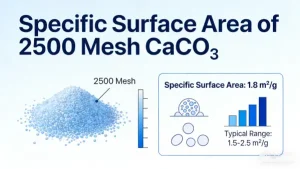
what is the specific surface area of 2500 mesh CaCO₃
The specific surface area (SSA, measured by BET nitrogen adsorption method) of 2500 mesh CaCO₃...
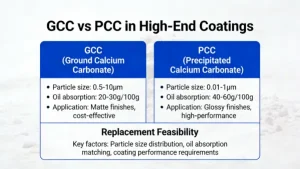
can GCC replace PCC in high-end coatings
GCC (Ground Calcium Carbonate)cannot achieve 100% full replacement of PCC (Precipitated Calcium Carbonate) in the...