Core Recommended Fineness for PVC Pipe CaCO₃
Fineness Selection by PVC Pipe Type
The optimal fineness varies based on the pipe’s application, pressure rating, and performance requirements:
-
Non-pressure PVC pipes (drainage, sewer, DWV, electrical conduit)
- Basic cost-sensitive formulations: 600~800 mesh (d₅₀≈10~20 μm) GCC, the most economical option for low-demand non-pressure pipes.
- Standard grade: 800~1000 mesh GCC, the mainstream choice to ensure sufficient stiffness, smooth surface, and stable extrusion processing.
-
Pressure-bearing PVC pipes (potable water, pressure-rated UPVC pipes)
- Mandatory minimum: 1250 mesh (d₅₀≤10 μm, preferably 5~8 μm) activated CaCO₃, to meet the strict impact resistance, tensile strength, and long-term hydrostatic stability requirements of standards like ASTM D1784 and EN ISO 1452.
- High-performance grade: 1500~2000 mesh (d₅₀≤5 μm) PCC or ultra-fine GCC, for premium pressure pipes requiring enhanced mechanical properties and aging resistance.
-
CorrugatedPVCpipes & foam core pipes
- Standard: 1000~1250 mesh ultra-fine GCC, to balance stiffness, extrusion flowability, and dimensional stability.
- Foam core layer: 1250~2000 mesh surface-activated CaCO₃, to improve cell uniformity and compensate for the stiffness loss from foaming, complying with ASTM F891.
Critical Additional Considerations
-
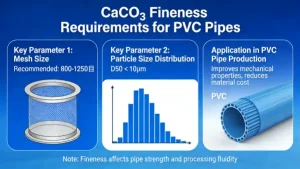
Particle Size Distribution (PSD) matters more than single mesh value
A narrow particle size distribution is critical for uniform dispersion in PVC resin, improved packing density, and consistent pipe performance. Avoid CaCO₃ with excessive large particles (>45 μm, i.e., high 325-mesh sieve residue), which can cause surface defects and stress concentration in the pipe.
-
Surface modification is essential for most applications
Stearic acid-coated (activated) CaCO₃ is strongly recommended for PVC pipes, as it improves compatibility with PVC resin, reduces oil absorption value, minimizes agglomeration, and enhances both processing performance and mechanical properties of the final product.
-
Fineness limits for ultra-fine grades
Excessively fine CaCO₃ (especially PCC with d₅₀ < 2 μm) can lead to poor melt flow, increased processing difficulty, and even pipe defects, so it is not recommended as the main filler, only used in small amounts (5~10 phr) for impact modification.