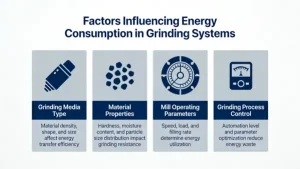
Energy consumption in grinding systems (e.g., ball mills, vertical roller mills, Raymond mills, vibration grinders) is influenced by multiple interconnected factors. Based on technical literature and industrial practice, key influences include:
🔷 1. Material Properties
Hardness & Mineral Composition: Harder materials (e.g., quartz vs. limestone) or minerals with poor grindability (e.g., high C₂S/C₄AF in clinker) significantly increase energy demand.
Moisture Content: >5% moisture often requires integrated drying (adding 15–30% energy); optimal feed moisture is typically 1–1.5% to avoid coating or blockage.
Feed Size & Distribution: Larger feed size drastically raises energy use. Reducing feed from 25 mm to 2 mm can boost mill output by ~66%, lowering specific energy by 25–30% (“more crushing, less grinding” principle).
Temperature: Feed >60°C causes electrostatic adhesion, coating, gypsum dehydration (in cement), and efficiency loss. Output drops 8–10% when feed exceeds 80°C.
Grindability: Affected by crystal structure (e.g., coarse calcite >1000 µm is harder to grind than microcrystalline forms) and cooling history (quenched clinker is more brittle).
🔷 2. Equipment Design & Condition
Mill Type & Configuration:
Single ball mill: ~42 kWh/t
Roller press + ball mill (combined): ~31 kWh/t
Roller press + ball mill (semi-finish): ~25 kWh/t
VRM + ball mill: ~29 kWh/t (Source: Cement industry surveys)
Wear Components: Worn liners, rollers, rings, or grinding media reduce efficiency; severe wear can increase energy use by 20–30%.
Classifier/Separator Efficiency: Poor classification returns合格 fines to mill, causing overgrinding. Efficient separators (dynamic/static combos) are critical.
Ventilation System: Accounts for 30–50% of total energy in some systems. Blockages, fan blade fouling, or improper airflow (ideal: 1.0–1.2 m/s in closed-circuit mills) raise能耗.
Transmission Efficiency: Upgrading to permanent magnet direct drives or optimizing bearings/lubrication reduces parasitic losses.
🔷 3. Operational Parameters
Product Fineness: Finer targets exponentially increase energy (e.g., d₉₇ <10 µm vs. 45 µm).
Grinding Media Grading: Incorrect ball/roller size distribution causes inefficient impact or overgrinding of fines.
Feed Rate & Stability: Overfeeding causes choking; underfeeding leads to idle grinding. Consistent, optimized feed maximizes throughput.
Airflow & Classifier Speed: Mismatched settings cause regrinding or coarse discharge.
Grinding Aids: Properly dosed additives (e.g., stearates, polyacrylates) can reduce energy by 5–10% by minimizing agglomeration and coating.
Circuit Type: Closed-circuit systems with efficient classification prevent overgrinding and save 15–25% energy vs. open-circuit.
🔷 4. System Integration & Auxiliary Factors
Pre-Grinding Stage: Accounts for >80% of system efficiency impact. HT pre-grinders or roller presses reducing feed to <2 mm can lower Bond Work Index by 10–25%.
Drying Integration: For moist feeds, using waste heat (e.g., kiln exhaust) for in-mill drying avoids standalone dryer energy penalty.
Heat Management: High internal temperatures (>120°C) trigger electrostatic effects and material degradation; cooling strategies are essential.
Automation & Optimization: Real-time sensors (current, vibration, PSD) coupled with AI-driven control (e.g., neural networks) dynamically adjust parameters for minimal kWh/ton.
🔷 5.Maintenance& Management
Preventive Maintenance: Cleaning, lubrication, and timely part replacement maintain design efficiency.
Operator Training: Skilled adjustments to feed, airflow, and classifier settings prevent energy waste.
Energy Monitoring: Tracking kWh/ton with clear system boundaries (e.g., “grind-only” vs. “crush-to-finish”) enables targeted improvements.
Workload Practices: Avoiding idling, optimizing batch sizes, and matching media to material reduce unnecessary consumption.
💡 Practical Insight
A holistic approach yields the greatest savings:
✅ Reduce feed size via pre-crushing
✅ Maintain optimal moisture (1–1.5%) and temperature (<60°C)
✅ Use wear-resistant components and monitor wear
✅ Implement closed-circuit grinding with high-efficiency classification
✅ Apply grinding aids where applicable
✅ Deploy smart controls for real-time optimization
These measures collectively address the root causes of energy waste—overgrinding, poor classification, thermal issues, and mechanical inefficiencies—leading to 20–40% reductions in specific energy consumption across industries like cement, mining, and GCC production.