Based on the chemical properties of calcium carbonate, calcium carbonate hardly undergoes observable hydrolysis in a pure aqueous solution system; only under specific “non-simple aqueous phases” or “auxiliary conditions” can the trace ions dissociated from it show an extremely weak tendency to hydrolyze, which can only be detected with special means. The specific scenarios and principles are as follows:
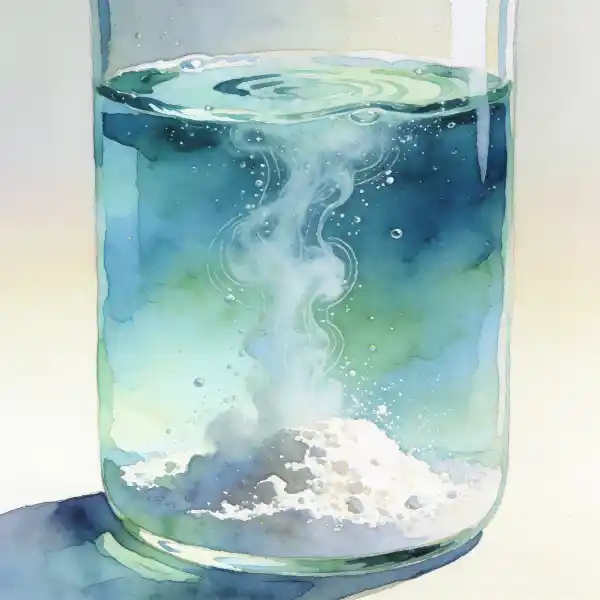
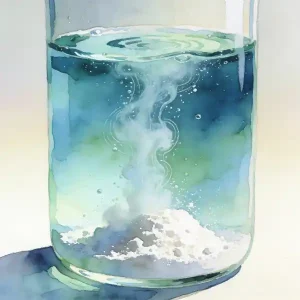
1. Ultrapure water/deionized water system (theoretical weak hydrolysis, no practical significance) Calcium carbonate has extremely low solubility in water (about 0.0013g/100mL at 20℃) and can only dissociate trace amounts of Ca²⁺ and CO₃²⁻. Theoretically, the dissociated CO₃²⁻ (a weak acid radical ion corresponding to the weak acid H₂CO₃) can undergo two steps of weak hydrolysis:
CO₃²⁻ + H₂O ⇌ HCO₃⁻ + OH⁻ HCO₃⁻ + H₂O ⇌ H₂CO₃ + OH⁻
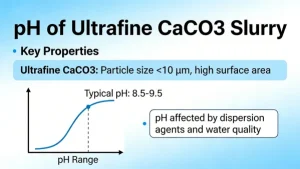
However, due to the extremely low concentration of CO₃²⁻ (determined by the low solubility product Ksp of calcium carbonate, approximately 3.3×10⁻⁹), the amount of OH⁻ produced by hydrolysis is negligible, and the pH of the solution hardly changes (close to neutral). No hydrolysis phenomenon can be observed macroscopically, and it has no practical application value.
2. Mixed aqueous solution coexisting with other electrolytes (hydrolysis tendency slightly enhanced, but still extremely weak) If there are a large amount of strong electrolytes (such as NaCl, KNO₃, etc.) in the aqueous solution, the “salt effect” will occur—that is, the ions dissociated from the strong electrolytes will reduce the activity of Ca²⁺ and CO₃²⁻, prompting the dissolution equilibrium of calcium carbonate (CaCO₃(s) ⇌ Ca²⁺(aq) + CO₃²⁻(aq)) to shift slightly to the right, and the concentration of CO₃²⁻ in the solution will increase slightly.
At this time, the hydrolysis degree of CO₃²⁻ will be slightly stronger than that in pure water. Even so, the H₂CO₃ (or decomposed CO₂) and OH⁻ produced by hydrolysis are still at the trace level, which cannot be detected by conventional experiments (such as pH test paper, bubble observation), and still does not belong to “obvious hydrolysis”.
3. High-temperature and high-pressure aqueous solution system (significantly improved hydrolysis degree, related to industrial scenarios) Under high-temperature (e.g., above 100℃) and high-pressure (e.g., in a closed high-pressure reaction kettle) conditions, the degree of water ionization will increase (ion product Kw increases), and the solubility of calcium carbonate will increase significantly (solubility product Ksp increases with the increase of temperature), resulting in a significant increase in the concentration of CO₃²⁻ in the solution.
At this time, the interaction between CO₃²⁻ and water molecules is enhanced, and the degree of hydrolysis reaction (CO₃²⁻ + H₂O ⇌ HCO₃⁻ + OH⁻) will be significantly improved. It can be detected that the pH of the solution increases significantly (alkalinity enhances), and even a small amount of CO₂ gas (produced by the decomposition of H₂CO₃) is generated. This scenario is common in geological processes (such as the interaction between underground hot water and carbonate rocks) or some high-temperature and high-pressure industrial reactions. However, it should be noted that the main body of hydrolysis at this time is the “dissociated CO₃²⁻”, not the calcium carbonate solid itself.
Key Supplements:
– If calcium carbonate is put into an acidic solution, H⁺ will combine with CO₃²⁻ to form H₂CO₃ (which then decomposes into CO₂ and H₂O), prompting the dissolution of calcium carbonate. This is a “double decomposition reaction between acid and salt”, not a hydrolysis reaction (the core of hydrolysis is the proton transfer between ions and water molecules, which does not involve the direct participation of external H⁺).
– The “hydrolysis” of calcium carbonate is essentially the hydrolysis of CO₃²⁻ dissociated from it, rather than the direct reaction of CaCO₃ solid with water. Therefore, all possible hydrolysis scenarios must be premised on “calcium carbonate dissolving and dissociating CO₃²⁻”, which can only be achieved under the above special conditions.