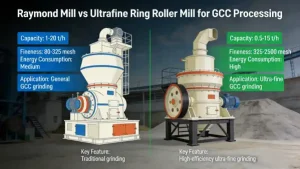
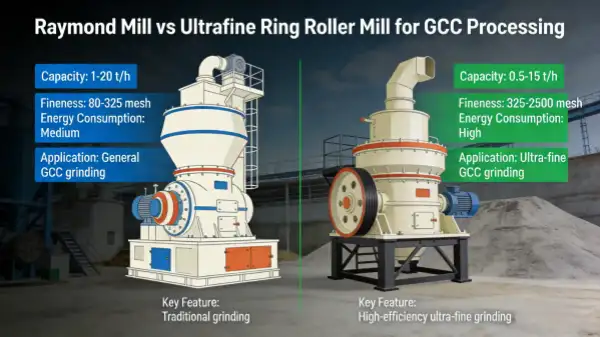
Both Raymond mill and ultrafine ring roller mill are mainstream mechanical powder grinding equipment for GCC physical processing (dry grinding), with core principles of roller-ring extrusion and grinding, but they are optimized for different grinding fineness, production capacity and application scenarios of GCC. The former is a classic equipment for medium-coarse GCC powder production, and the latter is a specialized equipment for high-end ultrafine GCC powder production.
This comparison focuses on practical production indicators (fineness, capacity, energy consumption, product quality) and economic indicators (investment, operation, maintenance) that are critical for GCC manufacturers, with conclusions applicable to industrial-grade GCC production for coatings, plastics, papermaking, rubber and other downstream fields.
Core Performance Comparison Table
|
Comparison Dimension
|
Raymond Mill (Standard/Modified Type)
|
Ultrafine Ring Roller Mill (Specialized for GCC)
|
|
GCC Grinding Fineness Range
|
80–600 mesh (D97: 20–5 μm); modified models up to 800 mesh
|
600–2500 mesh (D97: 5–0.5 μm); customizable to 3000 mesh for high-end demand
|
|
GCC Production Capacity
|
Large (5–50 t/h, based on 325 mesh GCC); high output for medium-coarse powder
|
Medium to small (0.5–8 t/h, based on 1250 mesh GCC); focus on ultra-fine powder yield
|
|
Unit Energy Consumption
|
Low (≤35 kWh/t for 325 mesh GCC); energy-efficient for medium-coarse grinding
|
Slightly higher (80–200 kWh/t for 1250 mesh GCC); grinding ultra-fine powder has higher energy consumption
|
|
GCC Product Quality
|
Particle size distribution is relatively wide; partial coarse particles exist; good whiteness retention
|
Narrow particle size distribution (D50/D97 ratio is small); no coarse particles; excellent whiteness retention (no over-grinding discoloration)
|
|
Applicable GCC Application
|
Conventional downstream: building materials fillers, low-end coatings, rubber reinforcing agents, papermaking filler (coarse pulp)
|
High-end downstream: high-grade water-based coatings, plastic masterbatches, ink pigments, food-grade fillers, cosmetic raw materials
|
|
Initial Equipment Investment
|
Low (30%–50% lower than ultrafine ring roller mill of the same specification)
|
High (specialized ultra-fine grinding structure + high-precision classifier)
|
|
Operation & Maintenance Difficulty
|
Mature technology, simple structure, easy maintenance; low requirement for operators; common易损件 (rollers, rings, blades)
|
Precision structure (especially the ultra-fine classifier), slightly higher maintenance requirement; specialized spare parts
|
|
Wear Part Consumption
|
Low (slow wear for medium-coarse grinding); low replacement cost
|
Moderate (faster wear for ultra-fine grinding); high-precision wear parts with slightly higher cost
|
|
Floor Space Requirement
|
Small (integrated structure, no additional large classifier)
|
Slightly larger (matching high-efficiency ultra-fine air classifier + dust collection system)
|
|
GCC Raw Material Adaptability
|
Adapt to various GCC ores (calcite, marble, limestone); allow small particle size fluctuation of raw materials
|
Require uniform raw material particle size (≤20 mm); suitable for high-purity GCC ore (whiteness ≥93)
|
Key Detailed Differences Analysis
1. Grinding Fineness & Product Granularity (Core for GCC Grading)
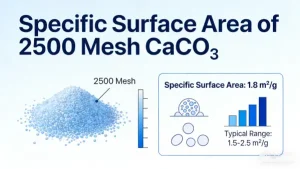
GCC’s market value is directly tied to grinding fineness: the higher the fineness, the higher the added value (e.g., 2500 mesh GCC is 3–5 times the price of 325 mesh GCC).
-
Raymond Mill: The traditional model is limited by the centrifugal classifier, and the fineness is mostly within 400 mesh; the modified model (with upgraded classifier) can reach 600–800 mesh, but the ultra-fine powder yield is low (≤30%), and there are coarse particle residues, which is not suitable for high-end GCC production that requires strict particle size control.
-
Ultrafine Ring Roller Mill: Equipped with a multi-stage high-precision air classifier (the core difference from Raymond mill), which can separate ultra-fine powder with D97 ≤1 μm, and the ultra-fine powder yield is ≥80%. The product has a narrow particle size distribution, which can meet the downstream demand for “narrow distribution GCC” (e.g., plastic masterbatches require uniform particle size to avoid affecting processing fluidity).
2. Production Efficiency & Energy Consumption
Energy consumption accounts for 30%–40% of GCC production costs, and the matching of fineness and energy consumption is the key to profitability:
-
Raymond Mill: It has an absolute advantage in the medium-coarse GCC segment (80–325 mesh): large output and low unit energy consumption. For example, the unit energy consumption of 325 mesh GCC is only 25–35 kWh/t, which is the most cost-effective equipment for mass production of conventional GCC.
-
Ultrafine Ring Roller Mill: Energy consumption increases with the increase of fineness (the energy consumption of 2500 mesh GCC is about 5 times that of 325 mesh GCC), but it has a higher ultra-fine powder yield than other ultra-fine grinding equipment (e.g., jet mill), and the comprehensive energy consumption is lower than jet mill (jet mill unit energy consumption ≥300 kWh/t for 1250 mesh GCC). It is the most cost-effective dry grinding equipment for ultra-fine GCC at present.
3. Product Quality & Downstream Adaptability
GCC’s key quality indicators (whiteness, particle shape, no coarse particles) are critical for high-end downstream applications (e.g., high-grade coatings require GCC with high whiteness and no coarse particles to avoid paint film pinholes):
-
Raymond Mill: The grinding force is relatively large, and there is a small amount of over-grinding phenomenon, which may cause a slight drop in GCC whiteness (≤1%); the particle shape is mostly irregular, which is suitable for conventional fillers that do not have high requirements for particle shape.
-
Ultrafine Ring Roller Mill: Adopts low-speed, high-pressure gentle grinding; the roller-ring extrusion force is uniform, no over-grinding, and the GCC whiteness can be retained by ≥99%; the particle shape is mostly sub-spherical, which can improve the compatibility of GCC with polymers (e.g., plastics, rubber) and enhance the mechanical properties of products.
4. Equipment Investment & Operation Cost
-
Initial Investment: Raymond mill is a mature conventional equipment with low R&D and manufacturing costs, and the investment of a complete production line is 30%–50% lower than that of an ultrafine ring roller mill of the same specification. The ultrafine ring roller mill’s high investment is mainly concentrated in the high-precision classifier and intelligent control system (to ensure stable fineness).
-
Subsequent Operation Cost:
-
Raymond mill: low wear part consumption, simple maintenance, low labor cost, suitable for small and medium-sized manufacturers with limited funds and conventional GCC production.
-
Ultrafine ring roller mill: the wear speed of rollers and rings is slightly faster (ultra-fine grinding has higher friction), and the classifier needs regular calibration, but the high added value of ultra-fine GCC can offset the higher operation cost, which is suitable for large manufacturers with high-end market positioning.
-
Selection Suggestions for GCC Manufacturers
The choice between the two equipment is determined by your GCC product positioning, downstream customer demand and production scale, and the core principle is “matching fineness with equipment” to avoid over-investment or insufficient product capacity:
Choose Raymond Mill if:
-
Your main product is 80–600 mesh medium-coarse GCC;
-
Downstream customers are concentrated in building materials, low-end coatings, rubber and other conventional fields;
-
The production scale is large (≥10 t/h), and the priority is low investment and high cost performance;
-
The raw material is ordinary GCC ore (whiteness ≤90, particle size fluctuation is large).
Choose Ultrafine Ring Roller Mill if:
-
Your main product is 600–2500 mesh ultra-fine GCC, or you plan to enter the high-end GCC market;
-
Downstream customers are concentrated in high-grade coatings, plastic masterbatches, ink, food/cosmetic and other high-value fields;
-
The production scale is medium and small (≤8 t/h), and the priority is product quality and ultra-fine powder yield;
-
The raw material is high-purity GCC ore (whiteness ≥93, uniform particle size).
Mixed Production Suggestion
If you need to produce both medium-coarse and ultra-fine GCC, it is recommended to build a multi-stage grinding line: use Raymond mill for primary grinding (to 325 mesh), and then use ultrafine ring roller mill for secondary ultra-fine grinding (to 600–2500 mesh). This can reduce the energy consumption of ultra-fine grinding and improve the overall production efficiency.
|
Equipment
|
Core Advantage
|
Core Limitation
|
Suitable Manufacturer
|
|
Raymond Mill
|
Low investment, low energy consumption, large medium-coarse powder output
|
Low ultra-fine powder yield, wide particle size distribution
|
Conventional GCC manufacturers with large scale and low-end market positioning
|
|
Ultrafine Ring Roller Mill
|
High ultra-fine powder yield, narrow particle size distribution, high product quality
|
High initial investment, slightly higher energy consumption
|
High-end GCC manufacturers with medium-small scale and high-value market positioning
|
In general, Raymond mill is the “basic equipment” for GCC industrial production, and ultrafine ring roller mill is the “upgraded equipment” for high-end GCC production. The choice depends on your market positioning and profit model: for the conventional market, Raymond mill is more cost-effective; for the high-end market, ultrafine ring roller mill is the only choice to ensure product competitiveness.