When grinding calcium carbonate (GCC/PCC), the choice between a jet mill and a ring roller mill (a high-efficiency upgrade of Raymond mills, including vertical ring roller mills and pendulum ring roller mills) hinges on core production requirements: product fineness, production capacity, purity needs, application grade (industrial/food-grade), energy consumption, and capital/operational costs.
CaCO₃ is a soft mineral (Mohs hardness 2.75) with low abrasiveness—both mills are well-suited for its dry grinding, but their design principles, performance characteristics, and optimal application scenarios differ drastically. Ring roller mills dominate large-scale production of medium-to-ultrafine industrial-grade GCC (the mainstream CaCO₃ market), while jet mills are the go-to for small-to-medium batch production of ultra-fine/high-purity CaCO₃ (high-value, niche applications like food/pharma/electronics).
Below is a comprehensive, CaCO₃-specific comparison of the two mills, including core parameters, pros/cons, key performance for CaCO₃ grinding, and a clear selection guide tailored to different CaCO₃ production needs (industrial/food-grade, medium/ultra-fine, low/high purity).
Core Parameter Comparison (CaCO₃ Grinding Focused)
All data is based on industrial dry grinding of GCC (ground calcium carbonate) (the primary application for both mills; wet grinding for PCC/nano-CaCO₃ uses bead mills, not these two). Metrics are normalized for CaCO₃ grinding conditions (feed size ≤5 mm, dry basis moisture <0.5%).
|
Metric
|
Jet Mill (Fluid Energy Mill)
|
Ring Roller Mill (Vertical/Pendulum Type)
|
|
Grinding Principle
|
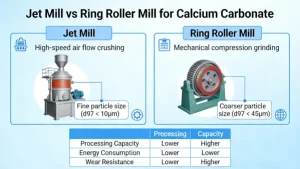
Supersonic high-pressure air (0.6–1.2 MPa) accelerates CaCO₃ particles to collide with each other/ceramic liners (no mechanical contact); classification is integrated.
|
Mechanical extrusion/crushing: Ring rollers roll against a grinding ring to crush CaCO₃; external air classifier for fineness control.
|
|
Optimal CaCO₃ Fineness
|
Ultra-fine to super-micron: D97 = 0.5–10 μm (D50 <1 μm achievable for nano-GCC); narrow particle size distribution (PSD, span ratio <2).
|
Medium to fine/ultra-fine: D97 = 10–100 μm (D50 2–20 μm for paper/coating grade); wider PSD (span ratio 2–3) (upgradable to narrow PSD with high-precision classifier).
|
|
Production Capacity (GCC)
|
Small-to-medium batch: 50–2,000 kg/h (scales with mill size; capacity drops sharply for D97 <5 μm).
|
Large-scale continuous: 1,000–20,000 kg/h (scales with mill size; far higher throughput for equivalent fineness).
|
|
Unit Energy Consumption (kWh/ton GCC)
|
Very high: 300–800 kWh/ton (driven by high-pressure air compressor; energy use doubles for D97 <5 μm).
|
Low-to-medium: 30–80 kWh/ton (mechanical grinding is far more energy-efficient; 80–90% lower than jet mill for same fineness).
|
|
Purity Control Capability
|
Excellent (food/pharma-grade ready)<br>- Ceramic (Al₂O₃/ZrO₂) liners/media (no metal wear particulates).<br>- Fully closed system (no dust/foreign matter ingress).<br>- HEPA-filtered air (no contamination).
|
Good (industrial-grade only)<br>- Metal (alloy steel/316L SS) rollers/ring (risk of metal wear particulates—cannot eliminate for food-grade).<br>- Closed system but with more mechanical contact points.<br>- 316L SS upgrade possible but wear still limits food-grade use.
|
|
Key CaCO₃ Application Grades
|
Food, pharma, nutraceutical, electronic grade (high-purity ultra-fine GCC); premium coating/plastic grade (narrow PSD).
|
Industrial grade (mainstream): Paper, coating, plastic, rubber, construction; low-to-medium purity ultra-fine GCC.
|
|
Noise Level (1m, unattenuated)
|
High: 85–110 dB(A) (aerodynamic noise from supersonic airflow; air compressor adds 85–105 dB(A)).
|
Moderate: 75–90 dB(A) (mechanical/vibration noise; no supersonic airflow—easier to mitigate).
|
|
Capital Cost (Same Capacity)
|
2–3x higher than ring roller mill (high-precision ceramic components, high-pressure air system, integrated classifier).
|
Low (cost-effective): Simple mechanical design; fewer high-precision parts; mature industrial supply chain.
|
|
Operational & Maintenance Cost
|
Very high:<br>- Air compressor energy (60–70% of OPEX).<br>- Ceramic nozzle/liner wear (frequent replacement).<br>- HEPA filter and air system maintenance.
|
Low:<br>- Minimal energy cost (mechanical grinding).<br>- Metal roller/ring wear is slow (CaCO₃ is soft; 6–12 month replacement cycle).<br>- Simple maintenance (fewer components).
|
|
Automation Compatibility
|
High (small-batch precision control): PLC/SCADA for pressure/airflow/PSD; closed-loop PSD control via integrated classifier.
|
Very high (large-scale continuous): PLC/SCADA for feed rate/grinding pressure/classifier speed; mature closed-loop control for mass production.
|
|
Floor Space & Installation
|
Compact (integrated classifier/grinding chamber) but requires additional space for high-pressure air compressors/dryers.
|
Larger (separate mill + classifier + dust collection) but no extra air system space; modular installation for large capacity.
|
Critical Note for CaCO₃
Both mills are dry grinding only (for GCC); wet grinding for PCC/nano-CaCO₃ uses bead mills/ball mills, not jet or ring roller mills. For CaCO₃, jet mills are not used for large-scale production due to energy/cost constraints—ring roller mills are the workhorse of the industrial GCC market (80% of global GCC production uses ring roller/vertical mills).
Key Advantages & Disadvantages for CaCO₃ Grinding
Jet Mill: Strengths & Limitations for CaCO₃
Jet mills are optimized for high-purity, ultra-fine CaCO₃—their unique design eliminates the single biggest purity risk in grinding (metal wear) and achieves fineness unattainable with ring roller mills, but this comes at a steep energy/cost price (unviable for large industrial batches).
Core Advantages (CaCO₃-Specific)
-
Ultra-fine grinding capability: The only dry mill that can produce GCC with D97 <5 μm (even D50 <1 μm) for high-end applications (e.g., nano-GCC for plastic film, food-grade GCC for nutraceuticals).
-
Superior purity: 100% metal-free grinding (ceramic liners/nozzles) + fully closed HEPA-filtered system = meets ISO 3262-5 Grade A (food-grade) and pharmaceutical purity standards (no heavy metal/metal particulate contamination).
-
Narrow PSD: Integrated high-precision classifier produces CaCO₃ with a narrow particle size distribution (span ratio <2), which improves performance in premium coatings/plastics (uniform dispersion, better gloss/hardness).
-
Gentle grinding: No mechanical extrusion/crushing—avoids CaCO₃ particle surface damage (critical for high-end applications where particle morphology matters).
-
Compact design: Integrated grinding/classification reduces floor space (ideal for small-scale high-value CaCO₃ production).
Core Limitations (CaCO₃-Specific)
-
Prohibitive energy cost: The single biggest downside—80–90% higher unit energy consumption than ring roller mills (air compression is energy-intensive). For large-scale industrial CaCO₃ production, this makes jet mills economically unfeasible.
-
Low production capacity: Even large jet mills max out at 2,000 kg/h for GCC (D97 5–10 μm)—a fraction of a ring roller mill’s throughput (10,000+ kg/h).
-
High maintenance/operational cost: Ceramic nozzles/liners wear over time (even with soft CaCO₃) and require frequent replacement; high-pressure air compressors need regular servicing (filters, oil changes).
-
High noise: Aerodynamic noise from supersonic airflow is hard to mitigate—comprehensive noise reduction (enclosures, silencers) is mandatory (adds cost).
-
Capacity drop for finer fineness: Production capacity halves when grinding from D97 10 μm to D97 5 μm (not scalable for ultra-fine CaCO₃ mass production).
Ring Roller Mill: Strengths & Limitations for CaCO₃
Ring roller mills are the de facto standard for industrial GCC production—they balance high capacity, low energy/cost, and reliable performance for medium-to-ultra-fine CaCO₃ (D97 10–100 μm), the largest segment of the CaCO₃ market. Their only major limitation is fineness/purity (unable to reach jet mill levels).
Core Advantages (CaCO₃-Specific)
-
High large-scale capacity: The biggest strength—supports continuous mass production (1,000–20,000 kg/h) for industrial-grade GCC, matching the demand of paper/coating/plastic manufacturers.
-
Ultra-low energy cost: Mechanical extrusion/crushing is far more energy-efficient than fluid energy grinding—30–80 kWh/ton for GCC (D97 10–50 μm), which is the lowest energy cost of any dry CaCO₃ mill.
-
Cost-effective (capital + OPEX): Mature industrial design with a low upfront cost (2–3x lower than jet mills); minimal maintenance (slow roller/ring wear for soft CaCO₃; 6–12 month replacement cycle) and low operational costs (no high-pressure air system).
-
Scalable fineness: Upgradable to D97 10 μm ultra-fine GCC with a high-precision air classifier (meets most industrial grade requirements for paper/coating).
-
Easy automation & operation: Mature PLC/SCADA integration for closed-loop PSD control (D50/D97); simple operation (fewer parameters to adjust than jet mills) — ideal for 24/7 continuous production.
-
Low noise: Mechanical/vibration noise is moderate (75–90 dB(A)) and easy to mitigate with basic enclosures/dampers (no costly supersonic airflow silencers).
Core Limitations (CaCO₃-Specific)
-
Fineness ceiling: Cannot grind GCC finer than D97 ~10 μm (mechanical grinding has a physical fineness limit); PSD is wider than jet mills (span ratio 2–3) — unsuitable for ultra-fine/high-end CaCO₃ applications.
-
Metal wear contamination risk: Metal rollers/ring (even alloy steel/316L SS) produce small metal particulates over time—cannot meet food/pharma-grade purity standards (ISO 3262-5 Grade A requires no detectable metal particulates).
-
Wider PSD: The integrated/classic air classifier produces a wider particle size distribution than jet mills—acceptable for industrial applications but not for premium coatings/plastics requiring narrow PSD.
-
Particle morphology damage: Mechanical extrusion/crushing can damage CaCO₃ particle surfaces (create irregular shapes) — minor for industrial applications but a downside for high-end uses where morphology matters.
-
Larger floor space: Separate mill, classifier, and dust collection system require more floor space than compact jet mills (not an issue for large CaCO₃ plants).
Hybrid Grinding Solution: Ring Roller Mill + Jet Mill (For Ultra-Fine CaCO₃)
For manufacturers needing large-scale production of ultra-fine GCC (D97 <10 μm) (a growing high-end market), a two-stage hybrid grinding line is the optimal solution—combines the low cost/high capacity of a ring roller mill with the ultra-fine precision of a jet mill, and is far more cost-effective than a standalone jet mill line.
Hybrid Process for Ultra-Fine GCC (D97 5–10 μm)
-
First stage (coarse grinding): Ring roller mill grinds raw limestone to D97 20–30 μm GCC (high capacity, low energy cost—10,000+ kg/h).
-
Second stage (ultra-fine grinding): Jet mill re-grinds the pre-ground GCC to D97 5–10 μm (smaller jet mill required, as feed size is already fine—cuts energy/capacity loss by 40–50%).
Key Benefits for CaCO₃
-
50% lower total energy cost than a standalone jet mill line (pre-grinding with a ring roller mill reduces jet mill workload).
-
Higher total capacity (10x that of a standalone jet mill) for ultra-fine GCC.
-
Preserves jet mill purity/PSD: The jet mill only re-grinds pre-fine GCC, so it maintains metal-free grinding and narrow PSD for the final ultra-fine product.
This hybrid solution is now the industry standard for large-scale ultra-fine GCC production (D97 5–10 μm) for premium coatings/plastics.
Definitive Selection Guide: Jet Mill vs Ring Roller Mill for CaCO₃
Choose the mill strictly based on your CaCO₃ product specs, production scale, and application grade—there is no “one-size-fits-all” solution, but the decision tree below eliminates ambiguity for 99% of CaCO₃ grinding applications:
Choose a RING ROLLER MILL if:
✅ You produce industrial-grade GCC (paper, coating, plastic, rubber, construction) — the mainstream market.
✅ Your target fineness is D97 10–100 μm (D50 2–20 μm) — meets 80% of industrial CaCO₃ demand.
✅ You need large-scale continuous production (1,000+ kg/h) with low energy/cost.
✅ Purity requirements are industrial-grade (no food/pharma/nano specs).
✅ You prioritize low capital/operational/maintenance costs (long-term profitability for mass production).
Choose a JET MILL if:
✅ You produce high-purity CaCO₃ (food, pharma, nutraceutical, electronic grade) — ISO 3262-5 Grade A.
✅ Your target fineness is D97 <10 μm (ultra-fine/super-micron GCC, D50 <1 μm nano-GCC).
✅ You need narrow particle size distribution (span ratio <2) for premium coatings/plastics/electronics.
✅ You operate small-to-medium batch production (50–2,000 kg/h) — high-value, low-volume CaCO₃.
✅ Purity is the top priority (no metal wear particulates/foreign matter contamination).
Choose the HYBRID (Ring Roller + Jet Mill) if:
✅ You need large-scale production of ultra-fine GCC (D97 5–10 μm) (premium industrial grade).
✅ You want to balance ultra-fine fineness with low energy/cost (50% lower OPEX than standalone jet mill).
✅ You target the high-end industrial CaCO₃ market (premium coatings/plastics) — growing demand.
Final Summary for CaCO₃ Producers
|
Scenario
|
Best Mill
|
Core Reason
|
|
Mass production of industrial-grade GCC (D97 10–100 μm)
|
Ring Roller Mill
|
Low cost, high capacity, ultra-low energy use — industrial workhorse.
|
|
Small-batch food/pharma/electronic grade GCC (D97 <10 μm)
|
Jet Mill
|
Metal-free purity, ultra-fine fineness, narrow PSD — meets high-end specs.
|
|
Large-scale ultra-fine industrial GCC (D97 5–10 μm)
|
Hybrid (Ring Roller + Jet Mill)
|
Balances high capacity/low cost (ring roller) with ultra-fine precision (jet mill).
|
For CaCO₃ producers, the ring roller mill is the foundation of industrial production (unmatched cost/capacity), while the jet mill is a niche tool for high-value, high-purity ultra-fine CaCO₃—the hybrid solution bridges the gap for large-scale ultra-fine GCC production and is the fastest-growing configuration in the CaCO₃ grinding industry.