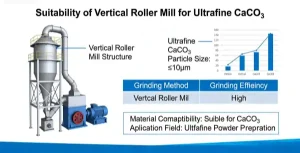
Vertical Roller Mill (VRM) is highly suitable for ultrafine ground calcium carbonate (GCC) production, and it has become one of the mainstream core grinding equipment in the modern CaCO₃ industry, especially for the large-scale production of ultrafine GCC with a fineness of D97=1–10 μm (the core fineness range of ultrafine CaCO₃ for coatings, plastics, papermaking, and rubber).
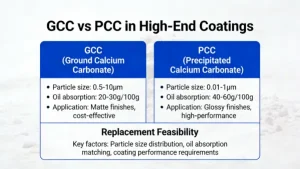
It should be noted that vertical roller mills are mainly used for the ultrafine grinding of heavy calcium carbonate (GCC) (processed from calcite, marble, limestone raw ore). Light calcium carbonate (PCC) is synthesized by chemical methods and does not involve mechanical grinding, so VRM is not applicable to PCC production.
Key Reasons for VRM’s Adaptability to Ultrafine CaCO₃ Grinding
-
Precise fineness control
VRM is equipped with a high-efficiency built-in classifier (cage classifier/eddy current classifier) with adjustable rotational speed and air volume. It can accurately screen ultrafine powder in real time during the grinding process, and the product fineness can be flexibly adjusted from D97=10 μm to 1 μm without secondary grinding, meeting the diversified ultrafine fineness requirements of the CaCO₃ industry.
-
High grinding efficiency & low energy consumption
VRM adopts the grinding principle of “pressing, rolling and shearing” between the grinding roller and grinding disc, which fully utilizes the pressure energy and kinetic energy of the equipment. Compared with the traditional ball mill (the traditional equipment for CaCO₃ grinding), its energy consumption for ultrafine grinding is 30%–50% lower (the unit power consumption of ultrafine GCC grinding is about 40–80 kWh/t). For large-scale production, the energy saving effect is extremely significant.
-
Integrated drying & grinding (suitable for raw material diversity)
Most CaCO₃ raw ores (limestone/calcite) contain a small amount of free water (3%–8%). VRM can realize one-step drying and grinding by introducing hot air into the mill cavity (hot air temperature 100–300℃). It does not require additional raw material drying equipment, which simplifies the production process and is suitable for the grinding of wet CaCO₃ raw ores, a common scenario in the industry.
-
Stable product quality & uniform particle size distribution
The grinding process of VRM is continuous and closed, and the powder is less affected by mechanical impact and over-grinding. The produced ultrafine CaCO₃ has a narrow particle size distribution (no obvious coarse particle tailing), regular particle shape (mostly irregular polygonal), and high whiteness retention (the whiteness loss of raw ore is less than 1%), which meets the high-quality requirements of ultrafine CaCO₃ for downstream application fields (e.g., high-gloss coatings require narrow particle size distribution to avoid coating precipitation).
-
Large production capacity & suitable for industrial scale-up
VRM has a series of models (from small-scale laboratory models to large-scale industrial models with annual output of 100,000–500,000 tons). It can meet the small-batch trial production and large-scale mass production of ultrafine CaCO₃, which is consistent with the industrial development trend of the CaCO₃ industry (large-scale, intensive production).
Technical Optimization Points of VRM for Ultrafine CaCO₃ Grinding (Critical for Stable Production)
To further improve the grinding efficiency and product quality of ultrafine CaCO₃, the VRM needs to be targeted optimized for the characteristics of CaCO₃ (low hardness, Mohs hardness 2.7–3, brittle):
-
Wear-resistant component material selection: Use high-hardness, low-wear ceramic lining (alumina ceramic/zirconia ceramic) or high-chromium alloy for the grinding roller, grinding disc and classifier impeller to avoid metal wear debris mixing into the CaCO₃ powder (ensuring the product’s low iron content, a key index of high-grade ultrafine CaCO₃).
-
Addition of grinding aids: Add a small amount of CaCO₃ special grinding aids (e.g., triethanolamine, polycarboxylate, fatty acid ester, dosage 0.05%–0.2% of raw ore mass) to the mill cavity to reduce the agglomeration of ultrafine CaCO₃ powder (ultrafine powder is easy to agglomerate due to surface tension) and improve the grinding efficiency by 15%–30%.
-
Air flow system optimization: Configure a high-pressure centrifugal fan and closed cyclone collector to ensure the smooth flow of hot air/powder in the mill cavity, avoid powder accumulation, and improve the collection rate of ultrafine powder (the powder collection rate can reach more than 99%).
-
Grinding pressure adjustment: For the ultrafine grinding of CaCO₃ (low hardness), the grinding pressure of the roller is reasonably reduced (generally 8–15 MPa) to avoid over-grinding and excessive energy consumption, while ensuring the grinding effect of raw ore particles.
VRM vs. Other Ultrafine Grinding Equipment for CaCO₃ (Advantages & Application Scenarios)
The CaCO₃ industry also uses air jet mills for ultrafine grinding (can reach D97<1 μm, even nano-level), but VRM is more widely used for ultrafine CaCO₃ production due to its cost and capacity advantages. The comparison is as follows:
|
Equipment
|
Fineness Range
|
Production Capacity
|
Unit Energy Consumption
|
Production Cost
|
Main Application Scenario
|
|
Vertical Roller Mill
|
D97=1–10 μm
|
Large (10–100 t/h)
|
40–80 kWh/t
|
Low
|
Large-scale production of industrial ultrafine GCC (coatings, plastics, papermaking)
|
|
Air Jet Mill
|
D97=0.5–5 μm (nano-level optional)
|
Small (0.5–5 t/h)
|
200–500 kWh/t
|
High
|
Small-batch production of high-end ultrafine/nano GCC (lithium battery separator, high-end cosmetics)
|
|
Ball Mill
|
D97=5–20 μm (ultrafine grinding with low efficiency)
|
Medium (5–30 t/h)
|
80–150 kWh/t
|
Medium
|
Traditional small/medium-scale CaCO₃ production (being phased out)
|
Notes for VRM Application in Ultrafine CaCO₃ Production
-
Raw ore pretreatment: The CaCO₃ raw ore needs to be crushed to a particle size of ≤20 mm before entering the VRM, and iron impurities (e.g., iron nails, iron ore in raw ore) need to be removed by a magnetic separator to avoid damaging the wear-resistant components of the mill and affecting the product’s iron content.
-
Wear-resistant component maintenance: Although the wear rate of VRM for CaCO₃ grinding is low (CaCO₃ has low hardness), the grinding roller and grinding disc still need regular inspection and maintenance (replacement cycle 1–3 years for industrial large-scale equipment) to ensure grinding efficiency.
-
Closed production environment: Ultrafine CaCO₃ powder has strong fluidity and is easy to fly. The VRM production line needs to be fully closed, and a dust removal system (bag dust remover) is configured to meet environmental protection requirements and avoid powder loss.
Vertical roller mill is the optimal choice for the large-scale, low-cost and high-quality production of ultrafine GCC (1–10 μm) in the CaCO₃ industry, and it is the core equipment for the technological upgrading of the traditional CaCO₃ grinding industry (replacing ball mills). For the production of ultra-nano CaCO₃ (D97<1 μm) with small batch and high added value, it can be used in combination with an air jet mill (VRM for primary ultrafine grinding + air jet mill for secondary nano grinding) to balance production capacity and fineness requirements.