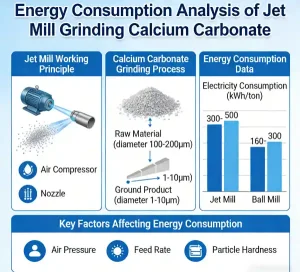
Yes, jet milling of calcium carbonate generally has relatively high energy consumption, which is inherent to the technology. However, the actual energy usage also depends significantly on factors such as mill type, process parameters, and required product fineness.
Main Reasons for High Energy Consumption in Jet Mills
Low EnergyConversion Efficiency Jet mills use compressed air or superheated steam to accelerate particles, causing them to collide and fracture. However, overall energy efficiency is typically below 20%, with most energy lost in gas acceleration and system resistance.
Ultrafine Grinding Demands Increase Energy Use If calcium carbonate needs to be ground to ultrafine sizes—such as D50 = 2–5 μm or D97 ≤ 10 μm (common in high-end applications like plastics, coatings, or lithium battery separator coatings)—higher gas velocities and tighter classification are required, significantly increasing energy consumption.
Differences Among Mill Types
Flat jet mill: Suitable for calcium carbonate with narrow particle size distribution, but high energy consumption.
Loop jet mill (e.g.,fluidized bedjet mill): Good for brittle materials like calcium carbonate, offering uniform particle size, but large footprint and high air consumption.
Steam kinetic mill (newer type): Uses superheated steam as the working fluid, improving energy efficiencyby ~30% and reducing operating costs by ~20%—a promising energy-saving development in recent years.
Energy Consumption Comparison with Other Grinding Technologies
| Mill Type | Achievable Fineness (D97) | Energy Consumption | Notes |
| Raymond Mill / Pendulum Mill | 10–75 μm | Low | High throughput; suitable for standard ground calcium carbonate |
| Ultrafine Ring Roller Mill (e.g., HCH series) | 3–10 μm | Moderate | Energy use is about one-third that of jet mills |
| Ball Mill | Up to 6500 mesh (~2 μm) | High (with overgrinding) | High capacity but low efficiency |
| Jet Mill | 1–10 μm | High | High purity, no contamination—ideal for premium applications |
Example: An ultrafine ring roller mill producing calcium carbonate with D97 = 5 μm consumes only one-third the energy of a jet mill and can achieve outputs up to 11 t/h.
Recent Advances to Reduce Jet Mill Energy Consumption (as of 2025)
Superheated Steam Jet Mills: Suitable for heat-sensitive or high-purity materials, offering >20% energy savings.
Intelligent Control Systems: Real-time optimization of air pressure and classifier speed using LSTM neural networks+ particle swarm optimization, reducing energy use by ~15%.
Nozzle DesignOptimization: For instance, optimizing nozzle throat diameter (e.g., 11.2 mm vs. 12.0 mm) can improve grinding efficiency by ~10%.
Fully Sealed Negative-Pressure Systems with Pulse-Jet Dust Collectors: Minimize air leakage and improve overall system efficiency.
Conclusion
If your application requires high purity, controlledparticleshape, and excellent dispersibility (e.g., in electronics, pharmaceuticals, or high-performance plastics), jet milling remains the preferred choice, despite its higher energy cost.
For cost-effective, large-scale production, consider alternatives like ultrafine ring roller mills or advanced vertical roller mills.
Emerging technologies such as steam-based jet mills and AI-driven process control are steadily mitigating the traditional high-energy drawbacks of jet milling.
If you have specific targets—for example, a desired fineness (e.g., D97 = 5 μm) or production capacity (e.g., 5 t/h)—I can help you further compare equipment options and estimate energy consumption.