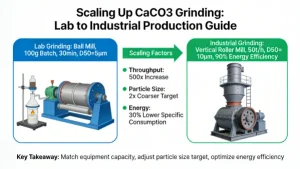
Scaling up lab-scale CaCO₃ grinding to industrial production is a systematic engineering process that corely follows the principle of matching lab product quality (particlesize, distribution, purity) while ensuring industrial continuity, efficiency, cost-effectiveness, and scalability. The lab is typically batch, small-volume, and manual, while industrial production is continuous, large-capacity, andautomated—the key challenge is to eliminate scale-up effects (e.g., uneven grinding, wider particle size distribution, higher energy consumption) caused by equipment size, process mode, and material flow changes.
This guide breaks down the scaling-up process into 6 core steps (from lab data sorting to industrial line commissioning), with critical industrial design principles, equipment matching, parameter conversion, and solutions to common scale-up problems—tailored for both dry and wet grinding of calcium carbonate (ground calcium carbonate, GCC), the two mainstream lab/industrial processes.
Key Precondition: Systematically Sort Lab-Scale Grinding Baseline Data
All industrial scale-up design is based on lab core parameters—*no reliable lab data = blind industrial design*. You must first quantify and document all lab grinding details, especially product quality targets and process variables. The mandatory baseline data is listed below (sorted by priority):
| Category | Key Lab Data to Record |
| Product Quality Targets (non-negotiable) | Final CaCO₃ particle size (D50/D90/D100), particle size distribution (PSD, span: (D90-D10)/D50. narrow/wide), whiteness, SiO₂ impurity content, bulk density; whether the product is for coatings/paper/plastics (determines industrial precision requirements). |
| Raw Material Properties | Limestone feed size in lab, CaCO₃ purity, silica content, moisture, hardness (Mohs), particle shape (affects grinding efficiency and industrial pre-treatment). |
| Grinding Process Type | Dry grinding (most common for industrial GCC, lab: planetary ball mill, jet mill) or wet grinding (for ultra-fine/nano CaCO₃, lab: bead mill, sand mill); solid content (wet) or gas flow (dry) in lab. |
| Lab Grinding Parameters | Equipment type (planetary/ball/jet/bead mill), grinding medium (type: steel/ceramic/alumina; size: mm; filling rate: %), rotation speed/air pressure, batch grinding time, feed rate (semi-batch lab), grinding aid type/dosage (critical for reducing industrial energy consumption). |
| Lab Performance Data | Unit energy consumption (kWh/t CaCO₃ in lab), product yield, lab-scale agglomeration degree (and dispersion methods), equipment wear (lab media/liner loss). |
Critical Note: Lab grinding often uses selected small-batch limestone (uniform purity/size), while industrial production uses bulk raw ore—raw materialconsistencymust be considered in scale-up (add industrial pre-treatment steps to homogenize raw ore).
Step 1: Select Industrial Grinding Equipment Matched to Lab Process & Product Targets
The core rule for equipment selection: lab equipment type → industrial equipment type; productparticlesize → industrial equipmentprecision. CaCO₃ grinding is divided into dry grinding (mainstream for industrial GCC) and wet grinding (for ultra-fine/nano CaCO₃)—the two have completely different industrial equipment systems. Below is the one-to-one lab-to-industry equipment matching table (the most widely used in CaCO₃ industry, with capacity and particle size scope for reference):
Core Match: Dry Grinding (Lab → Industry)
Dry grinding is used for 90% of industrial GCC production (D50: 2–100 μm), suitable for construction, coatings, paper, and plastic fillers. Lab dry grinding (planetary ball mill, small jet mill) is matched to industrial continuous dry grinding equipment with the same grinding principle to minimize scale-up effects.
| Lab Dry Grinding Equipment | Industrial Dry Grinding Equipment | Applicable Product Particle Size (D50) | Typical Industrial Capacity (t/h) | Core Advantages for CaCO₃ |
| Planetary ball mill/Batch ball mill | Vertical Roller Mill (VRM) (first choice for large capacity) | 5–100 μm (coarse to fine GCC) | 5–200 t/h (customizable) | Low energy consumption (30–50% lower than ball mill), continuous operation, integrated grinding-classification, high whiteness (low iron contamination). |
| Tube/Pebble Ball Mill (with air classifier) | 2–50 μm (fine GCC) | 3–100 t/h | Simple structure, low investment, suitable for small/medium plants, easy to adjust particle size. | |
| Small lab jet mill | Fluidized Bed Jet Mill (precision dry grinding) | 1–10 μm (ultra-fine GCC) | 0.5–20 t/h | Narrow PSD, high purity (no metal contamination with ceramic nozzles), ideal for high-end coatings/paper. |
| Flat Jet Mill | 2–20 μm (ultra-fine GCC) | 1–30 t/h | Higher capacity than fluidized bed type, lower cost, suitable for medium-scale ultra-fine production. |
Core Match: Wet Grinding (Lab → Industry)
Wet grinding is for ultra-fine/nano CaCO₃ (D50: 0.1–5 μm) (high-end applications: ink, high-grade coatings, nano fillers), lab wet grinding (small bead mill/sand mill) is matched to industrial continuous wet grinding equipment—no agglomeration during wet grinding (a key advantage over dry grinding for ultra-fine particles).
| Lab Wet Grinding Equipment | Industrial Wet Grinding Equipment | Applicable Product Particle Size (D50) | Typical Industrial Capacity (t/h, solid content 60–75%) | Core Advantages for CaCO₃ |
| Lab bead mill/sand mill | Horizontal Bead Mill (first choice for wet ultra-fine grinding) | 0.1–5 μm (ultra-fine/nano CaCO₃) | 0.3–50 t/h | High grinding efficiency, narrow PSD, adjustable bead size (0.1–3 mm ceramic beads), continuous operation. |
| Vertical Bead Mill | 0.5–10 μm (fine wet GCC) | 1–30 t/h | Low floor space, low energy consumption, suitable for small/medium ultra-fine production. | |
| High-pressure homogenizer (lab nano grinding) | Industrial High-Pressure Homogenizer (coupled with bead mill) | <1 μm (nano CaCO₃) | 0.1–5 t/h | Achieves nano-level grinding, uniform particle shape, for high-end electronic/biomedical applications. |
Key Equipment Selection Tips:
Prioritize integrated grinding-classification equipment (e.g., VRM, fluidized bed jet mill) for industrial production—avoids separate grinding and classification steps (reduces energy consumption and PSD widening).
For high-purity CaCO₃ (food/pharmaceutical grade), select ceramic-lined/ceramic medium equipment (alumina/zirconia) to eliminate metal contamination (lab often uses plastic/ceramic media, industrial must match this).
Match capacity to market demand—VRM is the first choice for large-scale industrial plants (≥10 t/h) (low energy consumption, high efficiency); ball mill/jet mill for small/medium plants.
Step 2: Convert Lab Grinding Parameters to Industrial Continuous Process Parameters
The biggest difference between lab and industry is: lab = batch operation (fixed time, small volume); industry = continuous operation (fixed residence time, large material flow). Directly copying lab parameters (e.g., grinding time, rotation speed) will cause severe scale-up effects—parameter conversion must follow the principle of similarity (dynamic/geometric) and residence time equivalence.
Below are the core parameter conversion rules for dry/wet grinding (the most critical for CaCO₃ scale-up, industrial verified), with lab-to-industry examples:
Universal Conversion Rule for All Grinding Processes
Lab batch grinding time → Industrial continuous residence time
Residence time (τ) is the key parameter to ensure the same grinding degree—it is the time material stays in the industrial grinding chamber (replaces lab batch time).
Calculation: τ (industrial) ≈ K × t (lab), where K = 0.8–1.2 (correction factor, determined by pilot test; K<1 for high-efficiency industrial equipment like VRM, K>1 for low-efficiency equipment like ball mill).
Example: Lab batch grinding time = 60 min (planetary ball mill, D50=10 μm); industrial VRM grinding chamber residence time ≈ 48–60 min (K=0.8–1.0).
Industrial residence time is adjusted by feed rate (F) and grinding chamber effective volume (V): τ = V/F → adjust F to control τ (the most direct industrial operation method).
Dry Grinding: Lab → Industrial Parameter Conversion (Critical for CaCO₃)
Dry grinding is the mainstream for GCC—key parameters include grinding medium, rotation speed, air flow, grinding aid dosage.
Grinding Medium (Ball/VRM Roller):
Lab: small media (e.g., 2–5 mm steel balls); Industrial: scale up media size by particle size ratio (e.g., lab D50=10 μm → industrial media 10–30 mm steel balls/VRM roller with specific groove design). Media filling rate: lab (40–60%) → industrial (30–45% for ball mill, 60–70% for VRM roller gap) (industrial lower filling rate to avoid over-grinding/agglomeration).
Rotation Speed:
Lab: fixed rpm (e.g., 300 rpm planetary ball mill); Industrial: convert to linear speed (m/s) (the only meaningful parameter for large equipment, avoids centrifugal force overrun). For ball mills: industrial critical speed = 70–80% of theoretical critical speed (same as lab linear speed ratio). For VRM: roller linear speed = 10–15 m/s (matched to lab grinding pressure/linear speed).
Air Flow (Dry Classified Grinding):
Lab small jet mill air pressure (0.6–1.0 MPa) → industrial jet mill air pressure (0.7–1.2 MPa) (slightly higher to compensate for industrial pipeline pressure loss). For VRM/ball mill with air classifier: industrial air flow = product yield × air-solid ratio (lab) × 1.1–1.3 (compensate for industrial classification efficiency loss).
Grinding Aid Dosage:
Lab: batch addition (e.g., 0.1–0.5% of limestone mass, common aids: triethanolamine, sodium polyacrylate, glycol); Industrial: continuous on-line addition (same mass ratio as lab, 0.1–0.5%)—use a metering pump for precise addition (critical to avoid over-addition (agglomeration) or under-addition (high energy consumption)). *Industrial tip*: Dilute grinding aids with water/alcohol for uniform mixing with limestone feed.
Wet Grinding: Lab → Industrial Parameter Conversion (Ultra-Fine/Nano CaCO₃)
Wet grinding has no dust and no agglomeration—key parameters include solid content, grinding bead size, agitator speed, dispersant dosage.
Solid Content:
Lab: 40–60% (low to avoid high viscosity); Industrial: 60–75% (higher to reduce subsequent drying energy consumption, industrial uses high-efficiency dispersants to control viscosity). Adjust by adding water/slurry in industrial production.
Grinding Bead Size:
Lab: 0.1–2 mm ceramic/zirconia beads (ultra-fine grinding); Industrial: same bead size as lab (critical for ultra-fine/nano CaCO₃—no scale-up, only increase bead filling rate (70–85% industrial vs. 60–70% lab)).
Agitator Speed:
Lab bead mill agitator rpm (e.g., 1500 rpm) → industrial tip speed (m/s) (10–18 m/s, same as lab) (avoids bead wear and slurry overheating).
Dispersant Dosage:
Lab: 0.2–1.0% (e.g., sodium polycarboxylate, ammonium polyacrylate); Industrial: 0.2–1.0% mass ratio (same as lab), continuous addition via metering pump (ensures slurry dispersion and low viscosity).
Step 3: Design the Industrial Pre-Treatment & Post-Treatment System (Non-Grinding Core)
Lab grinding uses pre-processed small limestone particles (e.g., 0–2 mm), while industrial production starts from raw limestone lumps (0–500 mm)—the pre-treatment system determines grinding efficiency and product quality, and the post-treatment system ensures product collection, purification, and packaging. These systems are mandatory for industrial production (no lab equivalent) and must be matched to the grinding equipment and product targets.
A. Industrial Pre-Treatment System (Limestone → Feed for Grinding Equipment)
Core goal: homogenize raw ore, reduce feed size to industrial grinding equipment requirements, remove impurities (iron/silica), control moisture—all steps are continuous and automated.
Standard pre-treatment process for CaCO₃ industrial production (sorted by flow):
Raw Limestone Lumps (0–500 mm) → Jaw Crusher (primary crushing, 0–50 mm) → Cone Crusher/Impact Crusher (secondary crushing, 0–10 mm) → Vibrating Screen (classification, remove oversize particles) → Magnetic Separator (dry/wet, remove iron impurities—avoid grinding equipment wear and product iron contamination) → Dryer (only for dry grinding, control moisture ≤1%—avoid agglomeration; equipment: rotary dryer, flash dryer) → Belt Conveyor (automatic feeding to grinding equipment)
Key Pre-Treatment Tips:
For high-purity CaCO₃, add a scrubbing/washing step after secondary crushing (remove surface silica slime—see silica removal method in the previous question).
For large-scale plants (≥50 t/h), add a raw ore homogenization bin (store crushed limestone for 24–48 h) to ensure consistent feed quality (avoids lab raw material selection bias).
All pre-treatment equipment uses wear-resistant liners (high chromium steel/ceramic) to avoid iron contamination.
B. Industrial Post-Treatment System (Ground CaCO₃ → Final Product)
Core goal: classify to target particle size, collect product, remove agglomeration, package, store—matched to dry/wet grinding (completely different systems).
1. Post-Treatment for Dry Grinding (Mainstream GCC)
Standard continuous process:
Grinding Equipment Discharge → Air Classifier (precision classification, match D50/D90—core equipment for controlling PSD; industrial type: cyclone classifier, turbo classifier) → Cyclone Separator (primary product collection, 80–90% yield) → Bag Filter (secondary collection, 100% yield, environmental protection—dust emission ≤10 mg/Nm³) → De-Agglomerator (optional, high-speed mixer with grinding aid—break industrial agglomeration) → Automatic Weighing & Packaging Machine (25 kg/bag, 1000 kg/bulk bag) → Silo Storage (sealed, dry)
Critical: The air classifier is the “heart” of dry grinding post-treatment—its classification efficiency directly determines product PSD (narrow PSD requires high-precision turbo classifiers, matching lab laser particle size analysis).
2. Post-Treatment for Wet Grinding (Ultra-Fine/Nano CaCO₃)
Standard continuous process:
Grinding Equipment Slurry Discharge → Hydrocyclone (wet classification, control PSD—replace air classifier) → Filter Press (chamber filter press, reduce moisture to 30–40%) → Dryer (spray dryer/flash dryer, control moisture ≤0.5%—critical for ultra-fine particles, avoid agglomeration) → De-Agglomerator (mandatory) → Automatic Packaging → Silo Storage
Industrial tip: For nano CaCO₃ (D50<1 μm), add a ultrafiltration step after hydrocyclone (purify slurry, remove large particles) and a freeze dryer (optional, for high-end applications to preserve particle shape).
Step 4: Conduct Pilot-Scale Grinding Test (The Most Critical Step to Eliminate Scale-Up Effects)
Pilot test is the non-negotiable bridge between lab and industrial production—it is a small-scale industrial test (1/10 ~ 1/50 of the target industrial capacity) using mini industrial equipment (same principle/process as the planned industrial line). Skipping the pilot test will lead to huge industrial risks (e.g., unqualified product, high energy consumption, equipment failure).
Core Objectives of CaCO₃ Pilot Test
Verify parameter conversion: Confirm the industrial residence time, grinding aid dosage, classifier speed, and feed rate converted from lab data—adjust K (correction factor) to match lab product quality (D50/D90/PSD).
Eliminate scale-up effects: Solve industrial-specific problems (e.g., wider PSD, agglomeration, high energy consumption, equipment wear) that do not exist in the lab.
Optimize process flow: Test the matching of pre-treatment/grinding/post-treatment equipment (e.g., pre-treatment drying temperature vs. grinding efficiency, classifier air flow vs. product yield).
Collect industrial performance data: Record pilot-scale unit energy consumption (kWh/t), product yield, equipment wear rate (media/liner loss), and environmental emissions—provide accurate data for industrial line design and cost accounting.
Confirm raw material adaptability: Test bulk industrial limestone (not lab selected ore) to verify pre-treatment homogenization effects and product quality stability.
Pilot Test Scale Selection for CaCO₃
Small industrial plant (≤5 t/h): Pilot scale = 0.5–1 t/h
Medium plant (5–50 t/h): Pilot scale = 1–5 t/h
Large plant (≥50 t/h): Pilot scale = 5–10 t/h
Critical: The pilot test must run continuously for 72–168 hours (stable operation) to simulate industrial production—short-term batch pilot tests are meaningless.
Step 5: Design the Industrial Grinding Line (Automation, Energy Saving, Environmental Protection)
Based on lab baseline data + pilot test optimized parameters, design the full industrial CaCO₃ grinding line—core design principles for CaCO₃ industry: automation, low energy consumption, environmental compliance, scalability.
Key Industrial Design Considerations
Automation & Control: Adopt a PLC/DCS central control system to realize automatic control of the entire line (feed rate, grinding speed, classifier speed, grinding aid addition, packaging)—replace lab manual operation. Set up on-line quality detection (laser particle size analyzer for real-time PSD, on-line XRF for purity/silica content) to ensure product stability (no lab off-line detection delay).
Energy Saving: CaCO₃ grinding is a high-energy-consumption process (industrial dry grinding energy consumption: 50–200 kWh/t)—design energy-saving measures: (1) Use high-efficiency equipment (VRM vs. ball mill: 30–50% energy saving); (2) Recycle waste heat (dryer waste heat to preheat limestone feed); (3) Optimize grinding aid dosage (0.1–0.5% can reduce energy consumption by 10–30%); (4) Variable frequency control of all motors (adjust speed according to load).
Environmental Compliance: Meet global industrial environmental standards (critical for CaCO₃ production): (1) Dry grinding dust emission ≤10 mg/Nm³ (bag filter + electrostatic precipitator); (2) Wet grinding wastewater zero discharge (recycle filter press water for grinding/slurrying); (3) Noise control ≤85 dB (equipment sound insulation + pipeline damping); (4) Solid waste recycling (grinding media/liner waste as building materials).
Scalability: Design the industrial line with modular expansion (e.g., add a second grinding chamber/classifier for higher capacity, replace the classifier for finer particle size)—avoid full line reconstruction when market demand/product targets change.
Wear Resistance: CaCO₃ limestone has moderate hardness (Mohs 3–4), but industrial continuous grinding causes severe equipment wear—use wear-resistant materials for all contact parts: (1) Grinding chamber/liner: high chromium steel, alumina ceramic; (2) Grinding media: high carbon steel balls, zirconia ceramic beads; (3) Pipes/conveyors: wear-resistant rubber lining.
Step 6: Industrial Line Commissioning & Stabilization (From Start-Up to Mass Production)
After the industrial line is built, follow the step-by-step commissioning process (no direct full-load start-up) to avoid equipment damage and product unqualified—this step is to translate pilot test parameters into stable industrial mass production.
Standard Industrial Commissioning Process for CaCO₃ Grinding
No-Load Commissioning (1–3 days): Run all equipment (pre-treatment, grinding, post-treatment) without material—check motor speed, bearing temperature, pipeline air tightness, and PLC control system (ensure no mechanical/electrical failure).
Low-Load Commissioning (3–7 days): Feed at 30–50% of design capacity—verify material flow, equipment matching, and basic product quality (adjust feed rate/residence time to approach target D50).
Medium-Load Commissioning (7–15 days): Feed at 60–80% of design capacity—optimize all parameters (grinding aid dosage, classifier speed, air flow) to exactly match lab product quality (D50/D90/PSD/whiteness); record stable energy consumption and yield.
Full-Load Stabilization (15–30 days): Feed at 100% of design capacity—run continuously for 72–168 hours; ensure product quality is stable (no batch-to-batch variation), energy consumption is consistent with pilot test, and environmental emissions meet standards.
Mass Production: After stabilization, hand over to the production team—establish standard operating procedures (SOP) for all steps (based on commissioning parameters) and a preventive maintenance plan (regular replacement of grinding media/liners/classifier blades).
Common Industrial Scale-Up Problems & Solutions (CaCO₃ Specific)
Scale-up effects will inevitably occur during commissioning—below are the most frequent problems in CaCO₃ grinding and their proven industrial solutions:
| Common Scale-Up Problem | Root Cause | Industrial Solution |
| Wider PSD than lab (D90 too high) | Low industrial classification efficiency, uneven grinding, short residence time | 1. Upgrade to high-precision turbo classifier; 2. Increase residence time (reduce feed rate); 3. Optimize grinding media size ratio (add small media for fine grinding); 4. Adjust classifier air flow/speed. |
| Product agglomeration (dry grinding) | High raw material moisture, low grinding aid dosage, high grinding temperature | 1. Strengthen drying (moisture ≤1%); 2. Increase grinding aid dosage (0.05–0.1% more); 3. Add a de-agglomerator (high-speed mixer); 4. Cool grinding chamber (air cooling for jet mill). |
| Higher energy consumption than lab | Over-grinding, low equipment efficiency, improper grinding aid dosage | 1. Optimize classification (avoid over-grinding); 2. Adjust grinding media filling rate/liner design; 3. Optimize grinding aid type (triethanolamine + glycol composite aid is more effective); 4. Recycle waste heat. |
| Product iron contamination (high Fe content) | Pre-treatment no iron removal, metal grinding media/liner wear | 1. Add high-intensity magnetic separator (dry/wet) in pre-treatment; 2. Replace metal media/liner with ceramic (alumina/zirconia); 3. Regularly check and replace worn parts. |
| Low product yield (dry grinding) | Poor classifier matching, pipeline leakage, agglomeration | 1. Optimize classifier air flow/speed; 2. Repair pipeline air tightness; 3. Add de-agglomerator; 4. Use high-efficiency cyclone + bag filter (100% collection). |
Final Summary: Lab-to-Industry Scale-Up Roadmap for Different CaCO₃ Products
To simplify the process, here is the one-click scale-up roadmap for the three most common CaCO₃ product types (industrial verified, the most widely used in the market):
| CaCO₃ Product Type | D50 Range | Grinding Type | Lab Equipment → Industrial Equipment | Core Industrial Process Flow |
| Coarse GCC (Construction/Cement) | 50–100 μm | Dry | Planetary ball mill → Vertical Roller Mill (VRM) | Jaw Crusher → Cone Crusher → Magnetic Separator → Dryer → VRM → Air Classifier → Bag Filter → Packaging |
| Fine GCC (Coatings/Paper/Plastics) | 2–50 μm | Dry | Planetary ball mill/jet mill → VRM/Fluidized Bed Jet Mill | Jaw Crusher → Cone Crusher → Washing (silica removal) → Magnetic Separator → Dryer → VRM/Jet Mill → Turbo Classifier → Bag Filter → De-Agglomerator → Packaging |
| Ultra-Fine/Nano CaCO₃ (High-Grade Coatings/Ink/Nano Fillers) | 0.1–10 μm | Wet | Lab bead mill/homogenizer → Horizontal Bead Mill (coupled with homogenizer) | Jaw Crusher → Cone Crusher → Washing → Magnetic Separator → Wet Bead Mill → Hydrocyclone → Filter Press → Spray Dryer → De-Agglomerator → Packaging |
Key Success Factors for CaCO₃ Grinding Scale-Up
Lab data accuracy: No vague lab parameters—quantify all process and quality indicators.
Pilot test rigor: Do not skip or shorten the pilot test (continuous 72+ hours operation is mandatory).
Equipment matching: Follow lab equipment principle → industrial equipment principle (minimize scale-up effects).
Raw material consistency: Industrial pre-treatment homogenization is as important as grinding itself.
On-line quality control: Real-time PSD/purity detection avoids lab off-line detection delay.
Energy/environmental compliance: Non-negotiable for long-term industrial production (avoid rework/penalties).