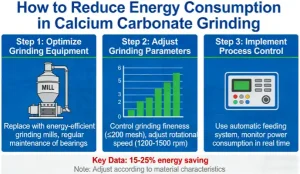
Energy is the single largest operating cost in calcium carbonate (CaCO₃) grinding—especially when producing ultrafine grades like 2000 or 2500 mesh. In many plants, electricity accounts for 60–70% of total production costs. The good news? With smart engineering and process optimization, you can reduce energy consumption by 25–40% without compromising product quality.
Below are 7 proven strategies used by leading GCC (Ground Calcium Carbonate) producers worldwide.
1. Optimize Feed Size: Don’t Over-Crush
Grinding efficiency drops dramatically when feed particles are too large.
- Ideal feed size: ≤5 mm for ultrafine mills (e.g., ring roller or jet mills).
- Why it matters: Reducing feed from 20 mm to 5 mm can lower mill energy use by 15–20% because the mill spends less time on coarse breakage.
✅ Action Step:
Install a two-stage crushing system:
Install a two-stage crushing system:
- Primary jaw crusher → Secondary hammer mill or impact crusher
- Add a vibrating screen to ensure only ≤5 mm material enters the mill.
💡 Case Example: A plant in Indonesia reduced specific energy from 135 kWh/t to 115 kWh/t just by optimizing feed size.
2. Choose the Right Mill Type for Your Target Fineness
Not all ultrafine applications require a jet mill. Using high-energy equipment unnecessarily wastes power.
表格
| Target D97 | Recommended Mill | Energy Use (kWh/t) |
|---|---|---|
| >15 μm (800 mesh) | Raymond Mill | 40–60 |
| 8–15 μm (1250–800 mesh) | Ring Roller Mill | 60–90 |
| 5–8 μm (2000–1500 mesh) | Ultrafine Ring Roller Mill | 80–120 |
| <5 μm (2500+ mesh) | Jet Mill or Steam Kinetic Mill | 250–400 |
✅ Action Step:
If your application (e.g., PVC filler, paint) only requires D97=6–8 μm, a modern ring roller mill is sufficient—and uses ⅓ the energy of a jet mill.
If your application (e.g., PVC filler, paint) only requires D97=6–8 μm, a modern ring roller mill is sufficient—and uses ⅓ the energy of a jet mill.
🚫 Common Mistake: Using a jet mill for plastic-grade CaCO₃ “just to be safe.” This can double your energy bill with no performance gain.
3. Consider Steam Kinetic Mills (If You Have Waste Heat)
Steam kinetic mills use low-pressure steam instead of compressed air—ideal if your facility has boiler exhaust or waste heat.
- Energy savings: 20–30% vs. traditional jet mills
- Best for: Plants with existing steam infrastructure (e.g., paper mills, chemical plants)
✅ Action Step:
Audit your thermal energy flows. If you generate >2 bar steam as a byproduct, a steam kinetic mill could turn waste into savings.
Audit your thermal energy flows. If you generate >2 bar steam as a byproduct, a steam kinetic mill could turn waste into savings.
4. Implement Smart Automation & Real-Time Control
Manual operation leads to over-grinding and energy waste. Modern control systems optimize in real time.
Key features to look for:
- Closed-loop particle size monitoring (via online laser diffraction)
- Auto-adjusting classifier speed based on fineness
- Variable frequency drives (VFDs) on blowers and feeders
✅ Action Step:
Retrofit your mill with a PLC + HMI system. Even basic automation can cut energy by 10–15%.
Retrofit your mill with a PLC + HMI system. Even basic automation can cut energy by 10–15%.
📊 Data Point: A Turkish GCC producer reduced energy variability by 22% after installing AI-based load balancing.
5. Maintain Equipment Religiously
Worn components force the mill to work harder.
Common issues that increase energy use:
- Worn grinding rollers or rings → reduced grinding efficiency
- Clogged air classifiers → recirculation of fine powder
- Leaky ducts or filters → loss of airflow pressure
✅ Action Step:
Create a monthly maintenance checklist:
Create a monthly maintenance checklist:
- Inspect wear parts every 500 hours
- Clean classifiers weekly
- Check air tightness quarterly
⚠️ A 10% drop in classifier efficiency can increase energy use by 18%.
6. Integrate Drying and Grinding (For Moisture >0.5%)
If your limestone has >0.5% moisture, drying and grinding separately wastes energy.
✅ Solution: Use a direct-fired or indirect-heated mill system that dries and grinds in one step.
- Hot gas from a burner pre-dries feed material inside the mill chamber
- Eliminates need for a standalone rotary dryer
🔥 Energy saved: Up to 50 kWh/t compared to two-step processing.
7. Leverage Government Incentives for Green Manufacturing
Many countries offer subsidies for energy-efficient mineral processing:
- India: Capital subsidy up to 25% under “Make in India – Green Tech”
- EU: Horizon Europe grants for low-carbon industrial processes
- Brazil: Tax breaks for equipment with >30% energy reduction
✅ Action Step:
Ask your equipment supplier for documentation to support your incentive application (e.g., energy audit reports, ISO 50001 compliance).
Ask your equipment supplier for documentation to support your incentive application (e.g., energy audit reports, ISO 50001 compliance).