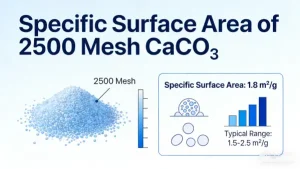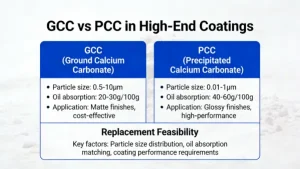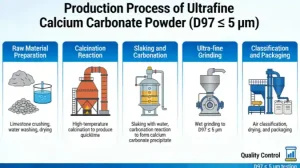
Ultrafine ground calcium carbonate (GCC) — typically defined as D97 ≤ 5 microns (≈2500 mesh) — is no longer a niche product. It’s now essential in high-growth sectors like electric vehicle batteries, medical plastics, premium coatings, and advanced PVC compounds.
But producing it consistently, efficiently, and profitably requires more than just a powerful mill. It demands an integrated approach covering raw material selection, process design, equipment choice, surface engineering, and quality control.
This guide walks you through every critical step — from quarry to bag — so you can build or optimize a plant that delivers true ultrafine performance without overspending.
✅ Step 1: Define “Ultrafine” for Your Application
Not all “ultrafine” is the same. Clarify your target based on end-use:
| Application | Target Fineness | Key Requirements |
| Lithium Battery Separator Coating | D50 = 1–2 μm, D97 ≤ 3 μm | Ultra-low Fe (<50 ppm), spherical morphology, narrow PSD |
| PVC Cable Insulation | D97 = 4–6 μm | Good dispersion, surface-treated, low abrasiveness |
| Automotive Basecoat Paint | D90 ≤ 2 μm | High brightness (>95%), no grit, consistent color |
| Medical-Grade Plastics | D97 ≤ 5 μm | USP/EP compliance, microbial control, traceability |
🔍 Tip: Over-specifying fineness wastes energy. If your customer only needs D97=6μm, don’t grind to 3μm.
✅ Step 2: Select High-Quality Limestone
Raw material quality dictates your upper performance limit.
Ideal Ore Characteristics:
CaCO₃ Purity: ≥98% (≥99.5% for battery/pharma)
Brightness (L*): >94% (ISO 2470)
Fe₂O₃ Content: <0.05% (battery), <0.1% (paint/plastic)
Moisture: <1% (preferably <0.5% for dry grinding)
Hardness: Mohs ≤3.0 (softer = less wear, lower energy)
📌 Action: Conduct XRF, XRD, and particle size analysis on representative samples before finalizing your source.
✅ Step 3: Choose the Right Grinding Technology
Three technologies dominate ultrafine GCC production. Each has trade-offs.
1. Jet Mill (Fluid Energy Mill)
Fineness: D97 = 1–5 μm
Pros: No contamination, extremely narrow particle size distribution (PSD), ideal for high-purity apps
Cons: Very high energy use (250–400 kWh/t), high operating cost
Best for: Battery, pharma, electronics
2. Steam Kinetic Mill
Fineness: D97 = 2–6 μm
Pros: 20–30% lower energy than air jet mills if you have waste steam
Cons: Requires stable steam supply (≥2 bar)
Best for: Integrated sites (e.g., paper mills, chemical plants)
3. Ultrafine Ring Roller Mill (e.g., HCH Series)
Fineness: D97 = 3–8 μm (modern models reach 5 μm reliably)
Pros: Energy-efficient (80–120 kWh/t), lower Capex, easy maintenance
Cons: Slightly broader PSD than jet mills (but acceptable for most industrial uses)
Best for: PVC, paint, rubber, masterbatch — 80% of ultrafine GCC demand
✅ 2026 Recommendation: Unless you’re making battery or medical-grade powder, a modern ultrafine ring roller mill is the most cost-effective solution.
✅ Step 4: Optimize the Full Process Flow
A robust ultrafine GCC line includes these integrated stages:
Limestone → Primary Crushing → Secondary Crushing → Screening → (Optional Drying) → Ultrafine Grinding + In-Line Classification → Surface Modification (if needed) → Pulse-Jet Bag Filter → Silo Storage → Automatic Packaging
Critical Design Notes:
Feed Size: Crush to ≤5 mm before grinding (reduces energy by 15–20%)
Drying: Integrate hot gas drying if moisture >0.5% — avoids separate dryer
Classification: Use high-speed turbo classifier with VFD for precise cut-point control
Dust Collection: Pulse-jet bag filter with emission <20 mg/m³ (meets EU/India standards)
Automation: PLC + HMI with real-time monitoring of feed rate, classifier speed, and pressure
✅ Step 5: Apply Surface Modification (For Polymer Applications)
Untreated ultrafine CaCO₃ agglomerates in polymers. Surface treatment is non-optional for plastics.
Best Practice: In-Line Dry Modification
Inject 0.8–1.5% stearic acid or titanate into hot powder stream (100–120°C)
Reaction forms hydrophobic calcium stearate layer instantly
Eliminates need for batch mixer, saves energy, ensures uniform coating
📈 Result: Filler loading in PVC increases from 30% → 45–50%, improving economics.
✅ Step 6: Ensure Quality Control & Traceability
Ultrafine customers demand consistency. Implement:
Online Laser Diffraction Analyzer: Real-time D50/D97 monitoring
Brightness Meter: ISO 2470 compliant
Moisture Sensor: <0.3% for storage stability
Batch Tracking: QR code or RFID for full traceability (critical for automotive/battery clients)
✅ Step 7: Calculate Economics (5 t/h Plant Example)
| Parameter | Value |
| Mill Type | Ultrafine Ring Roller (HCH1395) |
| Capacity | 5 t/h |
| Fineness | D97 = 5 μm |
| Energy Use | 110 kWh/t |
| Electricity Cost | $0.10/kWh → $11/ton |
| Selling Price | $90–130/ton (industrial grade) |
| Gross Profit | $70–110/ton |
| Annual Profit (6.000 hrs) | $2.1M – $3.3M |
| Payback Period | 14–20 months |
💡 Jet mill alternative would cost ~$35/ton in electricity alone — often not justified for industrial uses.