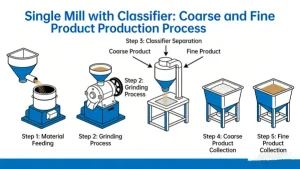
To produce both coarse and fine products simultaneously from a single mill, you need a modified closed-circuit grinding system that extracts two distinct particle size fractions instead of returning all oversize material to the mill. The core principle is to create a dual-product classification system that separates the mill discharge into three streams: fine product, coarse product, and return load (material requiring further grinding).
Core Configuration Options
1. Three-Product Classifier System (Most Efficient)
Use a specialized classifier designed to produce three outputs:
- Fine product: Meets the smallest target particle size (overflow or top discharge)
- Coarse product: Meets the larger target particle size (middlings or side discharge)
- Return load: Oversize material returned to the mill for regrinding
Popular equipment choices:
- T-Sepax three-separation classifier: Separates into coarse (d>150μm), medium-coarse (60-150μm), and fine powder
- Three-product cyclone: Uses dual vortex finders to create two overflow streams (fines and middlings) and one underflow (coarse return)
- Dual Classification System: Combines gravitational-inertial and centrifugal classifiers for two precise cut points
Process flow:
- Feed material enters the mill and is ground
- Mill discharge is directed to the three-product classifier
- Fine particles are collected as one product stream
- Medium-coarse particles are collected as a second product stream
- Oversize particles return to the mill for further grinding
2. Two-Classifiers-in-Series System
Install two classifiers with different cut sizes in sequence:
| Step | Process | Purpose |
|---|---|---|
| 1 | Mill discharge to first classifier (coarse cut) | Separates material into coarse product (collected) and intermediate material (passed to second classifier) |
| 2 | Intermediate material to second classifier (fine cut) | Separates into fine product (collected) and return load (returned to mill) |
| 3 | Return load mixed with fresh feed | Re-enters the mill for regrinding |
Advantage: Allows independent adjustment of both coarse and fine product specifications by changing classifier settings (wheel speed, airflow, etc.)
3. Modified Closed-Circuit System (Simplest Retrofit)
Adjust a standard single-classifier closed-circuit system to extract a portion of the coarse material as product:
- Install a diverter valve on the classifier underflow (return load) line
- Set the valve to split the underflow into:
- Return load: 70-90% of underflow directed back to the mill
- Coarse product: 10-30% of underflow collected as a second product stream
- The classifier overflow remains the fine product stream
Critical adjustment: Optimize classifier settings to ensure the underflow contains the desired coarse particle size distribution before splitting
4. Classifier Mill with Dual Collection (Dry Grinding)
Use an integrated classifier mill with specialized collection:
- Air classifier mill with dual discharge ports
- Alpine Dual Mill ADM: Features three interchangeable classifying wheels for flexible fineness adjustment
- NETZSCH CSM classifier mill: Can be modified with dual collection chambers
Process:
- Material is ground in the impact chamber
- Integrated classifier separates particles
- Fine particles exit through the top collector
- Coarse particles exit through a secondary discharge port (instead of full recirculation)
Key Operational Parameters for Dual-Product Control
| Parameter | Effect on Product Sizes | Adjustment Strategy |
|---|---|---|
| Classifier wheel speed | Higher speed = smaller cut size (finer product) | Set primary classifier for fine product cut; adjust secondary classifier for coarse product cut |
| Airflow rate | Higher airflow = larger cut size (coarser product) | Balance airflow to achieve both target particle distributions |
| Diverter valve position | Controls coarse product/return load ratio | Start with 10% coarse product, increase gradually while monitoring quality |
| Mill speed/power | Affects overall particle size distribution | Optimize for the smallest target particle size to minimize overgrinding |
| Circulating load | Higher load = finer overall product | Maintain 200-300% circulating load for efficient dual-product production |
Step-by-Step Implementation Guide
- Select Equipment: Choose between a three-product classifier, two-classifier setup, or modified closed-circuit system based on your particle size requirements and budget
- Configure the Circuit:
- For three-product classifier: Connect mill discharge directly to classifier; route three outputs appropriately
- For two-classifier system: Position first classifier after mill, second classifier after first
- For modified closed-circuit: Install diverter valve on classifier underflow line
- Calibrate Classifiers:
- Set first classifier to separate the desired coarse product from return load
- Set second classifier (if used) to separate fine product from intermediate material
- For three-product classifier: Adjust dual cut points to match both target particle sizes
- Test and Optimize:
- Run trial batches to verify product quality
- Adjust classifier speeds, airflow, and diverter valve position as needed
- Monitor particle size distributions of both products using laser diffraction or sieve analysis
- Implement Quality Control:
- Install online particle size analyzers for real-time monitoring
- Set up automatic control loops to maintain consistent product specifications
Practical Considerations
- Product Quality: Ensure both products meet their respective specifications without excessive overlap in particle size distributions
- Energy Efficiency: Three-product classifiers typically consume 15-20% more energy than single-product systems but save costs by eliminating a second mill
- Equipment Wear: Coarse product extraction reduces wear on mill liners and grinding media by removing larger particles from the recirculation loop
- Flexibility: Three-product systems allow quick switching between dual-product and single-product operation by closing one discharge port
The most effective methods to produce both coarse and fine products from a single mill with a classifier are:
- Three-product classifier: Best for precise dual specifications
- Two-classifiers-in-series: Ideal for widely different particle size requirements
- Modified closed-circuit: Most cost-effective retrofit solution
By implementing one of these configurations and carefully controlling operational parameters, you can maximize mill utilization while producing two distinct products simultaneously, improving overall process efficiency and profitability.