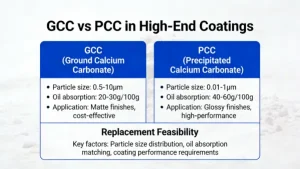
The oil absorption value (OAV) of GCC is a critical performance indicator that quantifies the maximum amount of oil adsorbed by 100 grams of GCC powder under standardized test conditions. It directly reflects the powder’s surface properties, specific surface area, dispersibility, and compatibility with polymer, coating, and ink matrices. Below are the internationally recognized standard test methods, along with calculation rules and key precautions.
1. Standard Manual Spatula Rub-Out Method (Gold Standard)
1.1 Reagents and Apparatus
| Category | Specifications |
| Test Oil | Refined linseed oil (acid value ≤5 mg KOH/g, density 0.927–0.930 g/mL at 20°C, ASTM D1955 compliant, standard oil for universal testing); Di-2-ethylhexyl phthalate (DOP, analytical pure, density 0.985–0.987 g/mL at 20°C, widely used for plastic industry applications) |
| Apparatus | Analytical balance (accuracy ±0.001 g); Smooth glass/marble plate (200×200 mm); Stainless steel spatula (20 mm width, 150 mm length); 10 mL burette (0.05 mL graduation); Forced-air drying oven; Desiccator with silica gel desiccant |
1.2 Sample Pretreatment
-
Sample Weighing: Accurately weigh the dried GCC sample according to its expected OAV:
- 10.000 ± 0.005 g for regular GCC (OAV 10–30 g/100g, most commercial products)
- 5.000 ± 0.005 g for ultra-fine GCC (<2 μm, OAV 30–50 g/100g)
- 2.000 ± 0.002 g for nano-scale GCC (OAV ≥50 g/100g)
-
Drying: Dry the sample in a forced-air oven at 105 ± 2°C for 2 hours to completely remove free moisture.
-
Cooling: Transfer the dried sample to a desiccator and cool it to room temperature (23 ± 2°C) before testing to prevent moisture reabsorption.
1.3 Step-by-Step Test Procedure
- Spread the pre-weighed GCC sample evenly in the center of a clean, dry glass plate.
- Add the test oil dropwise from the burette to the center of the powder. Add 3–5 drops at a time initially, then thoroughly rub and mix the oil and powder with the spatula after each addition, ensuring the oil fully penetrates all powder agglomerates.
- As oil is added, the loose powder will gradually form small clumps. Continue adding oil drop by drop, with thorough rubbing and mixing after each addition. Reduce to 1 drop at a time when approaching the end point to avoid over-titration.
-
End Point Judgment: Stop adding oil when the mixture forms a smooth, continuous, plastic paste that can be lifted with the spatula without cracking, crumbling, or leaving dry powder residue. The paste must not flow or stick excessively to the glass plate (this is the standardized end point defined by ISO and ASTM).
- Immediately record the total volume (or mass) of oil consumed.
- Perform duplicate tests for each sample; the relative deviation between parallel results must not exceed 5%, and the average value is taken as the final OAV.
1.4 Result Calculation
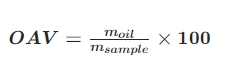
Where:
- moil = mass of oil consumed (g) = volume of oil (mL) × oil density (g/mL)
- msample = mass of the dried GCC sample (g)
If reporting OAV in mL/100g, the test oil type, density, and test temperature must be clearly stated in the report.
2. Automated Instrumental Methods (For Higher Precision)
These methods eliminate human error in end point judgment, deliver superior repeatability, and are suitable for batch testing and R&D scenarios.
2.1 Torque-Based Absorptometer Method
-
Principle: The instrument mixes the GCC sample with oil at a fixed rotational speed, and monitors the torque change of the stirring blade in real time. Torque rises sharply as the plastic paste forms; the instrument automatically stops oil dosing when the torque reaches a pre-calibrated threshold (matching the standard manual end point).
-
Procedure: Calibrate the instrument per the manufacturer’s instructions; weigh the specified amount of dried GCC into the test chamber; start the test, and the instrument will automatically dose oil, mix, monitor torque, and calculate/ output the OAV result once the end point is reached.
2.2 Capillary Rise Method (Washburn Method)
This method is mainly used for R&D of ultra-fine and nano-scale GCC, as it accurately measures the intrinsic surface adsorption properties of powder particles.
-
Principle: Based on the Washburn equation, it measures the absorption rate and saturated oil uptake of a GCC powder bed through capillary action, minimizing the impact of manual operation.
3. Critical Precautions & Influencing Factors
-
End Point Control: Over-titration (excess oil) causes abnormally high OAV results, while under-titration leads to low values. Always add oil 1 drop at a time near the end point, with full rubbing after each addition.
-
Sample Drying: Free moisture in the sample occupies particle surface adsorption sites, resulting in lower measured OAV. Ensure full drying and desiccator cooling before testing.
-
Test Environment: Maintain a test temperature of 23 ± 2°C and relative humidity of 50 ± 5%. Temperature changes alter oil viscosity and density, while high humidity causes sample moisture reabsorption.
-
Sample Property Impacts:
- Finer GCC has a larger specific surface area, leading to higher OAV.
- Wider particle size distribution reduces OAV, as small particles fill gaps between large particles and lower oil holding capacity.
- Hydrophobically modified GCC (e.g., stearic acid-coated) has significantly lower OAV, as the surface coating reduces oil adsorption.
-
Oil TypeConsistency: OAV results from different oils (linseed oil, DOP, DBP, DOA) are not directly comparable. Always clearly specify the test oil type and standard used in the test report.
4. Official Standard References
- ASTM D281-12(2021): Standard Test Method for Oil Absorption of Pigments and Extenders by Spatula Rub-out
- ISO 787-5:2019: General methods of test for pigments and extenders – Part 5: Determination of oil absorption value
- ISO 19246:2016: Pigments and extenders – Determination of DOA absorption number by means of an absorptometer
- GB/T 5211.15-2014: General methods of test for pigments and extenders – Part 15: Determination of oil absorption value
- GB/T 19281-2014: Analytical methods for calcium carbonate