How to manage the heat generated in a high-speed air classifier mill
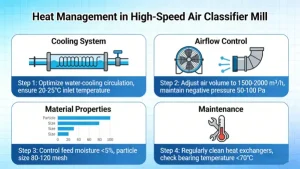
To effectively manage heat in a high-speed air classifier mill, implement a multi-layered strategy combining equipment design,active cooling systems,operational controls,real-time monitoring, and maintenance protocols. Target outlet temperatures of 35–45°C for heat-sensitive materials and <60°C for general applications to prevent product degradation and equipment damage. 1. Understand Heat Sources Heat generation in ACMs stems from: Source Mechanism Contribution Mechanical friction Rotor, classifier wheel, bearings ~30–40% Impact energy conversion Hammer/particle collisions ~25–35% Air compression High-velocity airflow in grinding chamber ~20–25% Motor inefficiency Electric motor heat transfer ~10–15% Material properties High-moisture or high-specific-heat materials Variable 2. Equipment Design Solutions Cooling Integration Dual cooling system: Combine water jacket cooling for the grinding chamber with air cooling for internal components to maintain 35–45°C outlet temps…
To effectively manage heat in a high-speed air classifier mill, implement a multi-layered strategy combining equipment design,active cooling systems,operational controls,real-time monitoring, and maintenance protocols. Target outlet temperatures of 35–45°C for heat-sensitive materials and <60°C for general applications to prevent product degradation and equipment damage.
1. Understand Heat Sources
Heat generation in ACMs stems from:
Source
Mechanism
Contribution
Mechanical friction
Rotor, classifier wheel, bearings
~30–40%
Impact energy conversion
Hammer/particle collisions
~25–35%
Air compression
High-velocity airflow in grinding chamber
~20–25%
Motor inefficiency
Electric motor heat transfer
~10–15%
Material properties
High-moisture or high-specific-heat materials
Variable
2. Equipment Design Solutions
Cooling Integration
Dual cooling system: Combine water jacket cooling for the grinding chamber with air cooling for internal components to maintain 35–45°C outlet temps
Jacketed housing: Install spiral or baffle-type cooling channels in the chamber walls and classifier housing
Cooled classifier wheel: Use hollow, internally cooled wheels with recirculating cooling fluid
Bearing protection: Outboard-mounted bearings with air purge systems and insulation for high-temperature environments
Material & Structural Optimization
High thermal conductivity materials: Use copper alloys, aluminum, or stainless steel with embedded cooling passages
Aerodynamic design: Optimize rotor geometry to minimize turbulence and pressure drop while maximizing heat transfer
Larger surface area: Add external fins or heat sinks to the grinding chamber exterior
3. Active Cooling Systems
Process Air Cooling
Method
Implementation
Temperature Reduction
Best For
Chilled inlet air
Pre-cool process air to 5–15°C using refrigeration
Baseline assessment: Measure temperature profile under standard operating conditions
Prioritize solutions:
Short-term: Optimize airflow and process parameters (1–2 weeks)
Medium-term: Install heat exchangers and monitoring systems (1–2 months)
Long-term: Upgrade to dual cooling system or closed-loop design (3–6 months)
Validation: Test each modification while monitoring temperature, product quality, and energy consumption
Documentation: Maintain records of temperature data, adjustments, and material quality to establish optimal parameters
Key Takeaways
Effective heat management in high-speed air classifier mills requires a holistic approach combining design, operational, and monitoring strategies. Prioritize closed-loop air systems with integrated cooling for most applications, and implement real-time temperature control to prevent product degradation and equipment damage. Always validate solutions against both thermal performance and final product specifications.
About Us: With over 20 years of dedicated expertise in ultrafine grinding technology, we deliver high-performance machinery that matches the precision and reliability of leading German and Japanese brands—at only 1/3 of their cost.
Beyond Equipment, We Deliver Total Confidence: We provide Free Material Testing to ensure precise equipment selection, followed by professional on-site installation and comprehensive training. Our 24/7 technical support team ensures your production line remains efficient and worry-free.