The core logic for judging whether calcium carbonate has undergone hydrolysis is: focus on theprotontransfer process between the dissociated CO₃²⁻ and water molecules (generating HCO₃⁻, H₂CO₃ and OH⁻), and realize the judgment by detecting hydrolysis products or changes in solution properties. However, it should be noted that calcium carbonate has extremely low solubility, and hydrolysis can only occur under special conditions (such as high temperature and high pressure, salt effect assistance). There is no obvious hydrolysis under conventional conditions. When judging, it is necessary to exclude interfering reactions (such as reactions with acids). The specific methods and precautions are as follows:
1. Core Judgment Basis: Detect Hydrolysis Products or Changes in Solution Properties
The essence of hydrolysis reaction is CO₃²⁻ + H₂O ⇌ HCO₃⁻ + OH⁻ and HCO₃⁻ + H₂O ⇌ H₂CO₃ + OH⁻. Therefore, the core of judgment is to detect the three types of products: “OH⁻ (increased solution alkalinity)”, “HCO₃⁻”, and “H₂CO₃ (or decomposed CO₂)”. The specific methods are as follows:
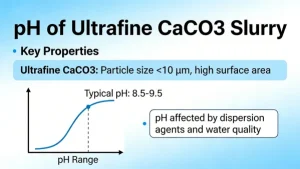
1.1 Detect changes in solution pH (most intuitive preliminary judgment) Hydrolysis will produce OH⁻, leading to an increase in solution pH (enhanced alkalinity).
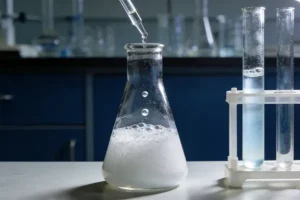
– Operation: Take the clarified solution after the reaction (filter to remove undissolved calcium carbonate solids to avoid solid interference), measure the pH with a precision pH meter (ordinary pH test paper has insufficient precision and cannot detect trace OH⁻); at the same time, set a blank control (pure water or a system without calcium carbonate under the same conditions).
– Judgment: If the pH of the sample solution is significantly higher than that of the blank control (e.g., the difference ≥ 0.2), and the interference of other alkaline substances is excluded (such as no NaOH, Na₂CO₃, etc. in the system), it can be initially judged that the hydrolysis of CO₃²⁻ exists (that is, calcium carbonate has indirectly undergone hydrolysis).
– Note: Under conventional conditions (normal temperature and pressure, pure water system), the amount of CO₃²⁻ dissolved by calcium carbonate is extremely small, and the OH⁻ produced by hydrolysis is not enough to change the pH. At this time, the pH is close to neutral, and judgment cannot be made by this method.
1.2 Detect HCO₃⁻ in the solution (qualitative/quantitative confirmation of hydrolysis intermediate products) HCO₃⁻ is the direct product of the first step hydrolysis of CO₃²⁻. Detecting HCO₃⁻ can directly prove that hydrolysis has occurred.
– Operation: Use ion chromatography (IC) or high-performance liquid chromatography (HPLC) to analyze the filtered clarified solution, and compare the retention time or characteristic peak of the HCO₃⁻ standard; chemical color development method can also be used (e.g., adding semicarbazide hydrochloride-FeCl₃ reagent, HCO₃⁻ will produce a specific color).
– Judgment: If the characteristic peak or color reaction of HCO₃⁻ appears in the sample solution, and there is no corresponding signal in the blank control, the occurrence of hydrolysis can be confirmed.
– Note: The detection limit of the detection method must be low enough (the concentration of HCO₃⁻ may be below ppm level) to avoid missed detection.
1.3 Detect H₂CO₃ or decomposed CO₂ (qualitative confirmation of final hydrolysis products) The second step of hydrolysis of CO₃²⁻ generates H₂CO₃, which is unstable and decomposes into CO₂ and H₂O. Detecting trace CO₂ can assist in judging hydrolysis.
– Operation: Carry out the reaction in a closed system. After the reaction, introduce the gas in the system into clarified lime water (or Ba(OH)₂ solution); gas chromatography (GC) can also be used to detect CO₂ gas.
– Judgment: If the lime water becomes turbid (generating CaCO₃ precipitate) or GC detects the characteristic peak of CO₂, and other sources of CO₂ are excluded (such as CO₂ in the air, reaction between acid and calcium carbonate in the system), it can assist in proving the occurrence of hydrolysis.
– Note: The amount of CO₂ produced by hydrolysis is extremely small, so the operation must be carried out under air-isolated conditions to avoid interference from CO₂ in the air.
2. Key Precautions: Exclude Interfering Reactions and Clarify Judgment Boundaries
2.1 Distinguish “hydrolysis reaction” from “acid-salt reaction” (most easily confused interference) If there is acid in the system (such as HCl, H₂SO₄, or even H₂CO₃ formed by CO₂ in the air dissolving in water), H⁺ in the acid will directly combine with CO₃²⁻ to form H₂CO₃ (which then decomposes into CO₂), prompting the dissolution of calcium carbonate. This is a “double decomposition reaction” (CaCO₃ + 2H⁺ = Ca²⁺ + CO₂↑ + H₂O), not a hydrolysis reaction.
– Exclusion Method: Before judgment, confirm that the system is “neutral/weakly alkaline” (no external acid) and that there is no large amount of H⁺; if CO₂ is detected, first check whether it is generated by the reaction between acid and calcium carbonate.
2.2 Exclude interference from other alkaline substances If there are other substances that can produce OH⁻ in the system (such as NaOH, KOH, Na₂CO₃, etc.), the pH of the solution will increase, interfering with the judgment of hydrolysis.
– Exclusion Method: Before the experiment, ensure that the reaction system is pure, containing only calcium carbonate and water (or the specified electrolyte system), without other impurities.
2.3 Clarify that the “hydrolysis of calcium carbonate” is essentially the “hydrolysis of CO₃²⁻” Calcium carbonate itself does not directly react with water; what hydrolyzes is the CO₃²⁻ dissociated after its dissolution. Therefore, the premise of judgment is “the presence of detectable CO₃²⁻ and its hydrolysis products in the solution”. If these ions are not detected, even if there is calcium carbonate solid, it cannot be considered that hydrolysis has occurred.
2.4 No need for judgment under conventional conditions: no obvious hydrolysis by default Under normal temperature and pressure, pure water system, calcium carbonate has extremely low solubility, and the concentration of CO₃²⁻ is not enough to produce detectable hydrolysis products. At this time, it can be directly judged that “no observable hydrolysis reaction has occurred”; only under special conditions such as high temperature and high pressure, and the presence of strong electrolytes (salt effect), it is necessary to judge through the above methods.
3. Summary: Judgment Process
Confirm the reaction conditions: whether it is a special condition that may promote the dissolution of calcium carbonate, such as high temperature and high pressure, salt effect (under conventional conditions, it can be directly judged that there is no obvious hydrolysis);
Exclude interference: confirm that the system has no external acid, alkaline impurities, etc.;
Sample pretreatment: filter to remove undissolved calcium carbonate and obtain a clarified solution;
Detection and verification: first measure the precise pH (preliminary judgment), then detect HCO₃⁻ (core confirmation), and detect CO₂ if necessary (auxiliary verification);
Compare with blank: all detections must be compared with blank controls to ensure that the signal comes from hydrolysis products.