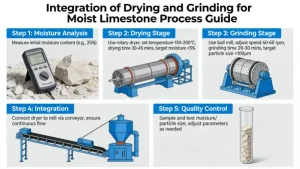
Integrating drying and grinding for moist limestone is a common requirement in industries such as cement production, flue gas desulfurization (FGD), and chemical processing. Moisture in limestone can hinder efficient grinding and cause operational issues like clogging or reduced throughput. To address this, combined drying-grinding systems are employed. Below are the main approaches and technologies used:
1. Use of Vertical Roller Mills (VRMs) with Hot Gas
How it works: A vertical roller mill grinds the limestone while simultaneously drying it using hot gases (typically 200–300°C) introduced into the mill chamber.
Advantages:
High energy efficiency (grinding + drying in one unit).
Compact design.
Handles feed moisture up to 8–12% (depending on system design).
Heat source: Kiln exhaust gas, dedicated hot air generator, or waste heat recovery.
2. Ball Mill with Pre-Drying or In-Mill Drying
Pre-drying: Limestone is first dried in a separate dryer (e.g., rotary dryer or fluidized bed dryer) before entering the ball mill.
In-mill drying: Hot air is injected directly into the ball mill to dry material during grinding.
Limitations: Less energy-efficient than VRMs; higher wear and maintenance.
3. Ring Roller Mills or Jet Mills with Integrated Drying
Suitable for fine grinding applications.
Use high-velocity hot air both as a grinding medium and drying agent.
Common in specialty chemical or FGD-grade limestone production.
4. Fluidized BedDryer + SeparateGrinder(Two-Stage System)
Used when moisture content is very high (>10–15%) or feed variability is significant.
Ensures consistent dryness before grinding.
More flexible but requires more space and capital cost.
Key Design Considerations:
Moisture content: Determine initial and target moisture (e.g., <1% for pneumatic conveying or FGD).
Particle size requirement: Fineness (e.g., 90% passing 90 µm for cement raw meal).
Heat source availability: Waste heat from kilns can significantly reduce operating costs.
Material abrasiveness: Limestone is moderately abrasive—select wear-resistant materials.
Dust control: Integrated bag filters or ESPs needed due to fine, dry dust.
Example Process Flow (Integrated VRM System):
Crushed limestone (≤75 mm, moisture ~5–10%) fed into VRM.
Hot gas (250–300°C) enters mill base, evaporating surface moisture.
Grinding rollers crush material against rotating table.
Classifier separates coarse particles (recirculated) from fine product.
Dried, ground limestone collected via bag filter or cyclone.
Tips for Optimization:
Monitor inlet/outlet gas temperatures to avoid over-drying or condensation.
Use moisture sensors on feed to auto-adjust hot gas flow.
Ensure proper sealing to prevent cold air ingress (reduces drying efficiency).
By integrating drying and grinding, you reduce equipment footprint, energy use, and operational complexity—making it ideal for large-scale, continuous operations.