Improving the brightness & whiteness of ground calcium carbonate (GCC) mainly targets removing colored impurities (especially iron, manganese, organic matter) and optimizing particle morphology & dispersion. Below is the practical, industrial improvement plan:
1. Raw Material Selection (The Foundation)
Whiteness starts with the ore.
- Use high-purity calcite with >98.5% CaCO₃, low Fe₂O₃, MnO, and organic matter.
- Reject ores with:
- Yellow/brown staining (iron oxides)
- Gray/black impurities (organic matter, graphite, clay)
- Pre-select by hand sorting, washing, or dry cleaning to remove surface mud and rust.
2. Remove Colored Impurities (Most Effective Method)
Iron and manganese are the main causes of low whiteness.
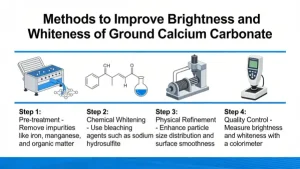
(1) High-Gradient Magnetic Separation
- Install wet or dry high-intensity magnetic separators before/during grinding.
- Removes weakly magnetic iron oxides, pyrite, and iron dust from equipment.
- Can typically increase whiteness by 2–8% ISO.
(2) Chemical Bleaching (For Wet Grinding)
Bleach the CaCO₃ slurry with reducing agents:
- Sodium dithionite (hydrosulfite) → reduces Fe³+ to colorless soluble Fe²+
- Oxalic acid / citric acid → chelates and dissolves iron impurities
- Follow with washing and filtration to remove dissolved metal ions.
(3) Flotation (For low-grade ore)
Removes quartz, clay, dolomite, and organic carbon to upgrade ore purity.
3. Grinding System: Avoid Iron Contamination
A huge hidden cause of low whiteness is iron introduced during grinding.
- Use non-iron grinding media:
- Zirconia beads
- High-alumina ceramic balls
- Quartz pebble
- Avoid steel balls or iron liners, which abrade and darken the powder.
- Line mills, pipes, and classifiers with polyurethane or ceramic.
4. Optimize Grinding & Particle Size
Brightness depends strongly on particle fineness and size distribution.
- Grind to narrow particle size distribution (e.g., D97 controlled tightly).
- Finer GCC (1250–2500 mesh and above) usually has:
- Higher light scattering
- Higher visual brightness and whiteness
- Use air classifiers to remove coarse, dark impurity particles.
5. Additives & Dispersants
- Use dispersants (sodium hexametaphosphate, sodium pyrophosphate) to improve dispersion and prevent agglomeration.
- Avoid colored or impure grinding aids.
- For wet grinding: add dispersants during milling to keep slurry stable and improve bleaching efficiency.
6. Drying & Post-Treatment
- Use clean hot air for drying; avoid flue gas dust contamination.
- Dry at moderate temperature to prevent oxidation of iron impurities (which causes yellowing).
- After drying: sieve and re-classify to remove agglomerates and foreign debris.
7. Surface Modification (Boosts Apparent Whiteness)
Coating GCC with:
- Stearic acid
- Coupling agents
- Polyacrylate dispersants
improves:
- Surface smoothness
- Light reflectivity
- Apparent brightness and hiding power