A well-designed calcium carbonate powder production line requires careful planning of process flow, equipment selection, layout, and environmental protection. The design differs significantly betweenheavy calcium carbonate (GCC)from natural limestone grinding andprecipitated calcium carbonate (PCC)via chemical synthesis. This guide focuses on GCC production, which is more common for industrial applications, with notes on PCC where applicable.
📋 Key Design Considerations
| Factor | Description | Critical Impact |
|---|---|---|
| Product Type | GCC (mechanical grinding) vs PCC (chemical precipitation) | Determines entire process flow |
| Fineness Requirement | 200-3000 mesh (5-75μm) for GCC; 500-5000 mesh for PCC | Dictates grinding & classification equipment selection |
| Production Capacity | 5,000-500,000 tons/year | Influences equipment size, number of production lines |
| Raw Material Quality | Limestone purity (>95% CaCO₃), hardness, moisture | Affects preprocessing & grinding efficiency |
| Application | Paper, plastics, rubber, paints, pharmaceuticals | Determines surface treatment needs & quality standards |
| Energy Efficiency | Power consumption (kWh/ton) | Major operational cost factor |
| Environmental Compliance | Dust, noise, wastewater regulations | Mandatory for permits & sustainable operation |
⚙️ Heavy Calcium Carbonate (GCC) Production Process Flow
1. Raw Material Preparation & Preprocessing
- Quarrying: Extract limestone blocks (typically 0.5-1.5m) from mine
- Primary Crushing: Jaw crusher reduces size to 100-300mm
- Equipment: PE series jaw crusher (capacity: 10-1000 t/h)
- Secondary Crushing: Cone crusher/hammer crusher further reduces to 5-20mm
- Screening: Vibrating screen removes oversized material for re-crushing
- Washing (Optional): Removes surface dirt/mud if raw material is contaminated
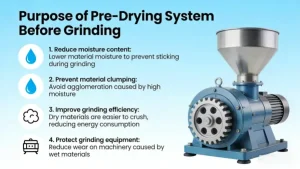
- Drying (If Needed): Rotary dryer reduces moisture to <1% (critical for grinding efficiency)
- Storage: Stockpile in silos with capacity for 7-15 days of production
2. Core Grinding & Classification System (Heart of Production)
| Stage | Equipment | Function | Fineness Control |
|---|---|---|---|
| Feeding | Vibrating feeder + belt conveyor | Uniform, continuous feeding to mill | Prevents overload, ensures stable operation |
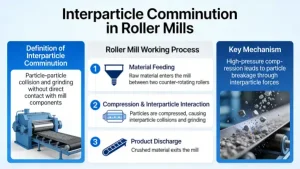
| Grinding | Raymond mill (200-400 mesh), Vertical mill (≤325 mesh), Ball mill (600-2500 mesh), Ultrafine vertical mill (>1250 mesh) | Reduces particle size to target fineness | Raymond mill: low investment; Vertical mill: energy-efficient (30% less than ball mill); Ball mill: ultra-fine capability |
| Classification | Turbine classifier, Airflow classifier | Separates qualified powder from coarse particles | Classifier speed adjusts fineness; precision up to D97=5μm |
| Collection | Cyclone separator + Pulse dust collector | Captures finished powder from air stream | Cyclone for primary separation; Pulse dust collector for efficiency >99.9% |
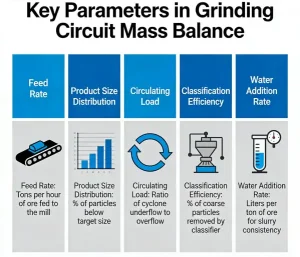
| Recirculation | Screw conveyor | Returns unqualified coarse powder to mill for regrinding | Ensures 100% product quality compliance |
PCC Process Note: PCC requires calcination (limestone → CaO + CO₂), hydration (CaO + H₂O → Ca(OH)₂), carbonation (Ca(OH)₂ + CO₂ → CaCO₃), then filtration, drying, and grinding.
3. Post-Processing (Optional)
- Surface Modification: For specialized applications (plastics, rubber)
- Equipment: High-speed mixer, continuous modification machine
- Modifiers: Stearic acid, titanate, silane coupling agents (1-3% of powder weight)
- Secondary Classification: For ultra-fine products requiring narrow particle size distribution
- Homogenization: Mixing different batches for consistent quality
4. Storage & Packaging
- Finished Product Silos: Capacity based on 3-7 days of production
- Packaging Options:
- 25kg bags (automatic bagging machine, 800-1200 bags/hour)
- Bulk tanker trucks (pneumatic conveying)
- Jumbo bags (1-2 tons each)
- Warehousing: Climate-controlled storage for modified products
🧰 Equipment Selection Guide
Grinding Mill Comparison Table
| Mill Type | Feed Size | Output Fineness | Capacity (t/h) | Power Consumption | Best Application |
|---|---|---|---|---|---|
| Raymond Mill | ≤30mm | 200-400 mesh | 1-20 | Medium | Small-to-medium scale, general-purpose powder |
| Vertical Mill | ≤50mm | 80-325 mesh | 5-100 | Low (15-25 kWh/t) | Large-scale production, energy-saving requirement |
| Ball Mill | ≤5mm | 600-2500 mesh | 3-50 | High (30-50 kWh/t) | Ultra-fine powder, high purity requirement |
| Ultrafine Vertical Mill | ≤30mm | 1250-3000 mesh | 2-30 | Medium-High | Specialized ultra-fine applications |
| Air Jet Mill | ≤1mm | 500-5000 mesh | 0.5-20 | Very High | Nano-powder, pharmaceutical-grade products |
Key Supporting Equipment
- Dust Collection: Pulse baghouse dust collector (air-to-cloth ratio 1:3-1:6)
- Conveying: Belt conveyors (long distance), screw conveyors (short distance), pneumatic conveying (powder)
- Control System: PLC + HMI for automatic operation, real-time monitoring of temperature, pressure, fineness
🗺️ Plant Layout Design
1. General Principles
- Process Flow Priority: Arrange equipment in logical sequence to minimize material handling
- Safety First: Maintain minimum 1.5m walkways, emergency exits, fire protection systems
- Environmental Zoning: Locate dust-intensive areas (crushing, grinding) downwind
- Future Expansion: Leave 20-30% space for capacity increase or technology upgrade
2. Layout Example (100,000 t/year GCC Line)
| Area | Equipment | Space Requirement | Height Requirement |
|---|---|---|---|
| Raw Material Yard | Jaw crusher, cone crusher, vibrating screen | 2,000-3,000 m² | 8-10m |
| Grinding Building | Vertical mill, classifier, dust collector | 800-1,200 m² | 15-20m |
| Finished Product Area | Silos, packaging machines, warehouse | 1,500-2,000 m² | 10-12m |
| Power & Control Room | Transformers, switchgear, PLC control system | 200-300 m² | 4-5m |
| Auxiliary Facilities | Compressor station, water treatment, maintenance workshop | 500-800 m² | 6-8m |
🌿 Environmental Protection & Safety Measures
1. Dust Control
- Source Capture: Enclose crushing/grinding equipment with negative pressure ventilation
- Efficient Collection: Pulse dust collectors (efficiency >99.9%) at all emission points
- Wet Suppression: Water spray systems in primary crushing areas
- Green Belt: Plant trees around site perimeter to reduce dust dispersion
2. Noise Reduction
- Sound Insulation: Install acoustic enclosures for crushers and mills
- Vibration Isolation: Use rubber pads or spring mounts for equipment
- Distance Buffer: Locate noise sources away from offices and residential areas
3. Wastewater Management
- Zero Discharge Design: Recycle all process water after sedimentation and filtration
- Sludge Treatment: Filter press dewaters sludge for use as building material
4. Energy Saving Measures
- Variable Frequency Drives: For fans, pumps, and conveyors to match load demand
- Heat Recovery: Capture waste heat from dryers for preheating
- Energy Monitoring: Real-time tracking of power consumption per process stage
📊 Capacity Planning & Cost Estimation
1. Capacity Calculation Example (100,000 t/year GCC Line)
- Operating Hours: 300 days × 20 hours = 6,000 hours/year
- Required Capacity: 100,000 t ÷ 6,000 h =16.7 t/h
- Equipment Selection: 1 set of vertical mill (20 t/h capacity) with 15% redundancy
2. Investment Breakdown (100,000 t/year GCC Line)
| Item | Percentage | Estimated Cost (USD) |
|---|---|---|
| Equipment | 60-70% | 1.8-2.1 million |
| Civil Works | 15-20% | 0.45-0.6 million |
| Electrical & Automation | 10-15% | 0.3-0.45 million |
| Installation & Commissioning | 5-10% | 0.15-0.3 million |
| Total | 100% | 2.7-3.45 million |
✅ Commissioning & Quality Control
1. Pre-Commissioning Checks
- Equipment alignment and lubrication verification
- Safety interlock testing
- Dust collection system efficiency test
- Control system calibration
2. Quality Control Parameters
- Chemical Analysis: CaCO₃ content (>95%), MgO, Fe₂O₃, Al₂O₃ impurities
- Physical Properties: Particle size distribution (D10, D50, D97), whiteness (>90%), moisture (<0.5%)
- Application-Specific: Oil absorption, specific surface area, bulk density
3. Routine Maintenance Schedule
- Daily: Check lubrication, temperature, and pressure
- Weekly: Inspect wear parts (crusher jaws, mill rollers)
- Monthly: Clean dust collectors, calibrate classifiers
- Annually: Major equipment overhaul, replace worn components
📌 PCC Production Line Design Notes
For precipitated calcium carbonate production, add these key steps:
- Calcination: Vertical shaft kiln converts limestone to quicklime (CaO) and CO₂ gas
- Hydration: Slaker converts CaO to lime milk (Ca(OH)₂ suspension)
- Carbonation: Reaction tower where lime milk reacts with CO₂ to form PCC precipitate
- Filtration: Filter press removes water from PCC slurry
- Drying: Flash dryer reduces moisture to <0.5% before final grinding
🎯 Final Design Tips
- Start with Market Demand: Define product specifications before selecting equipment
- Consult Experts: Engage with equipment manufacturers for customized solutions
- Modular Design: Build in stages for flexible capacity expansion
- Automation: Invest in PLC control for consistent quality and reduced labor costs
- Sustainability: Incorporate energy-efficient equipment and waste recycling systems from the beginning