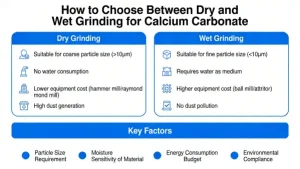
The selection of dry grinding or wet grinding for CaCO₃ (GCC/PCC) is determined by core product requirements (particlesize,dispersion, purity), end-use application, production cost, and process matching (e.g., subsequent surface modification)—this is the fundamental principle.
Dry grinding is the mainstream for conventional filler-grade CaCO₃ (cost-efficient, simple process), while wet grinding is the only viable industrial method for ultra-fine/nano CaCO₃ (D50 < 1 μm) with strict dispersion and particle size distribution requirements. A clear particle size boundary and application-driven performance demands are the key decision-making criteria, and the two processes have complementary advantages with almost no direct substitution in their core application scenarios.
Core Applicable Scope & Key Differentiation
First, the particlesize threshold is the most direct selection basis—this is the industrial consensus for CaCO₃ grinding, and other factors are secondary supplements:
| Index | Dry Grinding | Wet Grinding |
| Core Applicable D50 | 1 μm – 50 μm (coarse to fine grade); partial optimized processes can reach 0.5–1 μm (submicron, limited batch) | < 1 μm (ultra-fine/nano grade); mainstream industrial products: 0.1–0.8 μm (narrow particle size distribution, PSD) |
| Product Dispersion | Poor (inevitable particle agglomeration due to dry interparticle forces); needs post-grinding surface modification to improve dispersion | Excellent (liquid medium eliminates dry agglomeration; PSD is narrow and controllable; can realize in-situ wet surface modification for direct use in liquid systems) |
| Main Equipment | Raymond mill, vertical mill (coarse/fine), jet mill (ultra-fine dry), high-speed mechanical mill | Wet ball mill, sand mill (horizontal/vertical, mainstream for ultra-fine), bead mill (nano grade) |
| Process Flow | Simple (raw ore → crushing → grinding → classification → packaging); no wastewater, short cycle | Complex (raw ore → crushing → slurry preparation (water/solvent) → grinding → classification → concentration/drying (solid product) / direct slurry (liquid product) → wastewater treatment) |
| Cost Characteristic | Low total cost (low investment, operation, and environmental treatment costs); low energy efficiency per unit fine particle | High total cost (high investment in grinding/drying, high energy consumption; wastewater treatment required); high energy efficiency per unit ultra-fine/nano particle |
| Purity Control | Easy to introduce mechanical impurities (e.g., mill liner wear); suitable for general-purity fillers | High purity (closed slurry system, less impurity introduction); suitable for high-purity CaCO₃ for electronics/coatings |
Step-by-Step Selection Criteria (Industrial Practicability)
Follow this priority order to make decisions—no need for trade-offs in most cases; only the 0.5–1 μm submicron zone requires balancing cost and performance.
First: Determine the Target Particle Size (D50)
This is the one-step decision for most scenarios:
D50 ≥ 1 μm: Choose dry grinding—it is the most economic and efficient option; wet grinding has no cost or performance advantage here and is not recommended.
D50 < 1 μm: Must choose wet grinding—dry grinding cannot stably produce CaCO₃ with D50 < 1 μm in industrial batches (jet mill can reach submicron but has extremely high energy consumption, poor PSD, and serious agglomeration; not cost-effective).
D50 0.5–1 μm (submicron transition zone):
If dispersionrequirement is low (e.g., low-end plastic/rubber filler) and cost control is strict: Optimized dry grinding (jet mill + classification) is optional.
If dispersionrequirement is high (e.g., mid-end coating/paper coating): Wet grinding is the better choice (stable product quality, no post-grinding re-agglomeration).
Second: Combine End-Use Application & Product Performance Demands
Even for the same particle size, application-driven performance requirements will override cost considerations—critical for high-value-added CaCO₃ products:
Choose Dry Grinding If:
End applications: Low/mid-end plastic/rubber filler, paper bulk filler, building material additives, putty powder (no strict requirements for dispersion/PSD; cost is the core factor).
Process matching: Need integrated dry grinding + dry surface modification (the most common industrial combination for CaCO₃; shortens process, reduces intermediate handling, and lowers modification cost).
Site conditions: No wastewater treatment capacity, limited factory space, or small production scale (dry grinding has a compact layout).
Choose Wet Grinding If:
End applications: High-end liquid systems (water-based/oil-based coatings, inks, adhesives), high-performance plastics (nano CaCO₃ for toughening), papermaking coating pigment, cosmetics/food-grade CaCO₃ (strict requirements for dispersion, PSD, and purity).
Process matching: Need in-situ wet surface modification (modify CaCO₃ in slurry state; the modifier is uniformly adsorbed on particle surfaces without agglomeration; the modified slurry can be directly supplied to downstream liquid product production, saving drying costs).
Product form requirement: Need CaCO₃ slurry (direct supply to downstream coating/paper mills; avoids dry powder transportation and re-slurry preparation for customers).
Third: Evaluate Production Cost & Scale
Cost is the final check for the transition zone (0.5–1 μm) and non-mandatory wet grinding scenarios:
Large-scale production (≥10.000 t/a) of conventional filler-grade CaCO₃: Dry grinding is the only option (low unit cost, high production efficiency; wet grinding’s fixed investment and operation cost are not feasible).
Small-batch production of high-value-added ultra-fine/nanoCaCO₃: Wet grinding is acceptable (the high unit price of the product offsets the grinding cost; dry grinding cannot meet quality requirements).
Wastewater treatment cost: If the factory is in a region with strict environmental protection policies and high wastewater treatment costs, prioritize dry grinding for submicron products (if quality allows).
Key Supplementary Considerations for Industrial Application
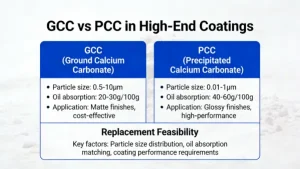
GCC vs.PCCgrinding: PCC has a loose, porous structure and lower hardness than GCC; wet grinding of PCC requires lower energy consumption and can reach a smaller particle size (D50 < 0.1 μm) more easily; dry grinding of PCC is prone to severe agglomeration and is only suitable for coarse-grade products.
Post-grinding processing: Dry grinding powder can be directly mixed with modifiers for dry surface modification (the most common CaCO₃ modification process); wet grinding slurry can be subjected to wet surface modification (using water-soluble/oil-soluble modifiers) and then dried to obtain modified powder, or directly used as a slurry product (saves drying cost).
Particle size distribution(PSD): Wet grinding produces CaCO₃ with a narrower PSD (no large particles due to the liquid medium’s classification effect); dry grinding has a wider PSD (needs high-precision air classification to remove coarse particles, increasing additional cost).
Impurity removal: Wet grinding can realize in-situ impurity removal (e.g., magnetic separation, flotation) in the slurry state, which is more efficient than dry impurity removal; suitable for high-purity CaCO₃ production.
Summary of Quick Selection Guide
| Scenario | Recommended Grinding Method | Core Reason |
| D50 ≥ 1 μm, low/mid-end filler (plastic/rubber/building materials) | Dry grinding | Cost-efficient, simple process, no wastewater |
| D50 < 1 μm, ultra-fine/nano CaCO₃ (coating/ink/nano plastic) | Wet grinding | Only viable method for fine particle, excellent dispersion |
| D50 0.5–1 μm, low dispersion requirement + strict cost control | Optimized dry grinding (jet mill) | Balances cost and basic particle size demand |
| D50 0.5–1 μm, high dispersion requirement (mid-end coating/paper coating) | Wet grinding | Stable PSD, no agglomeration, meets performance demands |
| Need CaCO₃ slurry for downstream liquid systems | Wet grinding | Direct slurry output, saves customer re-slurry cost |
| Integrated grinding + dry surface modification | Dry grinding | Process integration, shortens production cycle |
| High-purity CaCO₃ (cosmetics/food/electronics) | Wet grinding | Low impurity introduction, in-situ impurity removal |
In short, dry grinding is the cost-effective choice for conventional CaCO₃, and wet grinding is the quality-mandatory choice for ultra-fine/nanoCaCO₃—the two processes are not competitive but form a complete industrial grinding system for CaCO₃ covering all particle size grades and application scenarios.