To achieve a 1250-mesh (D97 ≈ 10 μm) calcium carbonate (CaCO₃) product, a precision-engineered dry-process production line with specialized ultrafine grinding equipment and strict process control is required . This guide covers the complete workflow, equipment selection, key parameters, and quality control measures to consistently meet this fineness standard.
Core Process Overview
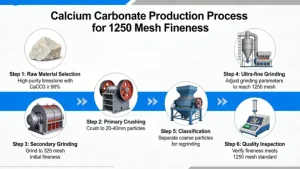
- Raw Ore Preparation → 2. Two-Stage Crushing → 3. Ultrafine Grinding → 4. Precision Classification → 5. Collection & Packaging → 6. Optional Surface Modification
1. Raw Material Requirements
- Purity: CaCO₃ content ≥ 97% (preferably ≥98%) to ensure high-quality end products
- Whiteness: ≥ 95% (critical for 1250-mesh applications in paints, coatings, and plastics)
- Hardness: Mohs hardness ≤ 3 (calcite/limestone is ideal; avoid ores with high silica content)
- Pre-treatment: Wash and manually sort ore to remove clay, iron, and other impurities that damage equipment and reduce quality
2. Key Equipment Selection
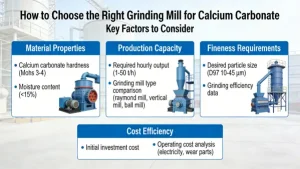
1250-mesh CaCO₃ production requires ultrafine grinding mills with internal/external classification systems—standard Raymond mills cannot reliably reach this fineness .
| Equipment Type | Typical Model | 1250-Mesh Output | Advantages | Disadvantages |
|---|---|---|---|---|
| Ultrafine Vertical Roller Mill | HLMX1300 | 5 t/h | Integrated grinding/classification, low energy consumption, uniform particle size | Higher initial investment |
| Superfine Ring Roller Mill | HGM125 | 4.5–6 t/h | Wide fineness range (150–2000 mesh), 24/7 operation capability | Higher wear on rollers/rings |
| Ball Mill + Air Classifier | Custom Configuration | 3–5 t/h | Mature technology, suitable for small-scale production | Larger footprint, lower efficiency |
Recommendation: For most industrial applications, choose the HLMX series ultrafine vertical mill or HGM series ring roller mill for optimal efficiency and product consistency .
3. Detailed Production Process
Stage 1: Two-Stage Crushing
- Primary Crushing: Use a jaw crusher to reduce raw ore from 0–500 mm to 0–30 mm
- Secondary Crushing: Use a hammer crusher or impact crusher to further reduce particles to 0–5 mm (optimal feed size for ultrafine mills)
- Screening: Remove oversized particles (>5 mm) to protect mill components and ensure stable grinding
Stage 2: Ultrafine Grinding (Core Process)
- Feeding: Use a closed-loop vibrating feeder to maintain a stable, uniform feed rate (critical for consistent fineness and mill stability)
- Grinding Chamber:
- Ultrafine Vertical Mill: 磨辊 (grinding rollers) press material against the grinding disc under high pressure (1.2–1.5x standard Raymond mill)
- Ring Roller Mill: Rollers revolve around the central shaft, grinding material against the ring under centrifugal force and spring pressure
- Airflow System: High-pressure fans generate upward airflow to carry fine particles to the classifier; coarse particles fall back for regrinding
Stage 3: Precision Classification (Critical for 1250-Mesh)
- Classifier Type: High-efficiency dynamic air classifier (rotor speed directly controls fineness)
- Key Parameter: Set rotor speed to 1,800–2,200 rpm (adjust based on real-time particle size analysis)
- Function: Separates particles by size—1250-mesh particles pass through the classifier, while coarser particles return to the grinding chamber
- Upgrade Option: Install a secondary classification system for tighter particle size distribution (D97 control)
Stage 4: Collection & Packaging
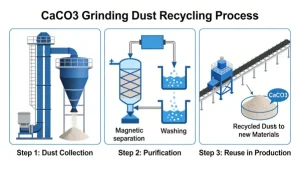
- Cyclone Collector: Captures 95% of qualified fine powder; air is recycled to the fan
- Baghouse Dust Collector: Captures remaining fine powder (ensures environmental compliance and recovers valuable product)
- Packaging: Use automatic weighing/packaging equipment for 25 kg/bag or bulk packaging; store in dry, sealed silos to prevent moisture absorption
Stage 5: Optional Surface Modification
For enhanced compatibility with polymers (plastics, rubber, coatings), add surface modifiers (e.g., stearic acid, titanate coupling agents) during grinding or in a dedicated continuous modifier:
- Addition Rate: 0.5–1.5% of powder weight
- Temperature Control: 80–120°C (optimizes modifier adsorption)
4. Critical Process Parameters for 1250-Mesh Consistency
| Parameter | Optimal Setting | Impact on Fineness |
|---|---|---|
| Classifier Rotor Speed | 1,800–2,200 rpm | Higher speed = finer product; lower speed = coarser product |
| Grinding Pressure | 1.2–1.5x standard | Higher pressure = finer particles but higher wear |
| Feed Size | 0–5 mm | Oversized feed causes vibration; undersized feed reduces grinding efficiency |
| Feed Rate | 80–90% of mill capacity | Stable feed prevents “material starvation” or overloading |
| Airflow Rate | Matched to classifier speed | Insufficient airflow = coarse product; excessive airflow = high energy consumption |
5. Quality Control & Troubleshooting
Quality Control Measures
- Real-Time Monitoring: Use a laser particle size analyzer to test fineness every 30 minutes; adjust classifier speed/grinding pressure as needed
- Batch Testing: Conduct full quality analysis (fineness, whiteness, purity, oil absorption) for each batch
- Preventive Maintenance: Regularly inspect wear parts (rollers, rings, classifier blades) and replace when worn to maintain fineness consistency
Common Issues & Solutions
| Issue | Cause | Solution |
|---|---|---|
| Fineness below 1250-mesh | Low classifier speed, insufficient grinding pressure, worn parts | Increase rotor speed by 100–200 rpm; raise grinding pressure; replace worn rollers/rings |
| Uneven particle size distribution | Poor classifier performance, unstable feed rate | Clean classifier blades; install a vibration-damping feeder |
| Low output | Oversized feed, clogged airflow, worn parts | Recheck crushing process; clean ducts/filters; replace wear parts |
| High energy consumption | Excessive airflow, overloading | Optimize airflow rate; reduce feed rate to 80% capacity |
6. Dry vs. Wet Process for 1250-Mesh CaCO₃
| Aspect | Dry Process | Wet Process |
|---|---|---|
| Fineness Capability | Reliably produces 1250-mesh (D97 ≈10 μm) | Typically used for >2500-mesh (D97 <5 μm) products |
| Investment Cost | Lower (simpler equipment, no wastewater treatment) | Higher (requires slurry handling, drying, wastewater treatment) |
| Energy Consumption | Lower for 1250-mesh production | Higher for 1250-mesh production (drying step is energy-intensive) |
| Application | Ideal for PVC, PE, paints, coatings, paper base coatings | Better for high-end paper surface coatings (requires <2 μm particles) |
Conclusion: The dry process is the most cost-effective and efficient method for 1250-mesh CaCO₃ production .
Final Recommendations
- Equipment: Invest in an HLMX1300 ultrafine vertical mill or HGM125 ring roller mill for stable 1250-mesh production
- Process Control: Implement real-time particle size monitoring and maintain strict control over classifier speed, grinding pressure, and feed rate
- Raw Materials: Use high-purity (≥98%) calcite/limestone with whiteness ≥95% to ensure premium product quality
- Maintenance: Establish a preventive maintenance schedule to replace wear parts and clean equipment regularly
By following this comprehensive approach, you can consistently produce high-quality 1250-mesh CaCO₃ that meets the stringent requirements of paints, coatings, plastics, and paper industries.