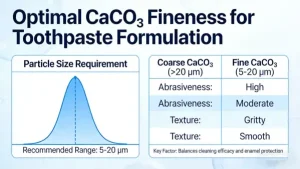
The required fineness of calcium carbonate (CaCO₃) for toothpaste formulation is primarily determined by the CaCO₃ type (precipitated PCC vs. ground/natural GCC) and the intended functionality of the toothpaste, with strict controls on particle size distribution, maximum particle size, and relative dentin abrasion (RDA) value to balance cleaning efficacy, enamel safety, mouthfeel, and paste stability.
1. Standard Particle Size Specifications by CaCO₃ Type
Two main grades of CaCO₃ are used in toothpaste, with distinct industry-standard fineness ranges:
Precipitated Calcium Carbonate (PCC)
PCC is the preferred grade for premium and functional toothpastes due to its uniform particle shape and highly controllable size.
-
Medianparticlesize (D50): 1.5–3.0 μm for most standard formulations, with specialized grades down to 1.5 μm for sensitive/children’s toothpastes.
-
Top size control (D97): ≤ 6.0 μm (97% of particles are smaller than 6 μm) per the Chinese national standard GB/T 23957-2021 for toothpaste-grade PCC.
-
Sieving requirement: ≥ 99.7% passing through a 45 μm (325 mesh) sieve.
-
TargetRDAvalue: 70–100, well below the 150 upper limit recommended by the FDI World Dental Federation for safe daily use.
Ground/Natural Calcium Carbonate (GCC)
GCC is widely used in economy and regular cleaning toothpastes, with formal graded fineness defined by the Chinese industry standard QB/T 2317-2024.
-
Medianparticlesize (D50): 5–12 μm for mainstream commercial grades, with the most widely used global specification at D50 7–9 μm.
-
Graded top size limits (QB/T 2317-2024): 6 official grades from Type A (max particle size 45 μm) to Type F (max particle size 16 μm), all requiring a ≥ 99.0% passing rate for the corresponding sieve size.
-
Sieving requirement: Minimum 99.5% passing through a 45 μm (325 mesh) sieve for all toothpaste-grade GCC.
-
Target RDA value: 80–150, adjusted by particle size for different cleaning performance needs.
2. Fineness Recommendations by Toothpaste Formulation Type
The optimal CaCO₃ fineness is tailored to the toothpaste’s target use case:
-
Daily regular cleaning toothpaste: GCC D50 7–12 μm or PCC D50 2–3 μm, with a hard maximum particle size < 30 μm (to eliminate gritty mouthfeel) and RDA 80–110, balancing cost, cleaning performance, and smooth texture.
-
Whitening toothpaste: GCC D50 8–15 μm with a narrow particle size distribution, strict maximum particle size < 25 μm, and RDA 100–150 (not exceeding the FDI safety limit), to enhance extrinsic stain removal without excessive enamel wear.
-
Children’s or sensitive teeth toothpaste: Ultra-fine PCC D50 1.5–2.5 μm, D97 < 5 μm, and RDA 30–70, for ultra-mild abrasion to protect delicate deciduous teeth and exposed dentin. Particles < 1 μm must be strictly minimized to prevent paste flocculation and “back coarsening” during storage.
-
Premium functional toothpaste (desensitizing, gum care): PCC D50 2–4 μm with a narrow particle size distribution, to ensure consistent mild abrasion, excellent dispersion, and long-term suspension stability in the paste.
3. Critical Non-Negotiable Fineness Controls
-
Particle size distributionmatters more than average size: A narrow distribution is mandatory to eliminate oversized particles (> 30 μm, which cause gritty texture and irreversible enamel damage) and limit ultrafine particles (< 1 μm, which trigger paste flocculation and instability).
-
Mesh size correspondence: All toothpaste-grade CaCO₃ universally requires ≥ 99.5% passing through 325 mesh (45 μm); high-end grades meet 600 mesh (25 μm) full passing, and ultra-fine specialized grades reach 1000 mesh (13 μm) and above.
-
Global safety norms: For EU and US markets, toothpaste-grade CaCO₃ typically has a D50 of 3–10 μm, maximum particle size < 20 μm, and an RDA value capped at 250 (FDA upper limit), with daily-use formulations restricted to < 150 RDA.
Key Industry Standards Reference
- GB/T 23957-2021: Light Calcium Carbonate for Toothpaste Industry (China)
- QB/T 2317-2024: Oral Care Products – Natural Calcium Carbonate for Toothpaste (China)
- FDI World Dental Federation: RDA safety limit for daily-use toothpaste ≤ 150
- US FDA: Maximum allowable RDA for over-the-counter toothpaste ≤ 250