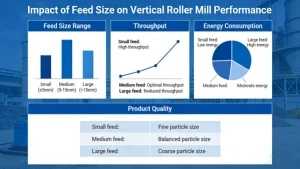
Feed size profoundly impacts vertical roller mill (VRM) performance by shaping material bed stability, grinding efficiency, power consumption, and mechanical integrity. The key takeaway: feed size must stay within a narrow optimal range (typically ≤5% of grinding roller diameter, often 40-100 mm for large VRMs). Oversize particles cause excessive vibration, wear, and energy waste; undersize feed destabilizes the material bed and impairs classification efficiency.
1. Optimal Feed Size Range
VRMs are designed to handle a specific feed size window, defined by the 5% rule: maximum feed size should be ≤5% of the grinding roller diameter.
- Typical ranges: 40-100 mm for large VRMs (up to 120 mm for specialized designs)
- Smaller VRMs: <30-50 mm depending on model
- Critical constraint: 95% of particles must be <3% of roller diameter for stable operation
2. Effects of Excessively Large Feed Size
When feed exceeds the optimal range, performance degrades across key metrics:
a. Grinding Efficiency & Capacity
- Reduced primary grinding efficiency: Large particles resist crushing, requiring more passes and higher circulation loads
- Lower throughput: Production rate decreases by 10-20 t/h for significant size violations
- Elevated power consumption: Increased cycles raise specific energy use by 0.3+ kWh/t
b. Mechanical Stability & Vibration
- Material bed instability: Large particles “prop up” grinding rollers, preventing proper contact and uniform layer formation
- Elevated vibration: Roller “bounce” from uneven loading triggers 1.4→1.1 mm/s vibration increases, risking safety shutdowns
- Component stress: Hydraulic tension rods, cylinders, and seals experience accelerated wear, leading to leaks and pressure loss
c. Wear & Maintenance
- Non-uniform wear: Deep grooves, cracks, and edge chipping on roller and table liners
- Increased external circulation: Unprocessed large particles overload scrapers, causing 松动 / 脱落 and potential blockages
- Higher maintenance frequency: Frequent liner replacement and unscheduled downtime
3. Effects of Excessively Small Feed Size
Undersize feed (overly fine particles) also harms performance, primarily by destabilizing the material bed:
a. Material Bed Instability
- Poor cohesion: Fine particles lack adhesion, increasing fluidization and “collapse” risk
- Cycle instability: Frequent bed collapse triggers periodic operational fluctuations and quality inconsistency
- Operator compensation: Increased water addition to stabilize the bed raises exit moisture, harming downstream processes
b. Grinding & Classification Inefficiency
- Elevated internal circulation: Fine particles recirculate excessively, overgrinding 合格产品 and wasting energy
- Reduced classification precision: Airflow carries fines prematurely, requiring higher separator speeds and lowering throughput
- Higher specific energy: Despite easier grinding, bed instability and overcirculation negate energy savings
4. Mechanistic Explanations
The VRM’s grinding principle—interparticle comminution under roller compression—depends on a stable, permeable material bed:
- Oversize particles: Act as “spacers,” reducing contact area and forcing rollers to work against larger resistance moments
- Undersize particles: Behave like fluid rather than a deformable solid, preventing proper pressure transmission and stable layer formation
- Ideal particle mix: A balanced PSD with coarse “skeleton” particles supporting fines creates a stable, porous bed that enables efficient energy transfer and airflow classification
5. Practical Implications & Optimization
| Problem | Solution | Expected Outcome |
|---|---|---|
| Oversize feed | Adjust crusher settings, install proper screening | Reduce vibration by 20-30%, increase capacity by 5-10% |
| Undersize feed | Optimize upstream crushing to avoid overgrinding | Stabilize bed, reduce water use, improve energy efficiency |
| Wide PSD | Implement pre-classification | Reduce circulation load, lower power consumption by 0.2-0.5 kWh/t |
| Feed size variation | Install real-time particle monitoring | Maintain consistent performance, extend component life |
6. Industry Best Practices
- Follow the 5% rule: Design crushing circuits to ensure ≤5% of roller diameter as maximum feed size
- Prioritize particle uniformity: Control PSD to minimize extreme sizes at both ends
- Adopt “more crushing, less grinding”: Optimize upstream crushing to reduce VRM load and improve overall energy efficiency
- Monitor and adjust: Use vibration sensors and particle analyzers to detect size-related issues early
Conclusion
Feed size is a primary determinant of VRM performance, with consequences spanning throughput, energy efficiency, mechanical wear, and operational stability. By adhering to the ≤5% roller diameter guideline and maintaining a balanced particle size distribution, operators can maximize capacity, minimize power consumption, and extend equipment life—core objectives for sustainable grinding operations.