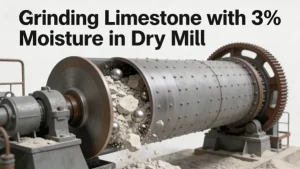
Yes, you can grind limestone with 3% moisture content in a dry mill—this moisture level is well within the typical acceptable range for dry grinding of limestone (generally 0–5% for most dry milling equipment). Limestone’s low plasticity and 3% moisture (a low-moisture condition) will not cause severe issues like excessive material adhesion, mill choking, or grinding efficiency collapse, provided you make minor process and equipment adjustments to mitigate mild adhesion risks.
Key Considerations for Dry Milling 3% Moisture Limestone
The core goal is to enhance ventilation/drying and prevent mild agglomeration/adhesion—simple tweaks to standard dry grinding operations are sufficient, with no need to switch to wet grinding.
1. Equipment TypeCompatibility(Most Common Dry Mills)
All mainstream dry grinding equipment for limestone works with 3% moisture; performance varies slightly, and no major modifications are needed:
Ball mill (tube mill): Best choice—the most widely used for limestone dry grinding. Its tumbling grinding body (steel balls/segments) breaks up mild agglomerates, and the open/closed circuit ventilation system easily removes residual moisture.
Raymond mill (suspension roller mill): Fully applicable—ensure good sealing of the roller/ring grinding zone and unobstructed air flow to avoid minor adhesion on the grinding surface.
Dry vertical mill: Suitable—its integrated air classification and high-velocity air flow in the mill efficiently carry away moisture and fine powder, preventing agglomeration in the grinding chamber.
Hammer mill/impact mill: For coarse grinding (≤200 mesh), no issues—high-speed impact shatters wet lumps, and positive pressure ventilation removes moisture quickly.
2. Optimize Ventilation & Mild In-Mill Drying (Critical Step)
Even 3% moisture requires boosted ventilation to eliminate residual moisture and carry fine powder out of the mill (avoids adhesion to mill liners/grinding media):
Airvolume/temperature: Use ambient air (25–35℃) for natural drying (sufficient for 3% moisture) or slightly raise the inlet air temperature to 80–120℃ (low-temperature drying, no fuel waste) for faster moisture removal—no need for high-temperature hot air (≥200℃).
Air flow path: Ensure unobstructed air flow in the mill and efficient dust collection (bag filter/cyclone) for the outlet air; maintain negative pressure in the mill to prevent dust leakage and ensure moisture is fully carried away.
3. Pre-Treat the Feed Material
3% moisture limestone may form small lumps during storage/transport—break up lumps before feeding (use a small crusher/disperser) to avoid choking the mill’s feed port and ensure uniform grinding. Blocky limestone (feed size ≤25–30mm, matching mill requirements) is far less prone to adhesion than powdery wet limestone, so avoid pre-crushing to fine powder before dry grinding.
4. Grinding Media & LinerMaintenance
Maintain the standard grinding media gradation for limestone dry grinding (e.g., steel balls of different diameters for ball mills) to ensure sufficient impact/crushing force to break up mild agglomerates.
Use wear-resistant liners (e.g., high manganese steel) for the mill body—they have low surface adhesion, and minor residual material can be easily cleaned during regular maintenance (no need for frequent shutdowns).
5. Adjust for ProductFinenessRequirements
Coarse/medium grinding (≤325 mesh): No fineness issues—3% moisture with good ventilation will not cause fineness deviation.
Ultra-fine grinding (≥1250 mesh): Mild agglomeration of fine limestone powder may occur (due to surface moisture). Strengthen the airclassifier (e.g., adjust classifier speed) or add a small amount of dry grinding aid (e.g., triethanolamine, in trace doses: 0.05–0.1% of feed weight) to prevent agglomeration and improve classification efficiency.
Special Edge Case to Avoid
If the dry mill has poor ventilation (e.g., blocked air ducts, aging dust collectors), or grinding is performed in low-temperature, high-humidity environments (e.g., winter with mill condensation), 3% moisture may cause slight adhesion on grinding media/liners. Fix this by:
Cleaning/repairing the ventilation/dust collection system;
Raising inlet air temperature to 100–120℃ to eliminate condensation;
Blending a small amount of dry limestone return material (moisture ≤1%) into the feed to dilute the 3% moisture.
3% moisture is a routine working condition for limestone dry grinding—no need for wet milling conversion. With basic optimizations (enhanced ventilation, lump dispersing, normal equipment maintenance), all standard dry mills will achieve stable grinding efficiency, qualified product fineness, and no major operational issues (e.g., choking, excessive adhesion).