Core Feasibility & Compatible Matrix
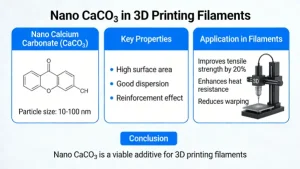
Nano CaCO₃ is primarily compounded with mainstream thermoplastic polymer matrices for filament production via twin-screw melt extrusion, the standard industrial process for 3D printing filament manufacturing. Compatible matrices include:
- Polylactic acid (PLA), the most common desktop 3D printing material
- Polypropylene (PP), acrylonitrile-butadiene-styrene (ABS), PETG, TPU, and other engineering thermoplastics
Surface-modified nano CaCO₃ (with stearic acid, silane, or titanate coupling agents) is required to improve compatibility with non-polar polymer matrices, prevent nanoparticle agglomeration, and ensure uniform dispersion in the filament.
Key Performance Benefits for 3D Printing Filaments
-
Mechanical PropertyOptimization
Nano CaCO₃ acts as an efficient nucleating agent, accelerating the crystallization rate and increasing crystallinity of the polymer matrix. At optimal loadings (typically 1–10 wt%), it simultaneously enhances stiffness, tensile modulus, and impact toughness, addressing the inherent brittleness of pure PLA and PP. For example, 3 wt% modified nano CaCO₃ can increase the impact strength of PP by ~65%, while 6 wt% loading can boost the elongation at break of modified PP composites to over 1600%.
-
Improved Dimensional Stability & Printability
The addition of nano CaCO₃ significantly reduces molding shrinkage and warpage of printed parts, a critical pain point for FDM 3D printing, especially for large-format components. It also optimizes the melt rheology of the composite, improving extrusion stability during filament production and printing consistency, with minimal negative impact on melt flowability at low-to-moderate loadings.
-
Functional & Economic Advantages
- It imparts a high-quality matte surface finish to printed parts, a desirable feature for decorative, cosplay, and prototype applications.
- It enhances thermal stability, heat deflection temperature, and even flame retardancy of the composite filament.
- As a low-cost mineral filler, it reduces raw material costs while maintaining or improving core performance, making it attractive for industrial-scale filament production.
Critical Technical Considerations
-
Surface modification is mandatory: Unmodified nano CaCO₃ is prone to severe agglomeration, which causes filament breakage, nozzle clogging, and degraded mechanical properties of printed parts.
-
Loading control: Excessively high filler content (>15 wt%) will lead to reduced melt fluidity, increased brittleness, and weakened interlayer bonding strength of printed parts, while too low loading provides negligible performance benefits.
-
Dispersionquality: Uniform dispersion via twin-screw compounding is essential to ensure consistent filament diameter tolerance and stable printing performance.
Current Applications
Nano CaCO₃-modified filaments are used in both academic research and commercial production, including low-cost high-performance functional filaments, matte finish filaments, and toughened engineering filaments for automotive prototypes, architectural models, and general-purpose functional parts. It is also widely used in cementitious 3D printing materials to improve early strength and printability.