GCC (Ground Calcium Carbonate)cannot achieve 100% full replacement of PCC (Precipitated Calcium Carbonate) in the vast majority of high-end coating systems. It can only realize limited partial replacement (blended use) in some mid-to-high end coating scenarios, while full replacement is only feasible in a few high-end coating sub-scenarios with lenient performance requirements, and must be premised on professional surface modification and formula optimization.
1. Fundamental Performance Gap (Root Cause of Replacement Limitation)
The essential difference in production processes determines the irreplaceable core advantages of PCC in high-end coatings:
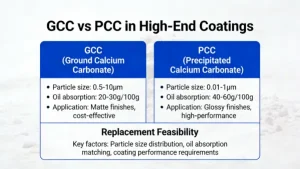
| Key Performance for Coatings | GCC (Ground Calcium Carbonate) | PCC (Precipitated Calcium Carbonate) |
| Particle Morphology & Size Distribution | Produced by physical grinding, with irregular particle shape, wide particle size distribution, and uncontrollable crystal form |
Synthesized by chemical precipitation, withcontrollable crystal form(cubic, spindle, chain-like, etc.), narrow particle size distribution, and highly regular morphology
|
| Oil Absorption Value | 15-30 ml/100g (low) | 40-80 ml/100g (high, tunable) |
| Specific Surface Area & Surface Activity | Low specific surface area, weak surface activity, poor pigment stabilization ability | Larger specific surface area, high surface activity, excellent dispersion in resin matrix, strong ability to prevent pigment floating/flooding |
| Rheological & Thixotropic Properties | Poor thixotropic adjustment and anti-settling performance | Excellent thixotropy and anti-settling performance (especially chain/needle-shaped PCC), critical for high-build and anti-corrosion coatings |
| Optical Properties | Irregular particles increase light scattering, which reduces gloss and transparency | Uniform nano-scale particles provide superior hiding power, high gloss retention, and transparency for clear coats |
2. Scenarios Where Partial/Limited Replacement is Feasible
In these scenarios, surface-modified ultra-fine GCC can partially replace PCC (usually with a replacement ratio of ≤50%) to reduce formula costs, without significantly compromising core coating performance:
-
Mid-to-high end architectural latex paints(matte/semi-gloss interior and exterior flat coatings): Modified GCC can replace part of PCC, with formula adjustments to dispersants and rheological additives to maintain application performance.
-
General powder coatings: GCC’s low oil absorption can increase filler loading, reduce melt viscosity, and improve coating leveling, with a typical replacement ratio controlled below 30%.
-
Mid-range industrial anti-corrosion primers & intermediate coats: For systems with low requirements on thixotropy and appearance, modified GCC can partially replace PCC, with verification of anti-settling and corrosion resistance.
3. Scenarios Where Full Replacement is Completely Unfeasible
In these high-end coating fields, PCC’s customized performance cannot be matched by GCC, and full replacement will lead to a fatal decline in coating quality:
-
AutomotiveOEMoriginal paints(topcoats, intermediate coats, electrophoretic paints): Extremely strict requirements on gloss, leveling, weather resistance, and stone chip resistance. GCC will cause gloss reduction, poor leveling, and defective orientation of metal flakes in metallic paints, which cannot meet OEM quality standards.
-
High-gloss/high-transparency wood topcoats(PU, UV topcoats): Ultra-high requirements for coating fullness, gloss, and transparency. GCC’s irregular particles will increase light scattering, resulting in a significant drop in gloss and haze, which cannot meet the requirements of high-end furniture coatings.
-
High-end waterborne industrial topcoats(rail transit, construction machinery, coil coatings): Strict requirements for rheological stability, salt spray resistance, and long-term weather resistance. PCC’s thixotropic control and anti-corrosion synergy cannot be replicated by GCC.
-
High-end special functional coatings(fire-retardant, antibacterial, insulating coatings, high-end printing inks): Extremely high requirements for filler purity, particle size uniformity, and surface activity. PCC’s customizable crystal form and surface properties are irreplaceable.
4. Industry Trends & Key Prerequisites
-
Technological progress: Wet-process ultra-fine GCC and nano-modified GCC have narrowed the performance gap with PCC, increasing the upper limit of partial replacement ratio, but still cannot break through the core performance bottleneck of irregular particle morphology.
-
Core driver of replacement: Cost reduction is the main motivation. The price of GCC is usually only 1/3 to 1/2 of that of PCC, so partial replacement is widely used in cost-sensitive mid-to-high end systems.
-
Mandatory prerequisite: Any GCC replacement for PCC in high-end coatings must be based onsurface modification(silane, titanate, stearic acid, etc.) of GCC, plus comprehensive formula optimization; unmodified GCC will directly cause serious coating defects.
-
Core principle: For high-end coatings, performance is the first priority, and cost sensitivity is low. Therefore, the irreplaceability of PCC in high-performance systems remains extremely strong in the industry.