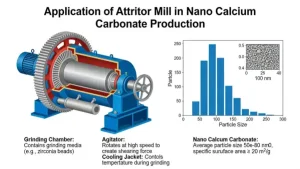
Attritor mills (also known as stirred ball mills/tower mills) are highly suitable for the production of nano calcium carbonate (nano CaCO₃, D97=0.1–1 μm), and they have become the core wet ultrafine grinding equipment for nano CaCO₃ manufacturing in the industry. Notably, attritor mills are exclusively used in wet grinding processes for nano CaCO₃ (dry grinding with attritor mills is ineffective for nano-scale preparation due to severe powder agglomeration). They are applicable for both nano heavy calcium carbonate (nano GCC) (mechanical grinding of calcite/limestone to nano grade) and nano precipitated calcium carbonate (nano PCC) (particle size homogenization/refinement of chemically synthesized PCC), perfectly meeting the technical requirements of nano CaCO₃ for high-end applications (e.g., lithium battery separators, high-grade coatings, nano composites).
Key Reasons for Attritor Mill’s Adaptability to Nano CaCO₃ Wet Grinding
Attritor mills rely on the high-intensity shear and impact force between ultra-fine grinding media and CaCO₃ slurry, combined with the anti-agglomeration effect of wet dispersion systems. This grinding principle is highly matched with the characteristics of CaCO₃ (low hardness, Mohs 2.7–3, brittle) and the technical pain points of nano powder preparation (easy agglomeration). The core advantages are as follows:
-
Ultra-fine grinding capability for nano-level particle size
Attritor mills use ultra-fine grinding media (zirconia beads, alumina beads, particle size 0.1–1 mm) with high filling rate (60–80% of the mill cavity volume). The high-speed rotating stirrer drives the grinding media to form intense turbulent motion, generating micro-shear force that can effectively crush fine CaCO₃ particles (1–5 μm) into 0.1–1 μm nano-scale particles—the core particle size range of industrial nano CaCO₃.
-
Wet grinding avoids nano powder agglomeration
Nano CaCO₃ particles have large specific surface area and strong surface tension, and dry grinding will cause serious irreversible agglomeration (forming large particle clusters). Attritor mills adopt a water-based slurry grinding system (adding dispersants), which uses the steric hindrance and electrostatic repulsion of dispersants to isolate nano particles in the slurry, ensuring the grinding product is a well-dispersed nano CaCO₃ slurry and avoiding invalid grinding caused by agglomeration.
-
Narrow particle size distribution (PSD) of products
The grinding process of attritor mills is a closed and continuous slurry circulation system, with no violent mechanical impact (unlike ball mills) and no over-grinding of particles. The produced nano CaCO₃ has a narrow PSD (no coarse particle tailing), which is a key index for high-end nano CaCO₃ applications (e.g., lithium battery separators require narrow PSD to ensure uniform coating).
-
Integrated grinding and surface modification
Attritor mills can realize one-step grinding and surface modification of nano CaCO₃ by adding surface modifiers (e.g., stearic acid, titanate coupling agent) directly into the grinding slurry. The high-shear force in the mill cavity promotes the uniform adsorption of modifiers on the surface of nano CaCO₃ particles, avoiding the uneven modification caused by post-grinding mixing and simplifying the production process of modified nano CaCO₃.
-
Low energy consumption and high grinding efficiency
Compared with dry nano grinding equipment (e.g., air jet mills, unit energy consumption 200–500 kWh/t), attritor mills for wet nano CaCO₃ grinding have a 30–60% lower unit energy consumption (about 80–150 kWh/t). The high filling rate of grinding media and efficient utilization of shear force make it suitable for large-scale industrial production of nano CaCO₃.
Critical Technical Optimization for Attritor Mill in Nano CaCO₃ Production
To ensure the grinding efficiency, product purity and dispersion of nano CaCO₃, attritor mills need targeted optimization for the characteristics of CaCO₃ and nano powder preparation, with the following core points:
-
Grinding media selection (purity and particle size are key)
Choose yttrium-stabilized zirconia beads (hardness Mohs 9.5, density 6.0 g/cm³) as the preferred grinding media—they have high hardness, low wear rate, and no metal ion precipitation, avoiding the introduction of iron/heavy metal impurities into nano CaCO₃ (a strict requirement for high-end applications such as lithium batteries and food-grade nano CaCO₃). The particle size of grinding media is matched with the target particle size: 0.1–0.3 mm beads for D97<0.5 μm nano CaCO₃, and 0.5–1.0 mm beads for D97=0.5–1 μm nano CaCO₃.
-
Dispersion system optimization (anti-agglomeration core)
Configure a water-based slurry with solid content 30–60% and add CaCO₃-special anionic dispersants (dosage 0.2–1.0% of CaCO₃ mass), such as sodium hexametaphosphate, sodium polyacrylate, and ammonium polycarboxylate. For nano GCC, sodium hexametaphosphate is preferred (good adsorption on calcite surface); for nano PCC, sodium polyacrylate is more suitable (matching the crystal surface properties of precipitated CaCO₃). The dispersant effectively reduces the slurry viscosity and prevents nano particle agglomeration during grinding.
-
Grinding parameter adjustment
-
Stirrer speed: 800–1500 rpm (medium speed for high viscosity slurry, high speed for low viscosity slurry, to avoid grinding media sedimentation and ensure sufficient shear).
-
Grinding time: 2–8 h (adjust according to target particle size; longer grinding time for smaller nano particles, but avoid over-grinding to reduce energy consumption).
-
Slurry temperature control: Equip the mill cavity with a cooling water jacket to control the slurry temperature at 25–40℃. Excessively high temperature will cause the dispersant to decompose and lose efficacy, leading to nano particle agglomeration; it can also cause crystal form changes of some nano PCC (e.g., aragonite to calcite).
-
Equipment material selection (impurity control)
Use zirconia ceramic or high-purity alumina ceramic for the mill cavity lining and stirrer paddle, instead of carbon steel or ordinary stainless steel. This avoids metal wear debris mixing into the nano CaCO₃ slurry and ensures the product’s low iron content (Fe₂O₃ < 0.01%)—a key quality index for high-end nano CaCO₃.
Application Scenarios of Attritor Mill in Nano CaCO₃ Industry
Attritor mills are the most widely used wet grinding equipment in the nano CaCO₃ industry, covering the entire production chain of nano GCC and nano PCC, with the main application scenarios:
-
Nano GCC wet deep grinding
Grind the pre-ground ultrafine GCC slurry (D97=1–5 μm) into D97=0.1–1 μm nano GCC slurry for high-end applications such as water-based industrial coatings (improving coating scratch resistance and gloss), plastic masterbatches (enhancing tensile strength), and papermaking (nano coating for high-grade paper).
-
Nano PCC particle size homogenization and refinement
Chemically synthesized nano PCC often has uneven particle size (with a small amount of coarse particles). Attritor mills are used to grind the PCC slurry to homogenize the particle size, eliminate coarse particles, and improve the uniformity of nano PCC—critical for its application in lithium battery separators (uniform coating to ensure battery safety).
-
Modified nano CaCO₃ one-step preparation
Add surface modifiers (e.g., stearic acid, aluminate coupling agent) into the grinding slurry of attritor mills. The high-shear force in the mill cavity promotes the chemical reaction between the modifier and the surface of nano CaCO₃ particles, realizing one-step grinding and surface modification. This process avoids the uneven modification of post-grinding mixing and improves the compatibility of nano CaCO₃ with organic polymers (e.g., PP, PE).
-
Small-batch trial production and large-scale industrial production
Attritor mills have a complete model series, from small laboratory models (0.5–5 L) for small-batch trial production of nano CaCO₃ to large industrial models (100–5000 L) for continuous production (output 1–10 t/h). They can meet the diversified production needs of the nano CaCO₃ industry.
Attritor Mill vs. Other Nano CaCO₃ Grinding Equipment (Advantages & Limitations)
The nano CaCO₃ industry also uses air jet mills and bead mills for grinding, but attritor mills have become the mainstream due to their comprehensive advantages in grinding efficiency, product quality and production cost. The detailed comparison is as follows:
|
Equipment
|
Grinding Method
|
Target Particle Size
|
Unit Energy Consumption
|
Production Cost
|
Core Advantages
|
Core Limitations
|
|
Attritor Mill
|
Wet (slurry)
|
D97=0.1–1 μm (nano)
|
80–150 kWh/t
|
Low
|
Narrow PSD, anti-agglomeration, integrated grinding/modification, large-scale production
|
Need post-treatment (solid-liquid separation, drying)
|
|
Air Jet Mill
|
Dry (powder)
|
D97=0.5–5 μm (sub-nano/nano)
|
200–500 kWh/t
|
High
|
No post-treatment, dry powder product
|
Severe nano powder agglomeration, wide PSD, high energy consumption
|
|
Horizontal Bead Mill
|
Wet (slurry)
|
D97=0.2–2 μm (nano/ultrafine)
|
100–180 kWh/t
|
Medium
|
High grinding speed, short time
|
Unsuitable for high-viscosity slurry, easy grinding media sedimentation
|
|
Vertical Roller Mill (VRM)
|
Dry (powder)
|
D97=1–10 μm (ultrafine)
|
40–80 kWh/t
|
Low
|
Large capacity
|
Cannot reach nano level, severe agglomeration
|
Key Technical Notes for Attritor Mill in Nano CaCO₃ Production
-
Slurry post-treatment (avoid agglomeration during drying)
The nano CaCO₃ slurry ground by attritor mills needs to go through solid-liquid separation (filter press, centrifugal separation) and low-temperature drying (spray drying, freeze drying) to avoid irreversible agglomeration of nano particles during high-temperature drying. Spray drying is the mainstream industrial process (drying temperature 80–120℃), which can produce nano CaCO₃ powder with good dispersibility.
-
Grinding media maintenance
Zirconia beads have low wear rate (wear loss < 0.01%/h), but long-term use will still cause particle size reduction and loss. Regularly screen and supplement grinding media to ensure the grinding efficiency and product quality of nano CaCO₃.
-
Impurity removal of raw materials
The raw materials (ultrafine GCC powder, PCC slurry) need to be pretreated to remove iron impurities (e.g., magnetic separation for GCC, filtration for PCC slurry) to avoid damaging the grinding media and lining of attritor mills, and to ensure the low iron content of nano CaCO₃.
-
Slurry viscosity control
The viscosity of the grinding slurry is controlled at 500–2000 mPa·s. Too high viscosity will lead to slow slurry circulation and low grinding efficiency; too low viscosity will cause insufficient collision between grinding media and CaCO₃ particles, resulting in ineffective grinding. Adjust the solid content and dispersant dosage to control the slurry viscosity.
Attritor mills are the optimal choice for the wet production of industrial nano CaCO₃ (D97=0.1–1 μm), and they are the core equipment for the technological upgrading of the CaCO₃ industry to the nano field. Their wet grinding principle fundamentally solves the technical pain point of nano CaCO₃ agglomeration, and the integrated grinding and modification function simplifies the production process and improves product added value.
Compared with dry grinding equipment (e.g., air jet mills), attritor mills have lower energy consumption and narrower product particle size distribution; compared with other wet grinding equipment (e.g., horizontal bead mills), they are more suitable for high-viscosity CaCO₃ slurry and large-scale industrial production. For the preparation of ultra-nano CaCO₃ (D97<0.1 μm), attritor mills can be used in combination with high-pressure homogenizers (attritor mill for primary nano grinding + high-pressure homogenizer for secondary ultra-nano grinding) to meet the ultra-fine particle size requirements of cutting-edge applications (e.g., nano biomaterials).