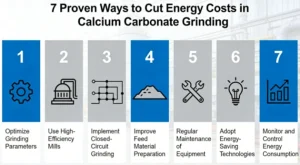
Calcium carbonate (CaCO₃) grinding is an energy-intensive core process in non-metallic mineral processing, with energy costs accounting for a large proportion of the total production cost. The following 7 proven, practical energy-saving methods are tailored to the characteristics of CaCO₃ dry/wet grinding processes, combining equipment optimization, process adjustment, and operational management—all verified by industrial applications to effectively reduce energy consumption per unit of finished product.
Optimize Grinding Equipment Configuration & Select Energy-Efficient Mill Models
The mill is the core energy consumer in CaCO₃ grinding, and equipment selection/upgrading is the most direct energy-saving measure.
Replace traditional low-efficiency mills: Phase out old ball mills with low grinding efficiency (energy utilization rate only 2%~5%) for vertical roller mills (VRM), airclassifiermills, or ultrafine impact mills—these energy-efficient models have an energy utilization rate of 15%~25%, and can reduce unit energy consumption by 30%~50% for the same fineness of CaCO₃ (e.g., 325 mesh heavy calcium carbonate).
Matching mill andclassifier: Use a high-efficiency dynamic air classifier with the mill (instead of traditional static classifiers). The classifier’s precision directly affects the mill’s cyclic load—high-precision classification reduces over-grinding of CaCO₃ particles, cutting useless energy consumption caused by repeated grinding by 20%~30%.
Large-scale equipment transformation: For batch production, replace multiple small mills with a single large-scale mill. Large mills have a higher volume-to-power ratio, and their unit energy consumption for grinding CaCO₃ can be reduced by 15%~20% due to the scale effect.
Preprocess Raw Materials to Reduce Grinding Load
CaCO₃ raw ore (calcite, limestone) with large particle size, high moisture, or mixed impurities will significantly increase the mill’s grinding resistance and energy consumption. Preprocessing can effectively lighten the subsequent grinding load:
Fine crushing pre-grinding: Optimize the crushing process to reduce the feed particle size of the mill—for example, crush raw ore from the traditional 20~30 mm to 5~8 mm (fine crushing to sand size). According to the grinding energy consumption law (Bond’s law), the energy consumption of grinding is inversely proportional to the square root of the feed particle size, which can reduce grinding energy consumption by 25%~35%.
Moisture control: For dry grinding, control the moisture content of CaCO₃ raw materials below 0.5%~1.0%. Excess moisture will cause particle agglomeration in the mill, increase grinding resistance, and even block the classifier. Use a low-energy hot air dryer (waste heat utilization preferred) for drying to avoid energy waste caused by wet material grinding.
Impurity removal: Remove hard impurities (e.g., quartz, feldspar) from raw ore by magnetic separation or gravity separation—hard impurities will accelerate mill liner/grinding medium wear and increase grinding energy consumption, and their removal can reduce unit energy consumption by 5%~10% while improving product quality.
Optimize Grinding Medium Parameters (for Ball/Tube Mills)
For enterprises still using ball mills (common in small and medium-sized CaCO₃ processing plants), optimizing the grinding medium is a low-cost, quick-effect energy-saving method with no need for large equipment investment:
Reasonable grading of grinding media: Adopt a multi-stage grading matching of steel balls/steel rods (large, medium, small) according to the feed particle size and finished product fineness of CaCO₃. The large grinding medium is responsible for crushing coarse particles, and the small one for fine grinding—this improves the grinding efficiency by 15%~20% compared with single-size grinding media.
Control grinding medium filling rate: The optimal filling rate of CaCO₃ grinding is 40%~45% (for ball mills). Excess filling will cause mutual collision and friction of grinding media (useless energy consumption), while insufficient filling will reduce the grinding contact area. Adjust the filling rate according to the mill’s load to keep it in the optimal range.
Use high-wear-resistance grinding media: Replace ordinary steel balls with high-chromium alloy grinding media (chromium content ≥20%). Their wear resistance is 3~5 times that of ordinary steel balls, reducing the frequency of adding grinding media and avoiding the decrease of grinding efficiency caused by worn media—indirectly reducing energy consumption by 8%~12%.
Utilize Waste Heat & Optimize Drying/Grinding Heat Supply System
Dry grinding of CaCO₃ requires hot air for drying and powder conveying, and the heat supply system is a secondary energy consumption point. Waste heat utilization can completely or partially replace traditional heat sources (boilers, electric heaters):
Recycle flue gas waste heat from production: Collect waste heat flue gas (150~300℃) from calcium carbonate calcination, cement production, or other industrial furnaces in the plant, and use it as the hot air source for dry grinding after dust removal and temperature adjustment. This can reduce the energy consumption of the heat supply system by 60%~80%.
Circulate tail gas of the grinding system: The tail gas from the mill/classifier (temperature 80~120℃, low moisture) is recycled to the grinding system after dust removal—mix it with fresh hot air to adjust the inlet air temperature and humidity. This recycles the sensible heat of the tail gas, reducing the heat required for fresh hot air by 30%~40%.
Optimize hot air distribution: Adopt a variable frequencyair supply system to adjust the hot air volume and temperature according to the moisture content of raw materials and the fineness of finished products. Avoid excessive hot air supply (causing heat waste) or insufficient supply (causing material agglomeration).
Adopt Variable Frequency Speed Regulation (VFD) for Key Auxiliary Equipment
CaCO₃ grinding systems include a large number of auxiliary equipment (fans, conveyors, feeders, pumps) with fixed speed operation in traditional processes—they run at full load even under low production capacity, resulting in serious “throttling loss” and energy waste. Variable frequency speed regulation can realize energy-saving operation according to the actual load:
VFDfor main fans and classifiers: The exhaust fan of the mill and the fan of the classifier are the main auxiliary energy consumers (accounting for 20%~30% of the total system energy consumption). Install VFD to adjust the speed according to the grinding load and finished product fineness—when the production capacity is reduced by 50%, the energy consumption of the fan can be reduced by about 75% (energy consumption of fans is proportional to the cube of speed).
VFDfor feeders and conveyors: Adjust the feeding speed of CaCO₃ raw materials in real time according to the mill’s load (detected by current, vibration, etc.). Avoid over-feeding (causing mill blockage and high energy consumption) or under-feeding (causing mill idling). Variable frequency control can reduce the energy consumption of feeders/conveyors by 25%~40%.
Unified energy control system: Connect all variable frequency equipment to a central control system, and realize automatic matching of mill load, feeding speed, hot air volume, and classifier speed—avoid manual operation errors and keep the entire grinding system in the optimal energy-saving operating state.
Reduce Over-Grinding & Optimize Product Fineness Control
Over-grinding is a common problem in CaCO₃ grinding—excessive grinding of fine particles that meet the fineness requirements not only wastes energy but also affects the product’s particle size distribution (PSD) and application performance. Precise fineness control can eliminate over-grinding:
Real-timeonlinefinenessdetection: Install a laser particle size analyzer at the classifier’s discharge port to detect the fineness of CaCO₃ finished products in real time (e.g., D97. D50). Link the detection data with the classifier’s frequency converter to automatically adjust the classifier’s speed—immediately correct the fineness deviation and avoid over-grinding caused by excessive classification speed.
Set reasonablefinenesstolerance: According to customer requirements, set a small and reasonable fineness tolerance (instead of pursuing ultra-fine fineness beyond the demand). For example, if the customer requires 325 mesh (D97 ≤45 μm), control the finished product at 42~45 μm—avoid grinding to 38~40 μm (over-grinding) which will increase energy consumption by 15%~25% for no added value.
Optimizeparticle size distribution: For CaCO₃ products used in plastics, coatings, and other fields, a reasonable PSD (wide distribution) can improve the product’s filling performance and reduce the requirement for ultra-fine particles. Adjust the grinding process to produce products with optimal PSD—reduce the content of ultra-fine particles (<10 μm) that require high grinding energy, and cut unit energy consumption by 10%~18%.
Strengthen Equipment Daily Maintenance & Operational Management
Poor equipment maintenance and non-standard operation will lead to a gradual decline in grinding efficiency and a continuous increase in energy consumption. Standardized management can maintain the equipment’s optimal operating state and avoid unnecessary energy waste:
Regular maintenance of mill liners and grinding media: Inspect the mill liner wear every 1~2 months—replace the seriously worn liner in time (the worn liner will reduce the grinding contact area and increase energy consumption). Check the grinding media wear and supplement new media regularly to keep the grading matching unchanged.
Reduce system air leakage: The dry grinding system of CaCO₃ is a closed negative pressure system—air leakage at the mill, classifier, pipeline, and valve joints will cause the hot air volume to decrease, the system pressure to be unstable, and the grinding efficiency to drop. Regularly check and seal the air leakage points—reducing air leakage rate from >15% to <5% can reduce fan energy consumption by 10%~15%.
Standardize operator training: Train operators to master the optimal operating parameters (mill load, feeding speed, hot air temperature, classifier speed) for different CaCO₃ raw materials and finished product fineness. Avoid random parameter adjustment caused by human factors—ensure the system runs stably at the energy-saving point for a long time.
Establish energy consumption accounting system: Count the unit energy consumption (kWh/ton) of CaCO₃ grinding per shift/day, and set an energy-saving assessment indicator. Link the indicator with the operator’s performance to stimulate the initiative of energy-saving operation.
Key Energy-Saving Effect Summary
Combining the above 7 methods, the comprehensive unit energy consumption of calcium carbonate grinding can be reduced by 40%~60% (specific effect depends on the original process and equipment level). For a medium-sized CaCO₃ processing plant with an annual output of 100.000 tons of 325 mesh heavy calcium carbonate, this can save millions of yuan in energy costs every year—while improving product quality and production efficiency.
The core of energy saving in CaCO₃ grinding is to improve energy utilization rate and eliminate useless energy consumption—it is not a single measure, but a systematic optimization of equipment, process, and management. Enterprises can select the suitable combination of methods according to their own production scale, equipment type, and product requirements, and implement them step by step to achieve the best energy-saving and cost-reducing effect with the least investment.
Additional Industrial Tip
For enterprises planning to expand production or upgrade processes, the integrated grinding-classification-drying system (e.g., vertical roller mill system) is the first choice—it integrates all processes into one set of equipment, with compact layout, low system energy consumption, and easy automatic control, and is the mainstream development direction of energy-saving grinding of calcium carbonate.