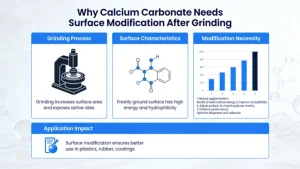
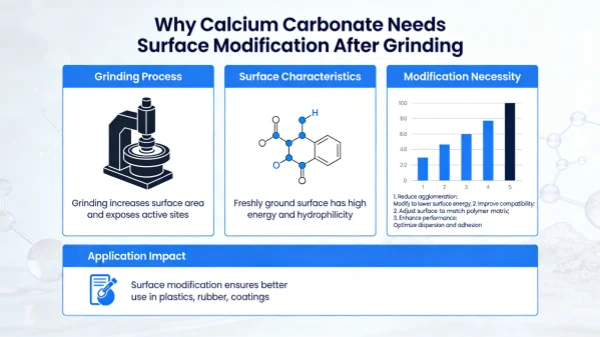
Calcium carbonate (CaCO₃) requires surface modification after grinding primarily because the raw ground CaCO₃ powder has inherent inorganic surface characteristics that lead to poor compatibility with organic matrices (e.g., plastics, rubber, coatings, inks), severe agglomeration, and limited functional performance. Surface modification is a core processing step that alters the surface physical and chemical properties of CaCO₃ powder—converting its hydrophilic, oleophobic inorganic surface to hydrophobic/oleophilic (or selectively hydrophilic for water-based systems), reducing agglomeration, and enhancing interfacial bonding with organic materials.
In short, grinding only refines the particle size of CaCO₃ to meet the fineness requirements of different applications, while surface modification unlocks the full application value of ground CaCO₃—turning it from a simple low-grade filler into a high-performance functional reinforcing filler that can improve product performance and reduce production costs.
Core Reasons for Surface Modification of Ground CaCO₃
1. Eliminate surface hydrophilicity and improvecompatibilitywith organic matrices
Ground CaCO₃ powder has a large specific surface area, and its surface is rich in hydroxyl groups (-OH) due to the crystal structure and grinding process—this gives it a strong hydrophilic, oleophobic characteristic. Most downstream applications of CaCO₃ involve blending with organic polymers (plastics, rubber, synthetic resins in coatings/inks), which are hydrophobic/oleophilic.
Without modification: The polar inorganic surface of CaCO₃ cannot form effective bonding with the non-polar organic matrix; there is a clear interface gap between the two phases. This leads to poor dispersion, phase separation during processing, and even “powder falling” in the final product.
With modification: Modifiers (e.g., stearic acid, titanate coupling agents, silane coupling agents) chemically adsorb or react with the hydroxyl groups on the CaCO₃ surface, covering the inorganic surface with a layer of organic hydrophobic groups. This makes the CaCO₃ surface have the same polarity as the organic matrix, achieving good interfacialcompatibilityand wetting—the powder can be uniformly dispersed in the organic system like a “organic particle”.
2. Reduceparticleagglomeration and improvedispersionuniformity
Grinding reduces CaCO₃ to micro/nano-scale particles, which have high surface energy. Under the action of van der Waals forces and hydrogen bonds (caused by surface hydroxyls), the fine particles tend to agglomerate into large secondary particles—even if ground to the required fineness, the agglomerated secondary particles cannot be uniformly dispersed in the matrix, which directly affects the performance of the final product (e.g., coating gloss, plastic toughness).
Surface modification reduces the surface energy of CaCO₃ particles by coating the surface with organic groups, and the organic modifier layer forms a steric hindrance effect between particles—preventing the re-agglomeration of fine particles and ensuring that the primary particles are stably and uniformly dispersed in the application system.
3. Enhance interfacial bonding and improve the mechanical properties of composite materials
When CaCO₃ is used as a filler for plastics/rubber/coatings, the unmodified powder only plays a simple filling role (reducing raw material costs), and even weakens the mechanical properties of the composite material (e.g., reduced tensile strength, impact strength, bending strength) due to poor interfacial bonding—because the interface gap becomes a “stress concentration point” under external force, leading to easy material fracture.
After surface modification, the organic modifier acts as a “bridge” between CaCO₃ and the organic matrix: one end of the modifier is chemically bonded to the CaCO₃ surface, and the other end is entangled or compatible with the organic polymer molecular chain. This achieves strong chemical/physical interfacial bonding, enabling effective stress transfer between the CaCO₃ filler and the matrix under external force. The modified CaCO₃ thus changes from a “passive filler” to an active reinforcing/toughening filler, significantly improving the tensile, impact, and flexural properties of the composite material.
4. Optimize processing performance and reduce equipment wear
Unmodified CaCO₃ powder has high hydrophilicity and agglomeration, which brings two major problems to the processing of organic composites (e.g., plastic extrusion/injection molding, rubber mixing, coating dispersion):
High meltviscosity: Agglomerated CaCO₃ particles increase the friction between polymer molecular chains, leading to higher melt viscosity of the composite material, which requires higher processing power and is prone to blockage of extruders/injection molds.
Severe equipment wear: Hard agglomerated CaCO₃ secondary particles act as “abrasives” during mixing/grinding, accelerating the wear of mixers, extruder screw barrels, and coating dispersion equipment.
Surface modification improves the dispersion of CaCO₃ in the organic matrix, reduces the meltviscosityof the composite material and the friction between particles and equipment, making the processing process smoother (lower energy consumption, fewer blockages) and significantly reducing the wear of processing equipment.
5. Reduce oil absorption value and lower production costs
The oil absorption value is an important index of CaCO₃ powder—refers to the amount of plasticizer/resin/ink oil required to wet the surface of CaCO₃ powder per unit mass. Ground unmodified CaCO₃ has a large specific surface area and many surface pores, leading to a high oil absorption value.
In applications such as PVC plastics (needing plasticizers) and coatings/inks (needing resins/oils), a high oil absorption value means more expensive organic raw materials (plasticizers, resins) are needed to wet the CaCO₃ surface, which directly increases production costs. Surface modification covers the surface pores and hydrophilic groups of CaCO₃ with organic modifiers, reducing the specific surface area available for wetting and significantly lowering the oil absorption value of CaCO₃. This allows for a higher filling amount of CaCO₃ in the organic matrix (without increasing the dosage of expensive organics) and reduces the consumption of plasticizers/resins, achieving the dual effect of improving product performance and reducing costs.
6. Expand application fields and upgrade product grades
Unmodified CaCO₃ has limited application scenarios and can only be used as a low-grade filler in low-end products (e.g., low-grade putty, ordinary woven bag plastics, cheap rubber soles) due to poor compatibility and dispersion. Its addition amount is also limited (generally <30%), otherwise the product performance will be severely degraded.
After surface modification, the performance of CaCO₃ is tailored to different application requirements (e.g., hydrophobic modification for oil-based coatings/plastics, hydrophilic modification for water-based coatings, special functional modification for engineering plastics), enabling it to be used in high-end products such as engineering plastics (PP/PE/ABS), water-based environmental protection coatings, high-gloss inks, silicone rubber, and adhesives. The maximum filling amount can be increased to 50% or even higher (e.g., 60-80% in PVC pipes), and it can replace part of the expensive reinforcing fillers (e.g., talc, carbon black), further expanding its application range and upgrading its product grade.
7. Improve the weather resistance and water resistance of the final product
Unmodified CaCO₃ has a hydrophilic surface, and water molecules can easily adsorb on its surface and penetrate into the interface between CaCO₃ and the organic matrix—this leads to problems such as water absorption, blistering, and aging of the final product (e.g., plastic products becoming brittle after water absorption, coating peeling off in a humid environment).
Surface modification forms a hydrophobic organic protective layer on the CaCO₃ surface, which repels water molecules and prevents water from penetrating the interface between CaCO₃ and the organic matrix. This significantly improves the water resistance, moisture resistance, and weather resistance of the composite material, making the final product suitable for more harsh application environments (e.g., outdoor plastic products, marine coatings, humid environment rubber products).
Grinding only solves the finenessproblem of CaCO₃, while surface modification solves the surface property and applicationcompatibilityproblem of ground CaCO₃. This modification is the key to transforming CaCO₃ from a cheap inorganic mineral powder into a high-value functional material that is widely used in the polymer, coating, ink, and rubber industries. Without surface modification, the excellent performance potential of fine ground CaCO₃ (e.g., reinforcing, toughening, cost reduction) cannot be realized, and it can only be limited to low-end filling applications.
In practical production, the type of modifier and modification process are selected according to the downstream application scenario (e.g., stearic acid for general plastics/rubber, silane coupling agents for high-end engineering plastics, titanate coupling agents for coatings) to achieve the best modification effect.