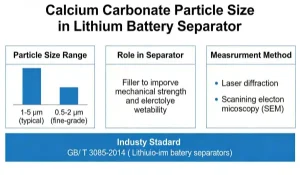
The particle size of calcium carbonate (CaCO₃) for lithium battery separators varies significantly by its application function (ceramic coating filler vs. sacrificial porogen for base film fabrication) and performance requirements, with two mainstream size ranges dominating commercial and research applications:
1. For Ceramic Coating Inorganic Filler (Mainstream Commercial Application)
CaCO₃ is most commonly used as a low-cost inorganic filler in separator ceramic coatings, to enhance the thermal stability, electrolyte wettability and mechanical strength of polyolefin (PE/PP) base films.
-
Nano-scale grade: 20–40 nm surface-modified nano-CaCO₃ is widely used in high-performance composite ceramic coatings (usually blended with boehmite). This size delivers high specific surface area, uniform dispersion in coating slurries, and excellent compatibility with aqueous binders, while avoiding particle agglomeration that impairs ionic conductivity.
-
Submicron to micron grade (industry general specification): The median particle size (Dv50) of CaCO₃ for commercial coated separators is typically0.05–1.5 μm, with an optimized and most widely adopted range of 0.1–1.0 μm. This size range matches the typical 1–2.5 μm thickness of ceramic coatings, avoids blockage of the separator’s intrinsic pores, and balances mechanical reinforcement and lithium ion transport efficiency.
- A broader range of 0.01–6 μm is reported in academic research for special cellulose-based or electrospun composite separators, adjusted according to the membrane’s pore structure and rate performance targets.
2. For Sacrificial Porogen in Separator Base Film Fabrication
CaCO₃ is also used as a pore-forming agent to create uniform porous channels in polyolefin separator base films (via acid leaching after film extrusion and stretching).
- Nano-CaCO₃ is the primary choice for this application, to form fine, homogeneous and interconnected porous structures in the base film.
- In some custom composite separator systems, CaCO₃ with an average particle size of up to 6 μm is used to fabricate macro-porous structures for high-rate battery designs.
Key Considerations for Particle Size Selection
- A narrow particle size distribution (PSD) is critical: commercial grades typically require D97 < 2×Dv50 to avoid large particles causing coating defects, separator piercing, or internal short circuit risks.
- Surface modification is mandatory for nano-CaCO₃, to reduce surface hydroxyl groups, prevent agglomeration, and improve compatibility with binders and carbonate-based electrolytes.
- The selected particle size must be smaller than the total thickness of the ceramic coating, and generally not exceed 1/3 of the base film’s intrinsic pore size, to maintain stable lithium ion transport.