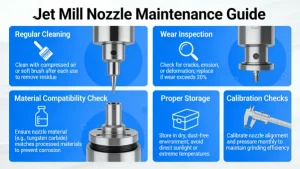
Jet mill nozzles are the core critical wear part for dry ultra-fine CaCO₃ grinding (D50=1–10 μm) — they generate supersonic airflow (1.5–3 Mach) to accelerate CaCO₃ particles for impact/collision grinding. Nozzle performance directly determines jet mill grinding efficiency, CaCO₃ product particle size distribution (PSD), and unit energy consumption.
For CaCO₃ grinding (even low-silica pure CaCO₃, Mohs 3–4; high-silica CaCO₃ with SiO₂ (Mohs 7) is more abrasive), nozzle maintenance focuses on four core goals: preventing abrasive wear, avoiding clogging, maintaining dimensional precision (aperture/angle), and ensuring airtight sealing. Silica impurities in limestone are the primary cause of nozzle wear, while CaCO₃ agglomeration (from high moisture) is the main cause of clogging—all maintenance steps are tailored to CaCO₃ grinding characteristics (low hardness but potential siliceous abrasion, sensitivity to moisture).
Below is a systematic, industrial-grade maintenance protocol for jet mill nozzles, divided into Daily/Shift Maintenance (basic, mandatory), Regular Scheduled Maintenance (weekly/monthly/quarterly, predictive), Fault Maintenance (targeted for common issues), and Preventive Upgrades (extend service life), with clear actionable steps, inspection tools, and replacement criteria—this is the standard maintenance process for CaCO₃ production plants.
Key Pre-Requisite: Nozzle Material & CaCO₃ Grinding Matching
Before maintenance, confirm the nozzle material is suitable for your CaCO₃ feed (pure vs. high-silica) — the right material reduces 70% of wear-related maintenance work. Jet mill nozzles for CaCO₃ use abrasion-resistant ceramic/metal alloys (no standard steel, which wears out in hours). The material selection and typical service life for CaCO₃ grinding are listed below (critical for setting maintenance/replacement cycles):
|
Nozzle Material
|
Applicable CaCO₃ Feed
|
Typical Service Life (24h continuous production)
|
Core Advantages
|
|
Zirconia Toughened Alumina (ZTA)
|
Pure CaCO₃ (SiO₂ <0.5%)
|
2–4 months
|
Low cost, good abrasion resistance for soft feed
|
|
Silicon Carbide (SiC)
|
Medium-silica CaCO₃ (0.5%<SiO₂<3%)
|
3–6 months
|
High hardness (Mohs 9.5), chemical inertness
|
|
Tungsten Carbide (WC-Co)
|
High-silica CaCO₃ (SiO₂ >3%)
|
6–12 months
|
Ultra-high abrasion resistance (best for siliceous feed)
|
|
Boron Carbide (B₄C)
|
Ultra-fine CaCO₃ grinding (D50<2μm)
|
4–8 months
|
Highest hardness, minimal nozzle wear (preserves PSD)
|
Industrial Tip: For fluidized bed jet mills (the most common for CaCO₃), use lanced nozzles (or venturi nozzles) — these are the standard design, and maintenance is identical across all jet mill types (flat jet, spiral jet) for CaCO₃.
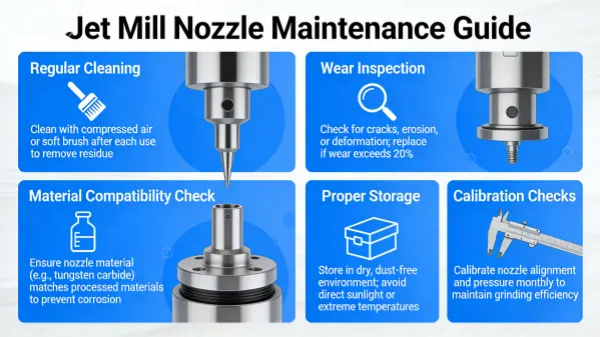
1. Daily/Shift Maintenance (Every 8–12h, Post-Production/Pre-Start-Up)
Mandatory for all CaCO₃ jet mill operations — takes 5–10 minutes per shift, prevents minor issues (clogging, minor wear) from escalating to unplanned downtime. Performed by on-site production operators (no special tools needed).
Core Maintenance Steps (Pre-Start-Up + Post-Production)
Pre-Start-Up (3 steps)
-
Visual Inspection: Check nozzle external condition — no cracks, chipping, or loose mounting; ensure nozzle is seated flush in the grinding chamber (no misalignment).
-
Air Purge (Unloaded): Power on the air compressor, set to operating pressure (0.7–1.2 MPa for CaCO₃), and purge nozzles with dry, oil-free compressed air for 1–2 minutes (reverse blow if needed) — remove residual CaCO₃ powder in the nozzle bore (prevents clogging during start-up).
-
Pressure Leak Test: Close the grinding chamber, run the air system at operating pressure — check for air leakage around nozzle flanges/seals (no hissing sound). Leakage causes reduced airflow velocity and poor grinding efficiency (CaCO₃ D50 shifts large).
Post-Production (4 steps, critical for preventing overnight agglomeration)
-
Full Purge: After stopping feed, run the jet mill with only dry compressed air for 3–5 minutes — clear all CaCO₃ powder from the nozzle bore and surrounding grinding chamber (prevents moisture absorption and agglomeration/clogging overnight).
-
Moisture Check: Wipe the nozzle inlet/outlet with a dry cloth — no water/oil residue (compressed air for CaCO₃ must be dew point ≤-40℃, oil content ≤0.01 mg/m³; water/oil causes CaCO₃ sticking in nozzles).
-
Seal Inspection: Check the rubber/PTFE seal between nozzle and grinding chamber — no hardening, cracking, or powder leakage (replace immediately if damaged).
-
Grinding Chamber Cleanup: Remove loose CaCO₃ powder around the nozzle base — prevents powder buildup that causes nozzle vibration/misalignment during operation.
Key Prohibition for Daily Maintenance
-
Do not use metal brushes/scratch tools to clean the nozzle bore (scratches increase powder adhesion and accelerate wear).
-
Do not run the jet mill with a partially clogged nozzle (causes uneven airflow, CaCO₃ PSD widening, and localized nozzle erosion).
2. Regular Scheduled Maintenance (Weekly/Monthly/Quarterly)
Performed by maintenance technicians (with precision tools) — focuses on measuring nozzle dimensional precision (the single most important factor for CaCO₃ grinding performance) and addressing early-stage wear/clogging. The frequency is based on your CaCO₃ silica content (higher SiO₂ = shorter maintenance intervals).
All maintenance is done with the jet mill shut down, depressurized, and locked out (LOTO) — critical safety step for industrial operations.
A. Weekly Minor Maintenance (15–20 mins, all CaCO₃ feed types)
-
Bore Cleanliness Check: Use a soft nylon brush (or cotton swab) to clean the nozzle bore — remove any stubborn CaCO₃ agglomerates (if present, soak in deionized water for 5 mins first, then clean).
-
Visual Wear Inspection: Use a flashlight to check the nozzle throat and exit (the most abrasive areas for CaCO₃) — no obvious wear, rounding, or burring (rounding of the exit causes airflow turbulence).
-
Mounting Torque Check: Retighten nozzle mounting bolts/nuts to the manufacturer’s specified torque (typically 20–30 N·m for ceramic nozzles) — CaCO₃ grinding causes slight vibration, which loosens fasteners over time.
B. Monthly Routine Maintenance (30–40 mins, critical for PSD stability)
Core focus: measure nozzle dimensional precision — wear causes nozzle aperture enlargement, which reduces airflow velocity and makes CaCO₃ D50 larger (the most common issue in CaCO₃ jet milling).
-
Aperture Measurement: Use a digital micrometer/steel plug gauge (0.01 mm precision) to measure the nozzle throat diameter (the narrowest part, critical for supersonic airflow) and exit diameter — record values and compare to the original factory specification (OFS).
-
Acceptance Criterion for CaCO₃: Aperture enlargement ≤5% of OFS (e.g., original 2.0 mm throat → max 2.1 mm; beyond this, CaCO₃ grinding efficiency drops 15–20%).
-
-
Concentricity/Angle Check: Use a nozzle alignment gauge to verify the nozzle is perfectly concentric with the air inlet (no off-center >0.1 mm) and the spray angle matches factory design (typically 15–30° for CaCO₃) — misalignment causes uneven particle impact and PSD widening.
-
Abrasion Layer Inspection (for coated nozzles): Check the WC-Co/SiC coating on metal nozzles — no peeling, flaking, or exposed base material (peeling causes rapid wear).
-
Complete Seal Replacement: Replace all rubber/PTFE seals around the nozzle (preventive replacement — seals harden in 1–3 months in CaCO₃ grinding environments).
C. Quarterly Major Maintenance (1–2h, for all jet mill nozzles)
Full disassembly and comprehensive inspection — performed even if the nozzle is within wear limits; critical for long-term nozzle life and CaCO₃ process stability.
-
Nozzle Disassembly: Remove nozzles from the grinding chamber (use plastic tools to avoid chipping ceramic nozzles) — clean the nozzle mounting seat with dry compressed air (remove powder buildup).
-
Ultrasonic Cleaning: Soak nozzles in deionized water + mild alkaline cleaner (0.5% NaOH) and run an ultrasonic cleaner (40 kHz) for 10–15 mins — removes all embedded CaCO₃ fine powder (unreachable by manual cleaning) from the nozzle bore and throat.
-
Full Dimensional Testing: Measure throat diameter, exit diameter, bore length, and spray angle — document all data in a nozzle maintenance log (track wear rate over time to set custom replacement cycles for your CaCO₃ feed).
-
Example: High-silica CaCO₃ (SiO₂=5%) → nozzle wear rate = 0.05 mm/month → set replacement at 4 months (before 5% aperture enlargement).
-
-
Grinding Chamber Nozzle Seat Inspection: Check the nozzle mounting seat for wear/corrosion — no grooves or deformation (if present, repair with wear-resistant epoxy or replace the seat).
-
Reassembly & Calibration: Reinstall nozzles with new seals, torque to specification, and perform a airflow velocity test (use a pitot tube) — ensure nozzle exit velocity is ≥300 m/s (supersonic) (the minimum for CaCO₃ ultra-fine grinding).
3. Fault Maintenance (Targeted for Common Nozzle Issues in CaCO₃ Grinding)
Even with regular maintenance, nozzle issues occur in CaCO₃ production (driven by silica abrasion and moisture-related agglomeration). Below are the 4 most common nozzle faults, their root causes (CaCO₃-specific), identifying symptoms, and step-by-step repair/replacement solutions — this is the troubleshooting guide for unplanned downtime.
All faults cause measurable changes in CaCO₃ product quality/process performance (easy to identify via on-line PSD/energy consumption data).
|
Common Nozzle Fault
|
CaCO₃-Specific Root Cause
|
Key Identifying Symptoms (CaCO₃ Production)
|
Step-by-Step Solution
|
|
Abrasive Wear (Most Common)
|
High-silica CaCO₃ (SiO₂>3%) scours nozzle throat/exit; compressed air with solid impurities
|
1. CaCO₃ D50 increases by >10% <br> 2. PSD widens (span >2) <br> 3. Unit energy consumption rises by >15% <br> 4. Nozzle aperture enlarged >5% OFS
|
1. Replace worn nozzle (match original material/design) <br> 2. Pre-remove silica from limestone (washing/flotation) <br> 3. Add a high-efficiency air filter (0.1 μm) to compressed air
|
|
Clogging
|
CaCO₃ moisture >1% (agglomeration); fine powder sticking in nozzle bore (no post-production purge)
|
1. Uneven airflow in grinding chamber <br> 2. CaCO₃ product has coarse particles (D90 spike) <br> 3. Air pressure drop across nozzle >0.1 MPa
|
1. Reverse blow with dry compressed air (0.9–1.2 MPa) <br> 2. Ultrasonic cleaning (as quarterly maintenance) <br> 3. Strengthen CaCO₃ drying (moisture ≤1%) <br> 4. Enforce post-production purge (3–5 mins)
|
|
Cracking/Chipping
|
1. Ceramic nozzle thermal shock (rapid air pressure changes) <br> 2. Over-tightening during mounting <br> 3. CaCO₃ coarse particles (>1 mm) impacting nozzle
|
1. Severe air leakage (hissing sound) <br> 2. CaCO₃ grinding efficiency drops drastically <br> 3. Visible cracks/chips on nozzle
|
1. Immediate replacement (cracked nozzles cannot be repaired) <br> 2. Avoid rapid air pressure changes (ramp up/down at 0.1 MPa/s) <br> 3. Tighten bolts to factory torque (no over-tightening) <br> 4. Add a vibrating screen to remove coarse CaCO₃ particles (>1 mm)
|
|
Seal Leakage
|
Seal hardening/cracking; powder buildup between nozzle and seat; loose mounting
|
1. Reduced airflow velocity <br> 2. Powder leakage around nozzle flange <br> 3. CaCO₃ D50 slight increase
|
1. Replace damaged seal with factory-spec part <br> 2. Clean powder buildup from nozzle seat <br> 3. Retighten mounting bolts to torque specification
|
Critical Note: Do not attempt to repair worn ceramic nozzles (e.g., grinding/filing the bore) — this destroys the supersonic airflow profile and causes poor CaCO₃ grinding performance. Only metal nozzles can be repaired (via WC-Co plasma spraying).
4. Preventive Maintenance & Upgrades (Extend Nozzle Service Life by 50–100%)
For CaCO₃ production plants (especially high-silica or continuous 24h operation), preventive upgrades reduce maintenance frequency and nozzle replacement costs — these are long-term investments that align with CaCO₃ grinding process optimization (no additional labor cost).
A. Process Optimization (Eliminate Root Causes of Nozzle Damage)
-
Raw Material Pre-Treatment:
-
Dry CaCO₃ feed to moisture ≤1% (flash dryer) — eliminate agglomeration/clogging.
-
Pre-remove silica (washing/flotation) to SiO₂ <0.5% — the single most effective way to reduce nozzle wear (silica is the main abrasive).
-
Add a magnetic separator + vibrating screen — remove coarse particles (>1 mm) and metal impurities (prevent nozzle impact damage).
-
-
Compressed Air Purification:
-
Install a 3-stage air treatment system (filter + dryer + oil remover) — ensure air is dry (dew point ≤-40℃), oil-free (≤0.01 mg/m³), dust-free (≤0.1 μm) — water/oil/dust accelerate nozzle wear and clogging.
-
-
Production Parameter Optimization:
-
Avoid over-pressure operation (>1.2 MPa for CaCO₃) — high pressure increases airflow velocity and abrasive wear (operate at 0.7–1.0 MPa for optimal grinding/wear balance).
-
Ramp up/down air pressure slowly (0.1 MPa/s) — prevent thermal shock to ceramic nozzles.
-
B. Nozzle Design/Material Upgrades
-
Switch to Wear-Resistant Materials: Upgrade from ZTA to WC-Co/B₄C for high-silica CaCO₃ (doubles service life).
-
Lined Nozzle Design: Use nozzles with a WC-Co inner liner (ceramic/metal outer body) — combines abrasion resistance with structural strength (prevents cracking).
-
Tapered Throat Nozzles: Replace standard straight-throat nozzles with tapered throat designs — reduces CaCO₃ powder adhesion and wear in the throat (the most critical area).
C. Maintenance Log & Predictive Replacement
-
Maintain a Digital Nozzle Maintenance Log: Record all inspection data (aperture, wear rate, replacement date), CaCO₃ feed properties (SiO₂ content, moisture), and process parameters (air pressure, production load) — identify wear trends (e.g., higher SiO₂ = faster wear).
-
Set Custom Replacement Cycles: Based on wear rate data, replace nozzles before they reach the 5% aperture enlargement limit (e.g., wear rate 0.05 mm/month → replace every 4 months) — avoid unplanned downtime and CaCO₃ product quality issues.
-
Keep Spare Nozzles in Stock: Maintain a spare set of nozzles (matching material/design) on-site — replace worn/cracked nozzles in 30 mins or less (minimize downtime).
5. Safety Guidelines for Nozzle Maintenance (Non-Negotiable)
Jet mill maintenance involves high-pressure air systems and heavy equipment — all steps must follow industrial safety standards (OSHA/ISO) to prevent injury. Key safety rules for CaCO₃ plant operators/technicians:
-
Lockout/Tagout (LOTO): Always shut down the jet mill, disconnect power, and depressurize the air system (0 MPa) before any nozzle maintenance — attach a LOTO tag to the power switch/air valve (only the maintenance technician can remove it).
-
Respiratory Protection: Wear a dust mask/respirator when cleaning the grinding chamber/nozzle — CaCO₃ fine powder (D50<10 μm) is a respiratory irritant.
-
Ceramic Nozzle Handling: Use soft plastic gloves/tools to handle ceramic nozzles — they are brittle and chip easily (chips cause severe injury).
-
High-Pressure Air Safety: Never point a compressed air nozzle at yourself/others (even low pressure) — air blast can cause eye/skin injury.
-
Grinding Chamber Ventilation: Open the grinding chamber cover and ventilate for 5 mins before maintenance — remove residual CaCO₃ powder and ensure no confined space hazards.
Standard Nozzle Maintenance Schedule for CaCO₃ Jet Milling (24h Continuous Production)
A customized schedule based on silica content (the main wear driver) — this is the industry benchmark for CaCO₃ ultra-fine grinding (fluidized bed jet mill):
|
CaCO₃ SiO₂ Content
|
Daily/Shift
|
Weekly
|
Monthly
|
Quarterly
|
Custom Replacement Cycle
|
Spare Nozzle Stock
|
|
<0.5% (Pure)
|
Mandatory
|
Minor
|
Routine
|
Major
|
4–6 months (ZTA/SiC)
|
1 set
|
|
0.5–3% (Medium)
|
Mandatory
|
Minor
|
Routine
|
Major
|
3–4 months (SiC/WC-Co)
|
1–2 sets
|
|
>3% (High)
|
Mandatory
|
Minor
|
Routine
|
Major
|
1–3 months (WC-Co/B₄C)
|
2+ sets
|
Final Key Takeaways for CaCO₃ Jet Mill Nozzle Maintenance
-
Wear is the #1 issue — pre-remove silica from limestone and use wear-resistant nozzle materials (WC-Co/B₄C) for high-silica feed.
-
Clogging is preventable — enforce post-production air purge and keep CaCO₃ moisture ≤1%.
-
Dimensional precision is critical — replace nozzles when aperture enlarges >5% of factory spec (to preserve CaCO₃ PSD/D50).
-
Preventive maintenance > reactive repair — set custom replacement cycles based on wear rate data and keep spare nozzles in stock.
-
Process optimization reduces maintenance — dry, de-silicified CaCO₃ feed and clean compressed air eliminate 90% of nozzle issues.
I can help you create a customized nozzle maintenance schedule for your specific CaCO₃ jet milling process (SiO₂ content, D50 target, production load) and recommend the best nozzle material/design upgrades to extend service life — just provide your jet mill model and CaCO₃ feed properties.