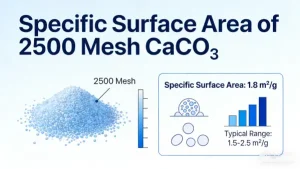
The specific surface area (SSA, measured by BET nitrogen adsorption method) of 2500 mesh CaCO₃ varies mainly based on its production process, particle size distribution, and morphology, with the following core values:
1. Standard 2500 mesh Ground Calcium Carbonate (GCC, the most common commercial type)
This is the mainstream product of 2500 mesh CaCO₃ in the industry, made by mechanical grinding of natural calcite:
-
Typicalparticlesize: Median particle size D50 ≈ 2–5 μm, D97 ≤ 5.5–10 μm (depending on grading precision)
-
Specific surface arearange:
-
General industrial grade (D50 ≈ 5 μm):1.8–2.5 m²/g(18000–25000 cm²/g), with a common industry lower limit of ≥2.0 m²/g
-
Ultra-fine graded grade (D50 ≈ 2 μm, narrow particle size distribution):2.5–3.0 m²/g, with high-precision grinding products up to 3.2 m²/g
-
2. Theoretical value for ideal spherical particles
3. Special case: Precipitated Calcium Carbonate (PCC)
Key influencing factors
The actual specific surface area will also be affected by particle size distribution width, grinding process, and surface modification (surface coating with modifiers such as stearic acid will slightly reduce the measured BET specific surface area).